It is common knowledge that the pressure of the atmosphere (about 105 newtons per square metre) is due to the weight of air above the Earth’s surface, that this pressure falls as one climbs upward, and, correspondingly, that pressure increases as one dives deeper into a lake (or comparable body of water). Mathematically, the rate at which the pressure in a stationary fluid varies with height z in a vertical gravitational field of strength g is given by
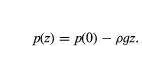
This means that, since ρ is about 103 kilograms per cubic metre for water and g is about 10 metres per second squared, the pressure is already twice the atmospheric value at a depth of 10 metres. Applied to the atmosphere, equation (124) would imply that the pressure falls to zero at a height of about 10 kilometres. In the atmosphere, however, the variation of ρ with z is far from negligible and (124) is unreliable as a consequence; a better approximation is given below in the section Hydrodynamics: Compressible flow in gases.