
- Table of Contents
- Why I tried manifesting for 30 days
- My ground rules (to avoid delusion)
- The daily routine I followed
- Step 1: Morning intention + visualization (process-focused)
- Step 2: Scripting (the “future memory” journal)
- Step 3: Specific gratitude
- Step 4: One “inspired action” daily
- Step 5: Night review + release
- My 30-day tracker template
- Week-by-week breakdown
- Week 1: Excited… and a little fake
- Week 2: The “nothing is happening” dip
- Week 3: Subtle momentum (and more confidence)
- Week 4: Real results (and real honesty)
- Results: what happened in 30 days
- 1) My routine improved first, then results followed
- 2) I created more opportunities than before
- 3) I didn’t get everything I wanted in the exact form
- 4) The biggest “manifestation” was identity
- The real lessons (what I’d do differently)
- Lesson 1: Manifestation works best as a focus system
- Lesson 2: “Feeling good” is not the goal—being stable is
- Lesson 3: Your nervous system matters
- Lesson 4: Action is the bridge between intention and reality
- Lesson 5: Detachment is not giving up
- How you can try this for yourself (30-day plan)
- 1) Choose one “manifestation target”
- 2) Pick one daily aligned action
- 3) Use the routine, but keep it flexible
- 4) Review weekly
- Common mistakes I nearly made
- FAQs
- Is manifestation real—or just psychology?
- What if I try for 30 days and nothing happens?
- Should I manifest multiple goals at once?
- Do affirmations matter?
- How long should I continue beyond 30 days?
- Can manifestation replace therapy or professional support?
- Key Takeaways
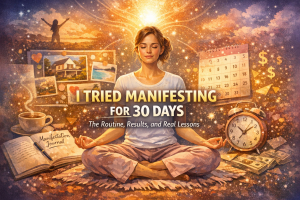
Can you “manifest” something in 30 days without slipping into magical thinking or wishful delusion? I decided to find out the practical way: I followed a simple manifestation routine for one full month, tracked what happened, and treated it like an experiment—equal parts mindset work and behavioral change.
This post shares the exact routine I used, what changed (and what didn’t), and the biggest lessons that made manifestation feel less like “woo” and more like attention + intention + consistent action.
Table of Contents
- Why I tried manifesting for 30 days
- My ground rules (to avoid delusion)
- The daily routine I followed
- My 30-day tracker template
- Week-by-week breakdown
- Results: what happened in 30 days
- The real lessons (what I’d do differently)
- How you can try this for yourself
- Common mistakes I nearly made
- FAQs
- Key Takeaways
Why I tried manifesting for 30 days
I wasn’t trying to “hack the universe.” I was trying to answer a more grounded question:
- Can a consistent intention-setting practice change my focus and choices enough to produce measurable outcomes?
- Can I use “manifestation” as a framework for clarity, confidence, and momentum?
I’ve heard both extremes: people claiming manifestation is everything, and people dismissing it as fantasy. My take going in was simple: if manifestation works at all, it should show up in the real world through better decision-making, better emotional regulation, and more consistent action. So I designed a 30-day routine that emphasized those elements.
What I chose to manifest: I kept my goals realistic and controllable—things where my behavior can plausibly influence the result. I picked three intentions:
- Primary goal: A meaningful professional win (a new client/project/opportunity).
- Secondary goal: A healthier daily rhythm (better sleep and consistent exercise).
- Mindset goal: Less overthinking, more calm confidence.
Notice what I didn’t pick: sudden lottery money, mind-reading, or outcomes fully outside my control. The point was to test manifestation as a practical tool, not as a miracle claim.
My ground rules (to avoid delusion)
This part mattered most. I wanted the benefits of intention-setting without falling into magical thinking. These were my non-negotiables:
- Reality stays real. If an action is required, I do the action. I don’t “visualize” instead of sending the email.
- No “sign chasing.” I did not treat random events as destiny or proof of cosmic approval.
- Track behaviors, not fantasies. I measured what I could: actions taken, mood shifts, habits completed, opportunities created.
- Detach from the outcome, not the process. I stayed emotionally flexible about timing and exact form, but consistent about daily effort.
- Safety first. Manifestation is not a substitute for medical care, therapy, legal advice, or financial planning.
I also used one “anti-delusion” question every day:
“What would I do today if I truly believed this was possible—and I still had to earn it?”
The daily routine I followed
My routine had five parts. Total time: 20–35 minutes per day (plus 1–2 small “inspired actions”).
| Routine Step | Time | What I did | Why it matters |
|---|---|---|---|
| 1) Morning intention + visualization | 5–8 min | Visualize the outcome + the process (not just the prize) | Trains attention and primes choices |
| 2) Scripting | 5–10 min | Write as if it already happened (with details) | Clarifies what you actually want and why |
| 3) Gratitude (specific) | 2–4 min | 3 things I’m grateful for, with “because…” | Builds emotional stability and reduces scarcity |
| 4) “Inspired action” | 5–20 min | One concrete step aligned with the goal | Turns intention into probability |
| 5) Night review + release | 3–5 min | Review: what moved me forward? then let go | Reinforces learning without obsessing |
Step 1: Morning intention + visualization (process-focused)
I sat quietly and pictured the outcome, but I made a key shift: I visualized the process that would naturally lead to it. For example, instead of imagining “I got the opportunity,” I imagined:
- writing better messages,
- showing up more consistently,
- feeling calm in conversations,
- handling rejection without spiraling.
This made visualization less like daydreaming and more like mental rehearsal.
Step 2: Scripting (the “future memory” journal)
I wrote one short page as if it’s Day 31 and the goal happened. But I forced myself to include:
- What changed in me (habits, choices, energy, discipline)
- What I did daily (actions that compounded)
- How it felt (relief, confidence, gratitude)
That last one is important: describing feelings helped me spot what I actually wanted underneath the goal—often it was “freedom,” “respect,” or “calm,” not just the result itself.
Step 3: Specific gratitude
Gratitude can be vague. I made it precise:
- “I’m grateful for ___ because ___.”
This tiny tweak stopped gratitude from becoming copy-paste positivity and made it emotionally real.
Step 4: One “inspired action” daily
I treated manifestation like this equation:
Clarity (what I want) + Emotion (why it matters) + Repetition (daily) + Action (proof) = Results (eventually)
So each day I did one action that made my goal more likely. Examples:
- Send one pitch / outreach message.
- Improve one portfolio page.
- Follow up with one warm contact.
- Do 20 minutes of focused work on a key skill.
- Walk 20 minutes or complete a short workout.
Step 5: Night review + release
At night, I answered:
- What did I do today that matches my intention?
- Where did I drift into fear or distraction?
- What is one adjustment for tomorrow?
Then I practiced “release” for 30 seconds—closing the journal, breathing out, and reminding myself I’m not here to control every outcome.
My 30-day tracker template
If you want to try this, tracking is what keeps the practice honest. Here’s the simple tracker I used (copy into Notes / Notion / a spreadsheet):
- Day: 1–30
- Mood (1–10): ___
- Morning routine done? (Y/N)
- Inspired action: (one sentence)
- Habit goal done? (Y/N)
- Evidence / wins: (anything small)
- Lesson / adjustment: (one line)
The “evidence / wins” line was crucial. It trained my brain to look for progress without inventing stories. Evidence could be tiny: “I followed up,” “I said no,” “I worked without procrastinating,” “I slept on time.”
Week-by-week breakdown
Week 1: Excited… and a little fake
The first week felt like starting any new habit: motivation was high, and part of me wondered, “Am I just pretending?”
What helped: I didn’t force belief. I aimed for willingness. I didn’t need to be 100% convinced; I just needed to practice consistently.
- Big shift: More clarity about what I wanted (and what I didn’t).
- Challenge: Mind wandering during visualization.
- Action win: I sent outreach I’d been delaying for weeks.
Week 2: The “nothing is happening” dip
This is where most people quit. The novelty fades, and you look around thinking, “Okay… where are the results?”
I noticed two patterns:
- I was measuring only the final outcome, ignoring small momentum.
- I was tempted to “do more rituals” instead of doing more work.
The fix was simple: I increased my daily “inspired action” quality. One focused action beat five scattered actions.
Week 3: Subtle momentum (and more confidence)
Week 3 surprised me. Not because the universe dropped gifts—but because my behavior got cleaner:
- I procrastinated less because I had a daily “north star.”
- I felt calmer during conversations and decisions.
- I noticed opportunities faster because my mind was primed to see them.
This week also felt emotionally lighter. Gratitude started working like a “reset button” when my brain tried to go negative.
Week 4: Real results (and real honesty)
In the final week, I had the most measurable outcomes—not all dramatic, but real:
- More consistent sleep and exercise days.
- Better focus blocks (less multitasking).
- At least one meaningful professional opportunity that came from my outreach chain.
And a bigger result: I stopped treating my goals like “someday” and started treating them like “daily.”
Results: what happened in 30 days
Here’s the honest version. Manifestation didn’t make life perfect. It made my inputs better—and that changed my outputs.
1) My routine improved first, then results followed
The most immediate “result” was internal:
- I felt more grounded in the morning.
- I had a clearer plan for the day.
- I had fewer spirals of doubt because I had a system.
That internal stability translated to external changes.
2) I created more opportunities than before
By doing one aligned action daily, I increased the number of “shots on goal.” If you message 0 people, probability is 0. If you message 30 people in a month—thoughtfully—probability changes.
3) I didn’t get everything I wanted in the exact form
Some outcomes didn’t arrive in 30 days, and that was part of the lesson. But the practice still worked because it moved me:
- from vague wanting → clear intention,
- from hoping → acting,
- from fear → experimentation.
4) The biggest “manifestation” was identity
By Day 30, I felt like the kind of person who follows through. That identity shift is powerful because it keeps compounding long after the challenge ends.
The real lessons (what I’d do differently)
Lesson 1: Manifestation works best as a focus system
Whether you view it spiritually, psychologically, or both, manifestation reliably changes what you pay attention to. And attention changes decisions. Decisions change outcomes.
Lesson 2: “Feeling good” is not the goal—being stable is
I stopped chasing constant positivity. Instead I aimed for emotional stability. I allowed bad days, but still completed the smallest version of the routine.
Lesson 3: Your nervous system matters
When I was anxious, I acted less. The best “manifestation hack” wasn’t another affirmation—it was a calm breath and a simple plan.
Lesson 4: Action is the bridge between intention and reality
My most productive days were not the most mystical. They were the days I visualized, then did one clear task. If manifestation has a “secret,” it’s this: do the next right step.
Lesson 5: Detachment is not giving up
Detachment meant I didn’t obsess over timing. I stayed committed to the process while allowing outcomes to unfold naturally. Ironically, that reduced pressure and improved performance.
How you can try this for yourself (30-day plan)
If you want to run your own 30-day experiment, use this structure:
1) Choose one “manifestation target”
- Make it specific: “Get 2 client calls,” not “Be successful.”
- Keep it plausible: something your actions can influence.
- Add a “why”: what emotional need is underneath it?
2) Pick one daily aligned action
Decide the action in advance. Examples:
- 1 outreach message daily
- 20 minutes of skill practice
- 1 page of content created
- 30 minutes of exercise
3) Use the routine, but keep it flexible
On busy days, do the “minimum version”:
- 1 minute intention
- 3 gratitude lines
- 1 small action
Consistency matters more than intensity.
4) Review weekly
Every 7 days, ask:
- What’s working?
- What’s not?
- What is one habit I’ll tighten next week?
Common mistakes I nearly made
- Using manifestation to avoid hard feelings. If you’re scared to act, the routine must include action.
- Picking goals you can’t influence. That’s a shortcut to disappointment.
- Over-consuming “manifestation content.” Learning can become procrastination. Practice beats endless videos.
- Trying to “force belief.” You don’t need perfect belief—just consistent effort and openness.
- Turning everything into a sign. That’s how you lose reality. Look for evidence of progress instead.
FAQs
Is manifestation real—or just psychology?
It can be both, depending on your worldview. In practical terms, manifestation reliably improves outcomes when it helps you clarify goals, regulate emotions, and take consistent action.
What if I try for 30 days and nothing happens?
Check your inputs: Are you taking aligned actions daily? Are your goals realistic and specific? Are you tracking evidence and adjusting weekly? If your actions don’t change, outcomes usually don’t either.
Should I manifest multiple goals at once?
In my experience, one primary goal works best. You can include a small secondary habit goal, but avoid scattering your focus across five major outcomes.
Do affirmations matter?
They can help if they feel believable. I prefer “bridging affirmations” like: “I’m learning to be consistent,” rather than “I’m already a millionaire” (if it triggers inner resistance).
How long should I continue beyond 30 days?
If the routine improves your consistency and clarity, keep a lighter version. Many benefits show up after the first month because habits compound over time.
Can manifestation replace therapy or professional support?
No. If you’re dealing with mental health challenges, trauma, or major life stressors, professional support can be essential. Manifestation can complement healthy support systems, but shouldn’t replace them.
Key Takeaways
- Manifestation became practical when I treated it like a daily focus-and-action system.
- Process-focused visualization worked better than fantasy outcomes.
- One aligned action per day changed my results more than “perfect vibes.”
- Tracking kept me honest and prevented sign-chasing.
- The biggest result was identity: becoming someone who follows through.