




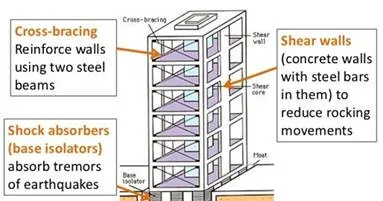
Tall buildings are subjected to heavy horizontal forces due to inertia during earthquake. Hence they need shear walls. A shear wall is a R.C.C. enclosure within the building built to take shear forces. It is usually built around lift room. These shear walls must be provided evenly throughout the buildings in both directions as well as from bottom to top. Apart from providing shear walls, the following techniques
are also used for making tall buildings earthquake resistant:
1. Base Isolation
2. Using Seismic Dampers.
Base Isolation
The idea behind base isolation is to detach (isolate) the building from the ground in such a way that earthquake motions are not transmitted up through the building, or at least greatly reduced. The concept of base isolation is explained through an example of building resting on roller. When the ground shakes, the roller freely roll but the building above does not move.
If the gap between the building and the vertical wall of foundation pit is small, the vertical wall of the pit may hit the wall. Hence 100% frictionless rollers are not provided in practice. The building is rested on flexible pads that offer resistance against lateral movements. This reduces some effect of ground shaking to the building. The flexible pads are called base-isolators, whereas the structures protected by means of these devices are called base-isolated buildings.
Seismic Dampers
Another approach for controlling seismic damage in buildings is by installing seismic dampers in place of structural elements, such as diagonal braces. When seismic energy is transmitted through them, dampers absorb part of it, and thus damp the motion of the building. Figure 20.4 shows the following
Types of seismic isolation bearings:
(a) High density rubber bearings
(b) Laminated rubber bearings and
(c) Friction pendulum bearings.

