




If either the number or nature of the reactions is insufficient to satisfy the equilibrium conditions, the structure is said to be initially unstable. Figure 1.4a illustrates this case. The structure consists of a triangular arrangement of members that are pinned at their ends. This combination of members forms a rigid body. However, the arrangement is supported on two roller supports, which offer no resistance to horizontal motion, and consequently the structure is initially unstable. This situation can be corrected by changing one of the roller supports to a hinge support, as shown in Fig. 1.4b. In general, a rigid body is initially stable when translational and rotational motions are prevented in three mutually orthogonal directions.
Even when the structure is adequately supported, it still may be initially unstable if the members are not properly connected together to provide sufficient internal forces to resist the applied external forces. Consider the four member pin-connected planar structure shown in Fig. 1.5a. The horizontal force, P, cannot be transmitted
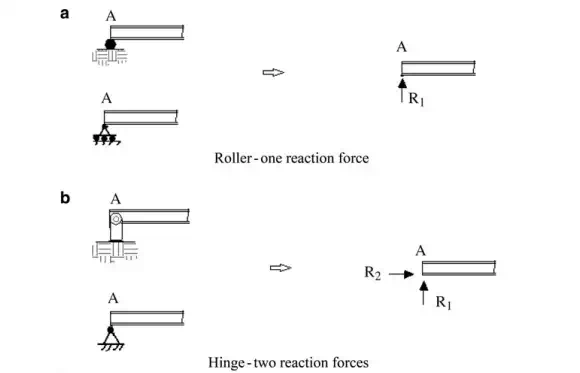
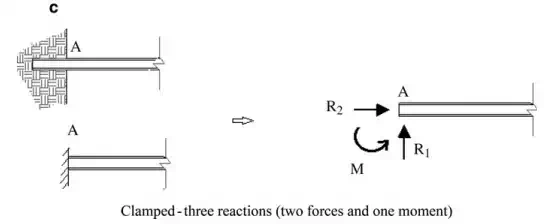
Fig. 1.3 Typical supports for planar structures
to the support since the force in member 1-2 is vertical and therefore cannot have a horizontal component. Adding a diagonal member, either 1-3 or 2-4, would make the structure stable.
In summary, initial instability can occur either due to a lack of appropriate supports or to an inadequate arrangement of members. The test for initial instability is whether there are sufficient reactions and internal member forces to equilibrate the applied external loads. Assuming the structure is initially stable, there still may be a problem if certain structural components fail under the action of the extreme loading and cause the structure to lose its ability to carry load. In what follows, we discuss various failure scenarios for structures which are loaded.
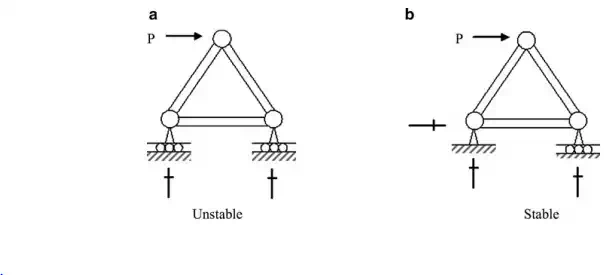
Fig. 1.4 Examples of unstable and stable support conditions—planar structure
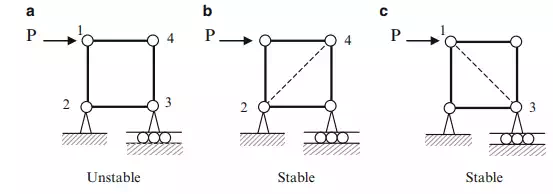
Fig. 1.5 Stabilizing an initially unstable planar structure
