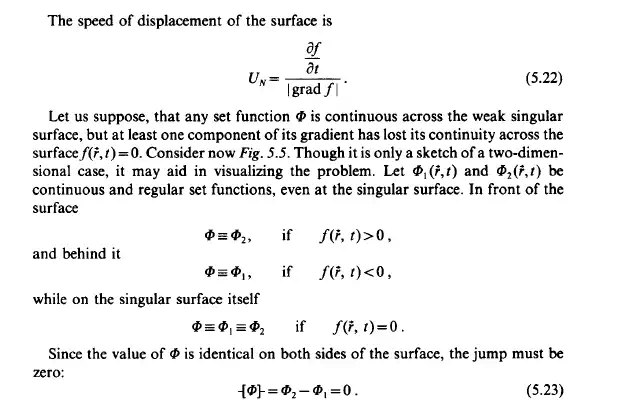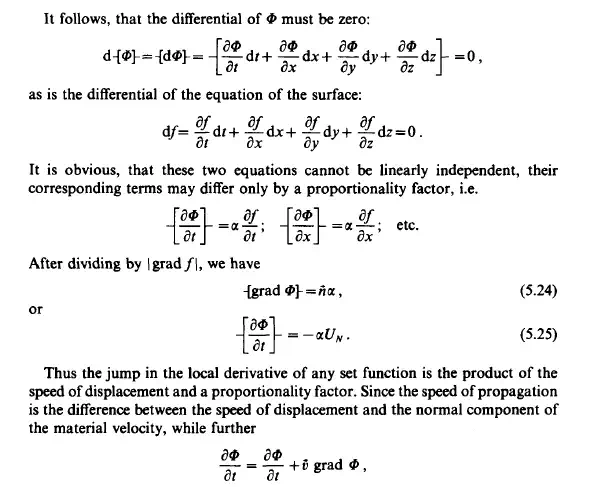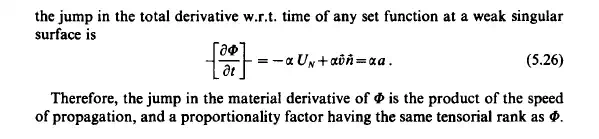
To determine the speed of displacement of a moving singular surface consider a surface as shown in Fig. 5.3. Let the points on this surface be given by the expression:

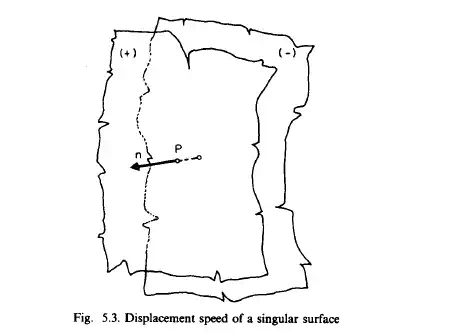
configuration of identifiable particles changing with time. We should also be careful not to confuse the “particle” of a continuum with the particles of corpuscular theories. Our “particle” is a portion of matter enclosed within an infinitesimal volume element. The velocity of the surface point P is defined by the equation
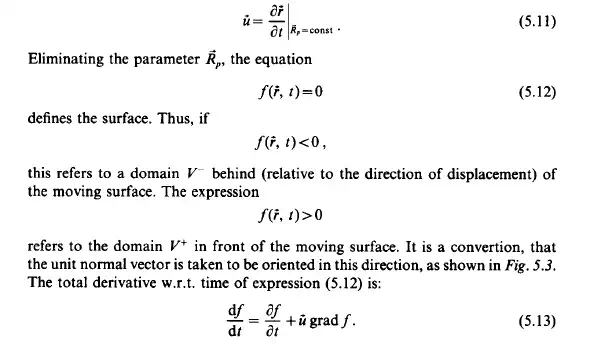
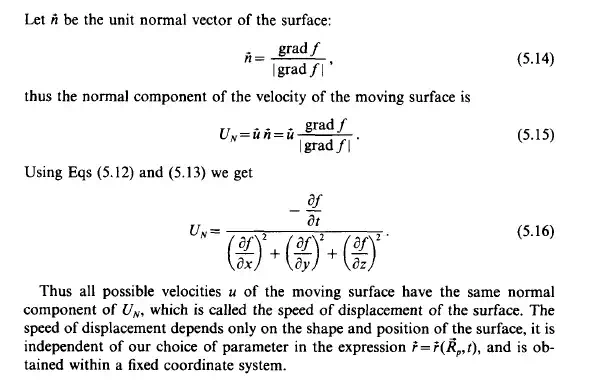
Speed of propagation
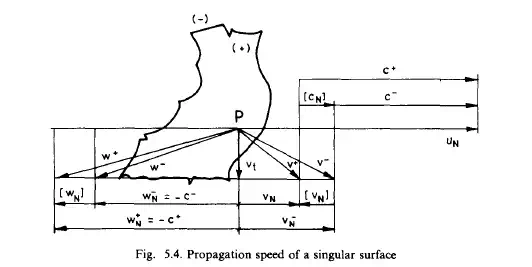
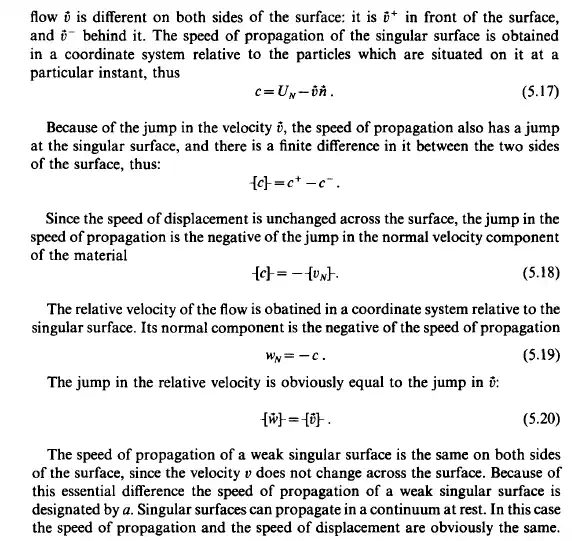
The motion of the singular surface is not the same as the motion of the particles which constitute the surface at any particular instance. The moving discontinuity changes continuously while sweeping across the fluid mass. Consider Fig. 5.4. The speed of displacement at the point P characterizes the motion of the singular surface in the fixed coordinate system. The velocity of the