




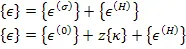
In this study, the total strain is assumed to be superimposition of mechanical and hygral strains.
 | (5.113) |
where,  is the hygral strain in laminate. The stress in global direction is given as
 | (5.114) |
The resultant in-plane forces are given as
 | (5.115) |
where,
 | (5.116) |
is defined as the resultant in-plane forces per unit length due to hygral strains.
In a similar way, we can give the resultant moments as
 | (5.117) |
where,
 | (5.118) |
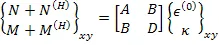
is defined as resultant moments per unit length due to hygral strains. Combining Equation (5.116) and Equation (5.118), we write
 | (5.119) |
The inverse of this equation is written as
 | (5.120) |
