Two types of windings mostly employed are known as Lap Winding and Wave Winding.
1. Simplex Lap-winding: In lap winding, the finishing end of one coil is connected to a commutator segment and to the starting end of the adjacent coil situated under the same pole and so on, till all the coils have been connected. This type of winding derives its name from the fact it doubles or laps back with its succeeding coils. Following points regarding simplex lap winding should be carefully noted :
a) The back and front pitches are odd and of opposite sign. But they cannot be equal. They differ by 2 or.
b) Resultant pitch YR is even, YR =YB – YF=2.
c) The number of slots for a 2-layer winding is equal to the number of coils. The number of commutator segments is also the same.
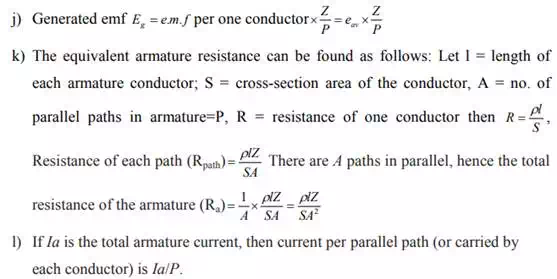
d) The number of parallel paths in the armature (A)=P where P the number of poles.
e) If YB > YF i.e. YB = YF + 2, then we get a progressive or right-handed winding i.e. a winding which progresses in the clockwise direction as seen from the commutator end. In this case, YC = + 1.
f) If YB < YF i.e. YB = YF -2, then we get a retrogressive or left-handed winding i.e. one which advances in the anti-clockwise direction when seen from the commutator side. In this case, YC = -1.

Z/P must be even to make the winding possible.
h) The total number of brushes is equal to the number of poles.
i) The number of armature conductors (connected in series) in any parallel path is Z/P.