Both Faraday’s law and Ampere-Biot-Savart’s law neatly come together in Lenz’s law written in 1835 by the Estonian-born physicist Heinrich Lenz (1804–1865). Lenz’s law states that electromagnetic-induced currents and forces will try to cancel the originating cause.
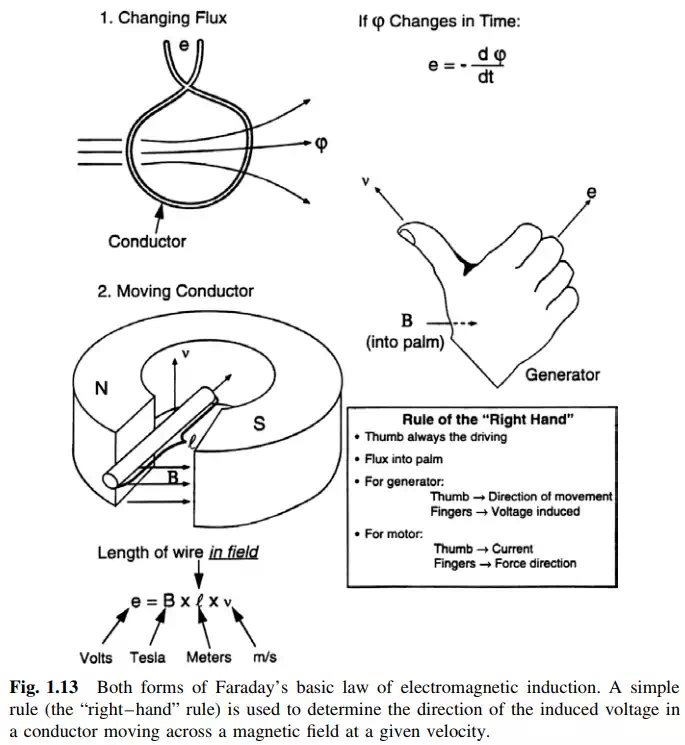
For example, if a conductor is forced to move cutting lines of magnetic force, a voltage is induced in it (Faraday’s law). Now, if the conductors’ ends are closed together so that a current can flow, this induced current will produce (according to Ampere-Biot-Savart’s law) a force acting upon the conductor. What Lenz’s law states is that this force will act to oppose the movement of the conductor in its original direction.
Here in a nutshell is the explanation for the generating and motoring modes of operation of an electric rotating machine! This law explains why when a generator is loaded (more current flows in its windings cutting the magnetic field in the gap between rotor and stator), more force is required from the driving turbine to counteract the induced larger forces and keep supplying the larger load. Similarly Lenz’s law explains the increase in the supply current of a motor as its load increases.
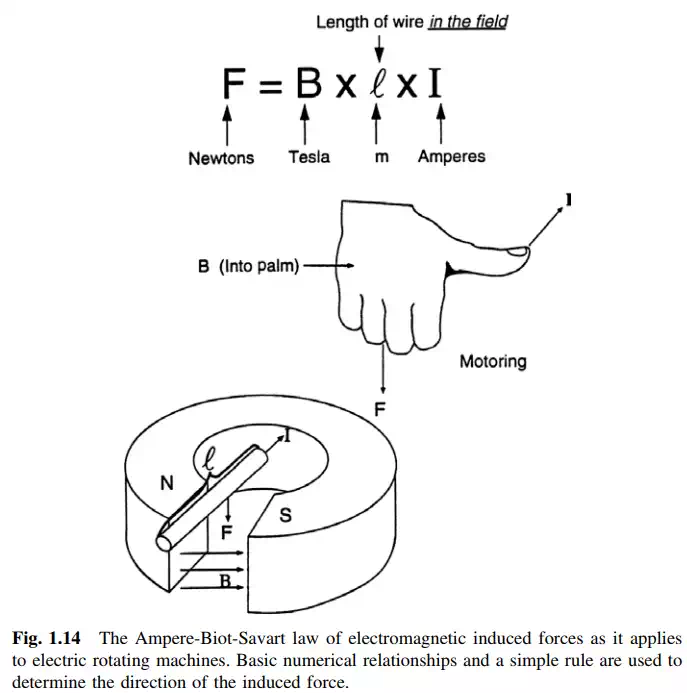
Figure 1.15 neatly captures the main elements of Lenz’s law as it applies to electric rotating machines.