The symbol ‘+’ is used for logical addition operator. It is also known as ‘OR’ operator. We can define the + symbol (OR operator) by listing all possible combinations of A and B with the resulting value of C for each combination in the equation A+ B = C. Since the variables A and B can have only two possible values (0 or 1). Only four (2 2 ) combinations of inputs are possible (see the table 5.1). The resulting output values for each of the four input combinations are given in the table. Such a table is known as a truth table. Hence, the below figure is the truth table for logical OR operator.
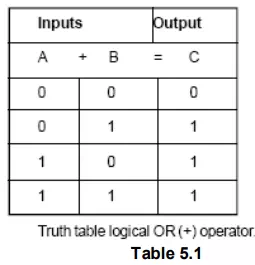
Observe that the result is 0 only when both input variables are 0. It is 1 when any one or both of the input variables are 1. This is the reason why the + symbol does not have the “normal” arithmetic meaning, but is a logical addition operator. This concept of logical addition may be extended to any number of variables. For example, in the equation A + B + C + D = E, even if A,B,C and D, all had the value of 1, the sum of the values (the result E) would be 1 only. The equation A+ B = C is normally read as “A or B equals C”.