
Introduction
A priority intersection occurs between two roads, one termed the ‘major’ road and the other the ‘minor’ road. The major road is the one assigned a permanent priority of traffic movement over that of the minor road. The minor road must give priority to the major road with traffic from it only entering the major road when appropriate gaps appear. The principal advantage of this type of junction is that the traffic on the major route is not delayed.
The principle at the basis of the design of priority intersections is that it should reflect the pattern of movement of the traffic. The heaviest traffic flows should be afforded the easiest paths. Visibility, particularly for traffic exiting the minor junction, is a crucial factor in the layout of a priority intersection. Low visibility can increase the rate of occurrence of serious accidents as well as reducing the basic capacity of the intersection itself.
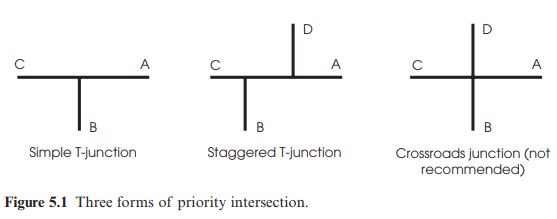
Priority intersections can be in the form of simple T-junctions, staggered junctions or crossroads, though the last form should be avoided where possible as drivers exiting the minor road can misunderstand the traffic priorities. This may lead to increased accidents.
Diagrammatic representations of the three forms are given in Fig. 5.1.
Within the two main junction configurations mentioned above (Tjunction/staggered junction), there are three distinct types of geometric layout for a single-carriageway priority intersection:
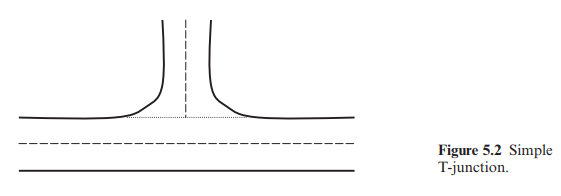
· Simple junctions: A T-junction or staggered junction without any ghost or physical islands in the major road and without channelling islands in the minor road approach (see Fig. 5.2).
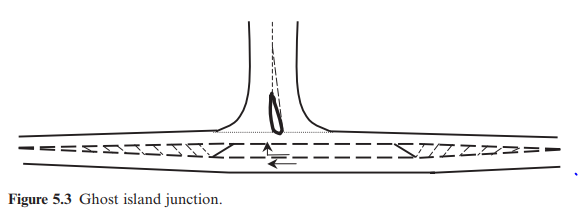
· Ghost island junctions: Usually a T-junction or staggered junction within which an area is marked on the carriageway, shaped and located so as to direct traffic movement (see Fig. 5.3).
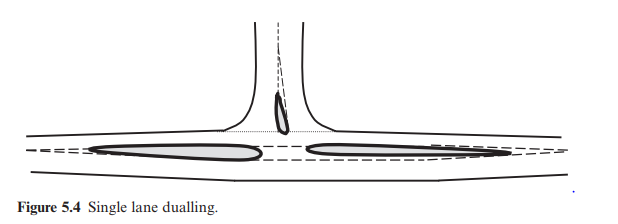
· Single lane dualling: Usually a T-junction or staggered junction within which central reservation islands are shaped and located so as to direct traffic movement (see Fig. 5.4).
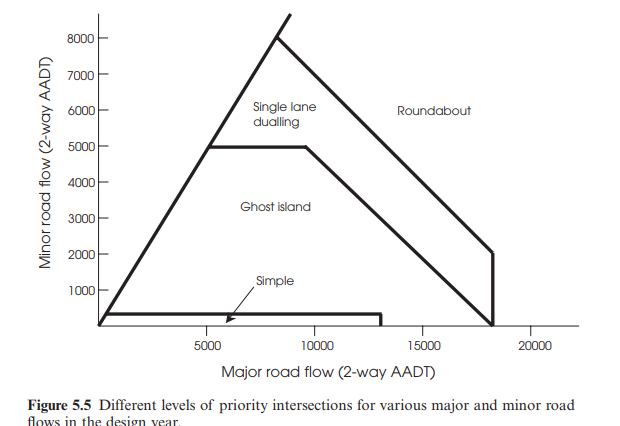
The type or level of junction utilised depends on the flows from both the major and minor roads. The ‘simple’ layout is appropriate for new junctions in rural locations where the 2-way AADT on the minor road is not expected to exceed 300 vehicles with the major road 2-way AADT not exceeding 13 000 vehicles. For single carriageway roads, the different levels of T-junctions appropriate to a range of flow combinations are illustrated in Figure 5.5 (DoT, 1981). The information takes into account geometric and traffic delays, entry and turning capacities and accident costs.