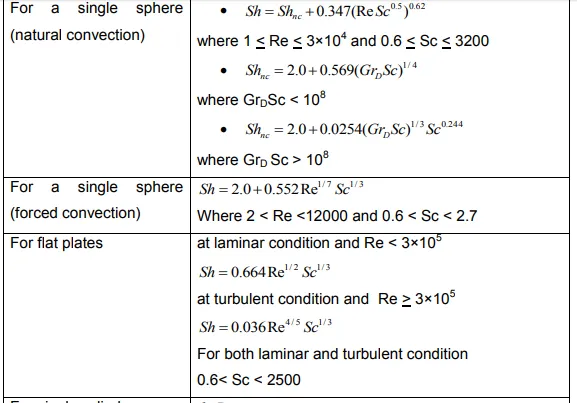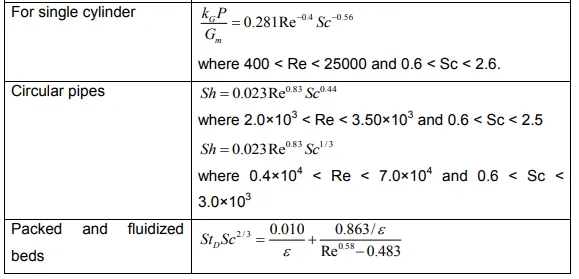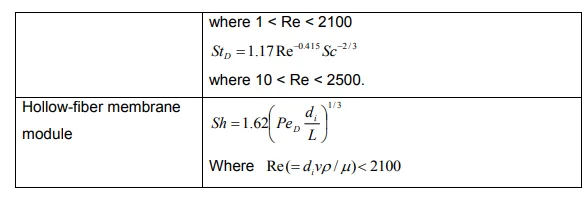
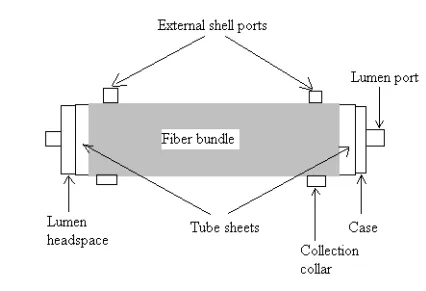
Hollow-fiber membrane modules are extensively used in various membrane separation processes including gas separation, reverse osmosis, filtration and dialysis. In this module a bundle of randomly packed fibers are enclosed in a case to contact two process streams. As per Bao et al. (1999), a typical hollowfiber membrane module is shown in Figure 3.2. When fluids flow through the shell and lumen as shown in Figure, mass is transferred from one stream to other stream through the fiber wall. The mass transfer depends on the nature of the membrane. There are numerous correlations in literature for shell side mass transfer coefficients in this module of membrane.
Costello et al. (1993) developed a correlation for mass transfer coefficient for liquid flowing through the shell parallel to the fiber which can be represented as: 0.53 0.33 Sh = f (f)Re Sc (3.48) where the packing fraction, f refers to the fraction of the cross sectional area that is occupied by the fibers. f(f) is the function of fiber packing fraction which is written as:

The Sherwood number and Reynolds numbers are defined as 2RkL/DAB and (2Rv0ρ(1-f))/(µf) respectively. R is the fiber radius and v0 is the superficial liquid velocity. The above correlation is valid in the range of 30<100f<75 and 20><Re
<350. In case of flow through the lumen and constant wall concentration which is more common in application, Cussler (1997) made a correlation which is given by>

where Sh = dikL/DAB is the Sherwood number for module length L. di is the fiber inside diameter. The correlations are also given in tabular form in Table