/
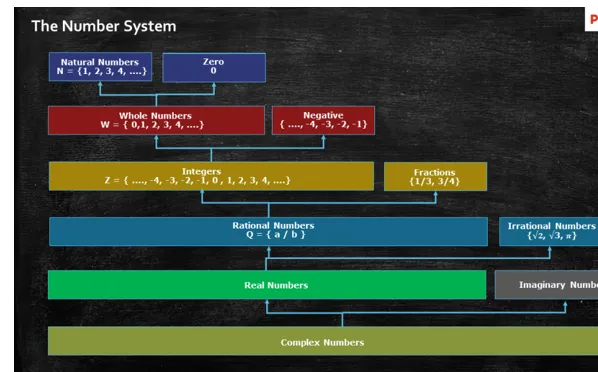
Natural Numbers
The natural (or counting) numbers are 1,2,3,4,5, etc. There are infinitely many natural numbers. The set of natural numbers, {1,2,3,4,5,…}, is sometimes written as N.
Whole Numbers
The whole numbers are the natural numbers together with 0.
Integers
The integers are the set of real numbers consisting of the natural numbers, their additive inverses and zero.
{…,−5,−4,−3,−2,−1,0,1,2,3,4,5,…}
The set of integers is sometimes written as Z for short.
Rational Numbers
The rational numbers are those numbers which can be expressed as a ratio between two integers. For example, the fractions 1/4 and −131/18 are both rational numbers.
Irrational Numbers
An irrational number is a number that cannot be written as a ratio (or fraction). In decimal form, it never ends or repeats.
The square root of 2 is an irrational number, meaning its decimal equivalent goes on forever, with no repeating pattern:
√2 =1.41421356237309…
Real Numbers
The real numbers is the set of numbers containing all of the rational numbers and all of the irrational numbers. The real numbers are “all the numbers” on the number line.
Imaginary Numbers
A number does not exist in the number line is called imaginary number. For example square root of negative numbers are imaginary numbers. It is denoted by ” i ” or ” j ”
i.e √-1 = i
Complex Numbers
All numbers that can be written in the form a + bi where a and b are real numbers and i is the “imaginary unit”, equal to the square root of -1.