- Table of Contents
- What Is On-Device AI?
- Why On-Device AI Is Taking Off Now
- 1) NPUs have become mainstream
- 2) Models got smaller (without becoming useless)
- 3) Tooling finally feels “developer-ready”
- The Big Benefits: Faster, Private, and Offline
- 1) Faster responses (lower latency)
- 2) More privacy by default
- 3) Works offline (and in low-connectivity regions)
- 4) Lower costs at scale
- Real-World Examples You’ll Notice in 2026
- AI PCs: NPUs become a “must-have”
- On-device GenAI on Android (Gemini Nano + APIs)
- Hybrid privacy architectures (device-first, cloud-when-needed)
- Tradeoffs and Limitations (The Honest Truth)
- 1) Battery and heat
- 2) Model size and memory limits
- 3) Quality gaps vs. the best cloud models
- 4) Updates and fragmentation
- How On-Device AI Works (Simple Technical Breakdown)
- The Hybrid Future: On-Device + Private Cloud
- Developer Playbook: How to Build with On-Device AI
- 1) Choose the “job” your on-device model will do
- 2) Design your UX around local-first
- 3) Build a smart fallback strategy
- 4) Take security seriously (yes, even on-device)
- 5) Plan for personalization without harvesting data
- Key Takeaways
- FAQs
- Is on-device AI the same as edge AI?
- Does on-device AI mean “no internet needed”?
- Is on-device AI always more private?
- Will on-device AI replace cloud AI?
- What devices benefit most from on-device AI in 2026?
- What’s the best framework to start with?
- Best Artificial Intelligence Apps on Play Store 🚀
- References & Further Reading
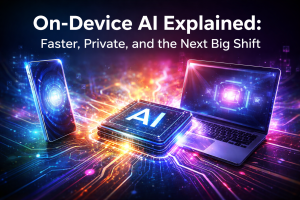
On-device AI is exactly what it sounds like: artificial intelligence that runs directly on your phone, laptop, tablet, smartwatch, car system, or other device—without needing to send every request to the cloud. Instead of uploading data (your voice, photos, text, or screen content) to a remote server, the model performs inference locally using your device’s CPU/GPU and—more importantly—its NPU (Neural Processing Unit).
Why does this matter in 2026? Because the hardware and software ecosystem has finally crossed a threshold: modern chips can run surprisingly capable models efficiently, and major platforms are actively pushing “AI that stays with you.” Microsoft’s Copilot+ PC requirements, for example, explicitly highlight the rise of 40+ TOPS NPUs as a baseline for next-generation AI experiences. Meanwhile, mobile platforms are rolling out increasingly capable small on-device models that power summaries, rewrites, image understanding, and more—sometimes even offline.
This post breaks down what on-device AI is, how it works, where it shines, where it struggles, and why it’s shaping up to be the next big shift in consumer tech and app development.
Table of Contents
What Is On-Device AI?
On-device AI (often grouped under edge AI) means running machine learning inference locally on a user’s device. That might include:
- Generating or rewriting text (small language models)
- Summarizing recordings or notes
- Classifying images, detecting objects, or enhancing photos
- Translating speech in real time
- Extracting meaning from screenshots, documents, or camera frames
Instead of the classic “send to server → wait → receive result” pattern, on-device AI moves compute closer to the data source. This reduces latency, improves reliability, and can dramatically improve privacy—because many tasks can be performed without sending sensitive content to a third party.
Two important terms you’ll hear a lot:
- Inference: Using a trained model to make predictions or generate outputs (what your app actually does on a device).
- Training/Fine-tuning: Teaching or adapting a model using data (usually done in the cloud, but certain forms can happen on-device too).
Why On-Device AI Is Taking Off Now
On-device AI is not new. Your phone has done local speech recognition and photo processing for years. What’s new is the scale and ambition: we’re moving from “a few ML features” to “AI-first experiences” powered by local models.
1) NPUs have become mainstream
Modern consumer chips increasingly include NPUs built for AI workloads. Microsoft’s Copilot+ PC requirements highlight an NPU capable of 40+ TOPS as a key requirement for many new Windows AI features. That’s not a niche spec anymore—it’s becoming a platform baseline.
2) Models got smaller (without becoming useless)
Researchers and product teams have improved distillation, quantization, compression, and runtime optimization. The result: smaller models that still deliver real value for summarization, rewriting, classification, and multimodal understanding.
3) Tooling finally feels “developer-ready”
Frameworks and runtimes have matured, including:
- Apple’s Core ML and Core ML documentation
- Google’s on-device pathways and TensorFlow Lite Android codelabs
- ONNX Runtime Mobile for cross-platform inference
- ExecuTorch for PyTorch-to-device deployment
The Big Benefits: Faster, Private, and Offline
1) Faster responses (lower latency)
Cloud AI adds network round-trips. Even a “fast” server response can feel slow when you include:
- Upload time (especially on mobile networks)
- Server queueing/traffic spikes
- Download time
On-device inference removes most of that. That’s why local AI feels “instant” for tasks like live captions, voice typing, camera filters, and image enhancements.
2) More privacy by default
If your data never leaves your device, you eliminate a whole class of risks. This is especially important for:
- Personal photos and private documents
- Health notes, financial text, IDs
- Customer support chats and business data
- Children’s data and sensitive communications
Privacy isn’t just a moral win; it’s a product advantage. Users increasingly demand features that work without uploading everything to a server.
3) Works offline (and in low-connectivity regions)
Offline AI is a superpower in the real world. On-device AI can keep features running:
- During travel (planes, trains, rural areas)
- In basements and elevators
- When data is expensive
- In enterprise environments that restrict outbound connections
Google has highlighted how Gemini Nano powers on-device capabilities on Pixel devices, and newer iterations increasingly focus on local and multimodal experiences.
4) Lower costs at scale
If you’re an app developer, server inference can get expensive fast. On-device AI can reduce (or sometimes eliminate) per-request costs—especially for high-frequency tasks like summarizing notes, cleaning text, or analyzing images locally.
Real-World Examples You’ll Notice in 2026
On-device AI is becoming visible in consumer features across phones and PCs:
AI PCs: NPUs become a “must-have”
- Microsoft’s Copilot+ PC overview: Copilot+ PCs
- Windows requirements mentioning 40+ TOPS NPUs: Windows 11 specifications
- Developer guidance for NPUs: Copilot+ PCs developer guide
On-device GenAI on Android (Gemini Nano + APIs)
- Pixel Feature Drop (Gemini Nano on Pixel 8 Pro era): Google Pixel blog
- Android Developers: Gemini Nano via ML Kit GenAI APIs (Aug 2025): Android Developers Blog
- Pixel ideas article on Gemini Nano offline/multimodal: Google Store article
Hybrid privacy architectures (device-first, cloud-when-needed)
- Apple’s Private Cloud Compute overview: Apple Security Blog
Tradeoffs and Limitations (The Honest Truth)
On-device AI is powerful, but it’s not magic. Here are the practical constraints:
1) Battery and heat
Running models continuously can drain battery and cause thermal throttling. Smart products use:
- Efficient runtimes (NPU acceleration)
- Smaller models for “always-on” tasks
- On-demand execution for heavier tasks
2) Model size and memory limits
Large cloud models can be huge. On-device models must fit within device RAM/storage constraints and still run fast enough to feel real-time.
3) Quality gaps vs. the best cloud models
For complex reasoning or niche knowledge, cloud models may still win. In practice, the best products increasingly use hybrid routing: default to device, escalate to cloud only when necessary.
4) Updates and fragmentation
Cloud AI can update instantly. On-device AI must handle:
- Model downloads and compatibility
- Different chip capabilities across devices
- Performance differences (low-end vs flagship)
How On-Device AI Works (Simple Technical Breakdown)
Here’s the simplest mental model:
- You ship a model (or download it after install).
- You run inference locally through a runtime optimized for the device.
- You accelerate compute using the NPU/GPU where possible.
- You manage constraints like battery, memory, and latency.
Key optimizations that make it possible
- Quantization: Using lower-precision numbers (e.g., int8) to reduce size and speed up inference.
- Pruning/Sparsity: Removing less useful connections/weights.
- Distillation: Training a smaller “student” model to imitate a larger “teacher.”
- Hardware-aware compilation: Converting models for specific accelerators.
Popular runtimes & frameworks
- Apple: Core ML
- Android: TensorFlow Lite codelab and on-device learning resources
- Cross-platform: ONNX Runtime Mobile
- PyTorch edge: ExecuTorch
Some platforms even support limited on-device personalization. For example:
- Core ML notes on on-device fine-tuning/retraining: Core ML docs
- TensorFlow Lite on-device training overview: TensorFlow Blog
The Hybrid Future: On-Device + Private Cloud
The most realistic future is not “device or cloud.” It’s device-first with privacy-preserving cloud escalation when needed.
For example, Apple describes Private Cloud Compute as a way to extend device privacy principles into cloud AI when heavier computation is required. That’s a blueprint many companies are moving toward: keep routine tasks local, route complex tasks carefully, and minimize exposure of sensitive user data.
As AI assistants become more deeply integrated into operating systems, this hybrid approach will likely become the default product architecture.
Developer Playbook: How to Build with On-Device AI
If you’re building apps (Android, iOS, Windows, or cross-platform), here’s a practical checklist.
1) Choose the “job” your on-device model will do
On-device works best for:
- Text cleanup: rewrite, proofread, format
- Summaries: notes, transcripts, emails (lightweight)
- Classification: intent detection, spam filtering
- Vision: OCR, object detection, photo enhancement
2) Design your UX around local-first
- Show results fast (progressive rendering if needed)
- Offer an “enhanced mode” that uses cloud only with consent
- Explain privacy clearly (“stays on device”)
3) Build a smart fallback strategy
Use on-device by default, but gracefully fall back when:
- Model confidence is low
- Task requires large context/knowledge
- User explicitly requests “best quality”
4) Take security seriously (yes, even on-device)
On-device doesn’t automatically mean “safe.” You still need secure engineering: protect model files, validate inputs, prevent sensitive leakage in logs, and handle prompt injection risks for any LLM-like feature. If your app includes generative AI, it’s worth reading OWASP’s GenAI guidance:
- OWASP Top 10 for LLM Applications: OWASP Project
- GenAI OWASP LLM Top 10 portal: OWASP GenAI
5) Plan for personalization without harvesting data
If you want personalization, consider privacy-preserving approaches like federated learning concepts (where training happens across devices without collecting raw data centrally):
- Federated learning explainer: Federated with Google
- Google Research blog (federated learning): Google Research
Key Takeaways
- On-device AI runs locally (phone/PC) for speed, privacy, and offline reliability.
- NPUs are the new battleground—AI PCs and flagship phones increasingly require them for premium features.
- Hybrid is the future: device-first with privacy-preserving cloud escalation for heavy tasks.
- Developers win with lower inference costs and better UX—if they design for battery, memory, and fallbacks.
- Security still matters: on-device GenAI needs careful handling of inputs, outputs, and data exposure.
FAQs
Is on-device AI the same as edge AI?
On-device AI is a subset of edge AI. “Edge AI” can include on-device processing on phones and laptops, but also gateways, routers, factory devices, drones, and embedded systems. On-device specifically focuses on user devices.
Does on-device AI mean “no internet needed”?
For many features, yes. But lots of products use a hybrid approach: local-first, then cloud for bigger tasks. The key is that on-device AI gives you the option to stay offline for many workflows.
Is on-device AI always more private?
Usually, but not automatically. It reduces the need to upload data, which is a major privacy win. Still, your app can leak data via logs, analytics, or unsafe storage. “On-device” is an advantage, not a guarantee.
Will on-device AI replace cloud AI?
Not completely. Cloud AI still excels at very large models, deep reasoning, and massive context windows. The likely future is hybrid: local for fast everyday tasks, cloud for heavy lifting.
What devices benefit most from on-device AI in 2026?
AI PCs with strong NPUs, flagship smartphones, and new wearables. You’ll also see growth in cars and smart home devices as chip efficiency improves.
What’s the best framework to start with?
If you’re building for iOS/macOS, start with Core ML. For Android, explore TensorFlow Lite and ML Kit pathways. If you want cross-platform control and portability, ONNX Runtime Mobile and ExecuTorch are strong options.
Best Artificial Intelligence Apps on Play Store 🚀
Learn AI from fundamentals to modern Generative AI tools — pick the Free version to start fast, or unlock the full Pro experience (one-time purchase, lifetime access).

AI Basics → Advanced
Artificial Intelligence (Free)
A refreshing, motivating tour of Artificial Intelligence — learn core concepts, explore modern AI ideas, and use built-in AI features like image generation and chat.
More details
► The app provides a refreshing and motivating synthesis of AI — taking you on a complete tour of this intriguing world.
► Learn how to build/program computers to do what minds can do.
► Generate images using AI models inside the app.
► Clear doubts and enhance learning with the built-in AI Chat feature.
► Access newly introduced Generative AI tools to boost productivity.
- Artificial Intelligence- Introduction
- Philosophy of AI
- Goals of AI
- What Contributes to AI?
- Programming Without and With AI
- What is AI Technique?
- Applications of AI
- History of AI
- What is Intelligence?
- Types of Intelligence
- What is Intelligence Composed of?
- Difference between Human and Machine Intelligence
- Artificial Intelligence – Research Areas
- Working of Speech and Voice Recognition Systems
- Real Life Applications of AI Research Areas
- Task Classification of AI
- What are Agent and Environment?
- Agent Terminology
- Rationality
- What is Ideal Rational Agent?
- The Structure of Intelligent Agents
- Nature of Environments
- Properties of Environment
- AI – Popular Search Algorithms
- Search Terminology
- Brute-Force Search Strategies
- Comparison of Various Algorithms Complexities
- Informed (Heuristic) Search Strategies
- Local Search Algorithms
- Simulated Annealing
- Travelling Salesman Problem
- Fuzzy Logic Systems
- Fuzzy Logic Systems Architecture
- Example of a Fuzzy Logic System
- Application Areas of Fuzzy Logic
- Advantages of FLSs
- Disadvantages of FLSs
- Natural Language Processing
- Components of NLP
- Difficulties in NLU
- NLP Terminology
- Steps in NLP
- Implementation Aspects of Syntactic Analysis
- Top-Down Parser
- Expert Systems
- Knowledge Base
- Inference Engine
- User Interface
- Expert Systems Limitations
- Applications of Expert System
- Expert System Technology
- Development of Expert Systems: General Steps
- Benefits of Expert Systems
- Robotics
- Difference in Robot System and Other AI Program
- Robot Locomotion
- Components of a Robot
- Computer Vision
- Application Domains of Computer Vision
- Applications of Robotics
- Neural Networks
- Types of Artificial Neural Networks
- Working of ANNs
- Machine Learning in ANNs
- Bayesian Networks (BN)
- Building a Bayesian Network
- Applications of Neural Networks
- AI – Issues
- A I- Terminology
- Intelligent System for Controlling a Three-Phase Active Filter
- Comparison Study of AI-based Methods in Wind Energy
- Fuzzy Logic Control of Switched Reluctance Motor Drives
- Advantages of Fuzzy Control While Dealing with Complex/Unknown Model Dynamics: A Quadcopter Example
- Retrieval of Optical Constant and Particle Size Distribution of Particulate Media Using the PSO-Based Neural Network Algorithm
- A Novel Artificial Organic Controller with Hermite Optical Flow Feedback for Mobile Robot Navigation
Tip: Start with Free to build a base, then upgrade to Pro when you want projects, tools, and an ad-free experience.

One-time • Lifetime Access
Artificial Intelligence Pro
Your all-in-one AI learning powerhouse — comprehensive content, 30 hands-on projects, 33 productivity AI tools, 100 image generations/day, and a clean ad-free experience.
More details
Unlock your full potential in Artificial Intelligence! Artificial Intelligence Pro is packed with comprehensive content,
powerful features, and a clean ad-free experience — available with a one-time purchase and lifetime access.
- Machine Learning (ML), Deep Learning (DL), ANN
- Natural Language Processing (NLP), Expert Systems
- Fuzzy Logic Systems, Object Detection, Robotics
- TensorFlow framework and more
Pro features
- 500+ curated Q&A entries
- 33 AI tools for productivity
- 30 hands-on AI projects
- 100 AI image generations per day
- Ad-free learning environment
- Take notes within the app
- Save articles as PDF
- AI library insights + AI field news via linked blog
- Light/Dark mode + priority support
- Lifetime access (one-time purchase)
Compared to Free
- 5× more Q&As
- 3× more project modules
- 10× more image generations
- PDF + note-taking features
- No ads, ever • Free updates forever
Buy once. Learn forever. Perfect for students, developers, and tech enthusiasts who want to learn, build, and stay updated in AI.
References & Further Reading
- Microsoft: Copilot+ PCs overview — https://www.microsoft.com/en-us/windows/copilot-plus-pcs
- Microsoft: Windows 11 specs (Copilot+ PC NPU requirements) — https://www.microsoft.com/en-in/windows/windows-11-specifications
- Microsoft Learn: NPU devices (Copilot+ guidance) — https://learn.microsoft.com/en-us/windows/ai/npu-devices/
- Android Developers Blog: Gemini Nano via ML Kit GenAI APIs — https://android-developers.googleblog.com/2025/08/the-latest-gemini-nano-with-on-device-ml-kit-genai-apis.html
- Apple Security: Private Cloud Compute — https://security.apple.com/blog/private-cloud-compute/
- Apple Developer: Core ML — https://developer.apple.com/machine-learning/core-ml/
- ONNX Runtime Mobile — https://onnxruntime.ai/docs/get-started/with-mobile.html
- ExecuTorch Documentation — https://docs.pytorch.org/executorch/index.html
- OWASP Top 10 for LLM Apps — https://owasp.org/www-project-top-10-for-large-language-model-applications/
- NIST AI Risk Management Framework (AI RMF) — https://www.nist.gov/itl/ai-risk-management-framework
If you found this helpful, consider adding a short “Privacy & Offline” note near your app features list—users love knowing what stays on device.