




INTRODUCTION
In the previous chapters, we have been studying forces acting at one point. But, sometimes, the given forces have their lines of action parallel to each other. A little consideration will show, that such forces do not meet at any point, though they do have some effect on the body on which they act. The forces, whose lines of action are parallel to each other, are known as parallel forces.
CLASSIFICATION OF PARALLEL FORCES
The parallel forces may be, broadly, classified
into the following two categories, depending upon their directions :
1. Like parallel forces.
2. Unlike parallel forces.
LIKE PARALLEL FORCES
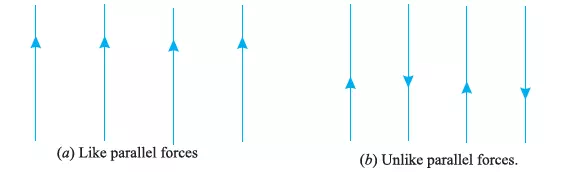
The forces, whose lines of action are parallel to each other and all of them act in the same direction as shown in Fig. 4.1 (a) are known as like parallel forces.
UNLIKE PARALLEL FORCES
The forces, whose lines of action are parallel to each other and all of them do not act in the same direction as shown in Fig. 4.1 (b) are known as unlike parallel forces.
METHODS FOR MAGNITUDE AND POSITION OF THE RESULTANT OF PARALLEL FORCES
The magnitude and position of the resultant force, of a given system of parallel forces (like or unlike) may be found out analytically or graphically. Here we shall discuss both the methods one by one.
ANALYTICAL METHOD FOR THE RESULTANT OF PARALLEL FORCES
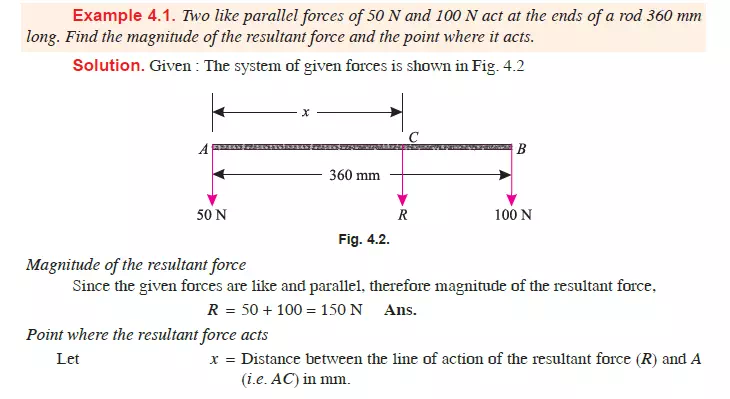
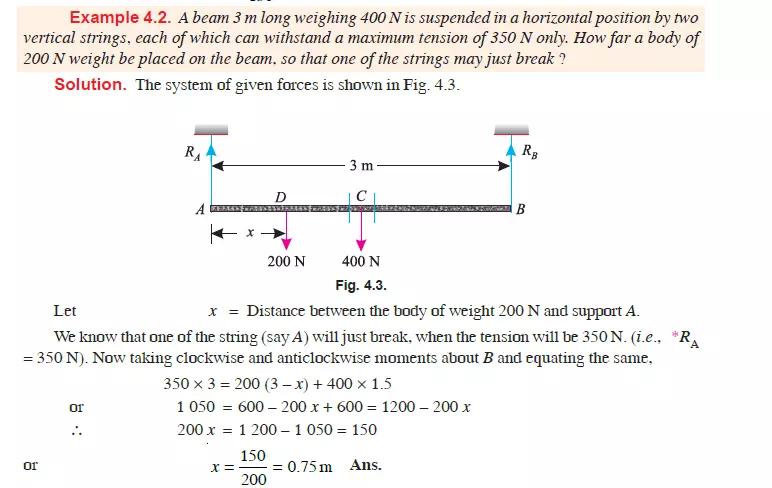
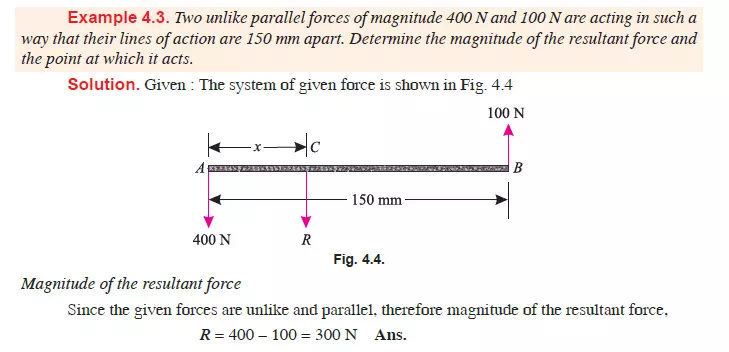
In this method, the sum of clockwise moments is equated with the sum of anticlockwise moments about a point.


GRAPHICAL METHOD FOR THE RESULTANT OF PARALLEL FORCES
Consider a number of parallel forces (say three like parallel forces) P1, P2 and P3 whose resultant is required to be found out as shown in Fig. 4.6 (a).

First of all, draw the space diagram of the given system of forces and name them according to Bow’s notations as shown in Fig. 4.6 (a). Now draw the vector diagram for the given forces as
shown in Fig. 4.6 (b) and as discussed below :
1. Select some suitable point a, and draw ab equal to the force AB (P1) and parallel to it to some suitable scale.
2. Similarly draw bc and cd equal to and parallel to the forces BC (P2) and CD (P3) respectively.
3. Now take some convenient point o and joint oa, ob, oc and od.
4. Select some point p, on the line of action of the force AB of the space diagram and through it draw a line Lp parallel to ao. Now through p draw pq parallel to bo meeting the line of action of the force BC at q.
5. Similarly draw qr and rM parallel to co and do respectively.
6. Now extend Lp and Mr to meet at k. Through k, draw a line parallel to ad, which gives the required position of the resultant force.
7. The magnitude of the resultant force is given by ad to the scale.
Note. This method for the position of the resultant force may also be used for any system of forces i.e. parallel, like, unlike or even inclined.

