
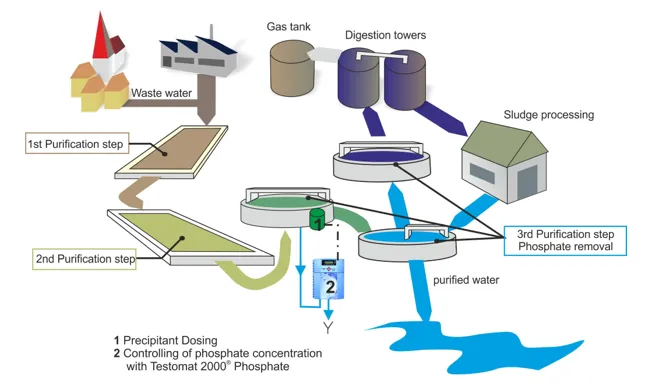
Conceptual solution for treatment plant
When is it necessary to measure phosphate levels?
The measurement of the phosphate content in the wastewater of industrial processes becomes more and more important, because the phosphate values must be lower than the legally permitted values if the wastewater is discharged into the sewer system.
In accordance with § 11 of the German drinking water ordinance of 2001, the limits are 2,2 mg / l phosphorus (6.75 mg / l PO4) for phosphates added to the drinking water.
Where do phosphates come from?
Phosphates are mainly found in fertilizers and detergents. They are released into the groundwater by agricultural fertilizers in the soil or by domestic wastewater with phosphate detergents. In industrial plants, orthophosphates (PO4) are directly fed into the processing water to prevent corrosion in their piping systems.
Industrial and agricultural discharges in rivers and lakes lead to a nutrient surplus in the waters. This results in undesirable algae growth and a falling oxygen content in the water. The ecological balance suffers sustained damage.
Through the water cycle, high amounts of phosphates and nitrates also enter the ground water.
In order to prevent this environmental hazard, policies for the concentration of phosphates and nitrates in water have been established.
Phosphates in Sewage Treatment Plants
In waste water treatment plants, phosphate concentration must be measured in order to ensure effective wastewater treatment. Phosphates are removed either by chemical precipitation or biological elimination from wastewater.
By feeding in dissolved iron salts (ferrous chloride), most of the phosphorus from wastewater is precipitated and deposited along with the contaminants from the primary settlement tank to the bottom of the basin.
Increasingly important in wastewater treatment plants is the phosphate recovery from wastewater and sludge, since phosphorus is an important and finite raw material.