




There are a number of methods commonly employed in industry to alter the key properties of polymers. These include copolymerisation, varying the degree of crystallinity, varying the average molecular mass, addition of plasticisers, blending and alloying, stabilisation, vulcanisation, and fibre-reinforcement.
The most commonly altered properties of polymers are strength, modulus, toughness, and wear and environmental resistance.
Copolymerisation
Copolymers, as was described before, are a combination of two or more different polymers. The molecular chains within a copolymer are comprised of different monomer units.
Usually the monomer units form a random arrangement thereby favouring the formation of an amorphous structure with a lower packing density and a lower Tg. Copolymerisation, therefore, tends to lower the modulus turning a brittle polymer into a flexible copolymer.
Degree of Crystallinity
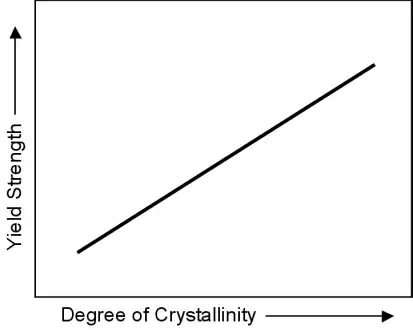
The amount of crystalline regions in a polymer can greatly affect its tensile strength, elastic modulus, density, and resistance to chemical attack.A higher level of crystallinity means a structure with a higher level of order in its atomic arrangement. As the atoms pack closer together the strength of the secondary bonds increases thereby increasing both the strength and modulus of the polymer.

