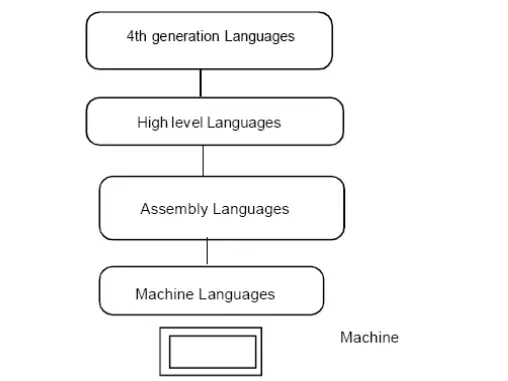
A programming language is a means of communication for the user to communicate with the computer system. The programming language is a set of instructions which tells the computer what to do. This is a language which is understood by both man and machine. There are a number of programming languages. However all these languages are designed to perform at least certain basic instructions and operations; These instructions and operations are :
– Input/output operations,
– Arithmetic operations
– mathematical operations like addition, subtraction,
– Logical operations – Comparison for equality, inequality etc.
– Movement of instructions and data to and from the CPU. To use the programming language, the programmer has to strictly follow the rules of the language including all commas, punctuation marks etc. otherwise the program will not be understood by the computer. Thus, although the programming languages are much smaller and simpler than the natural languages, they have to be used with the greatest accuracy.
Types of programming languages
a) Machine Language
b) Assembly Language
c) High Level Language