
Modulus of elasticity ( ) and the modulus of rigidity (
 ) are related by the following equation:

Here,  represents a number called Poisson’s ratio given to the particular material. When the material is being stretched in one direction, it gets shortened in a perpendicular direction. In the direction that the material becomes elongated, the axial strain (
 ) is defined as the fractional increase in the length. In the direction that the material shortens, the transverse strain (
 ) gives the fractional reduction in length. The diagram below illustrates these changes in shape:
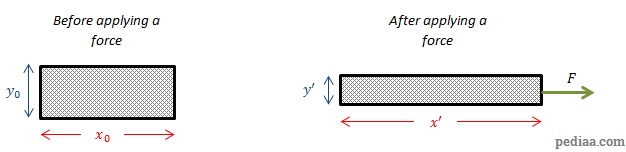
Defining Poisson’s ratio
In this diagram, the axial strain is:

The transverse strain is:

Note that since the object shortens in the direction perpendicular to the force,  . Poisson’s ratio () is defined as:

The minus sign has been introduced to ensure that takes a positive value.