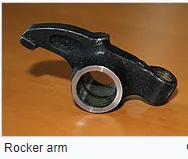
A rocker arm (in the context of an internal combustion engine of automotive, marine, motorcycle and reciprocating aviation types) is an oscillating lever that conveys radial movement from the cam lobe into linear movement at the poppet valve to open it. One end is raised and lowered by a rotating lobe of the camshaft (either directly or via a tappet (lifter) and pushrod) while the other end acts on the valve stem. When the camshaft lobe raises the outside of the arm, the inside presses down on the valve stem, opening the valve. When the outside of the arm is permitted to return due to the camshafts rotation, the inside rises, allowing the valve spring to close the valve.
Some overhead cam engines employ short rocker arms in which the cam lobe pushes down (rather than up) on the rocker arm to open the valve. On this type of rocker arm, the fulcrum is at the end rather than the middle, while the cam acts on the middle of the arm. The opposite end opens the valve. These types of rocker arms are particularly common on dual overhead cam motors, and are often used instead of direct tappets.