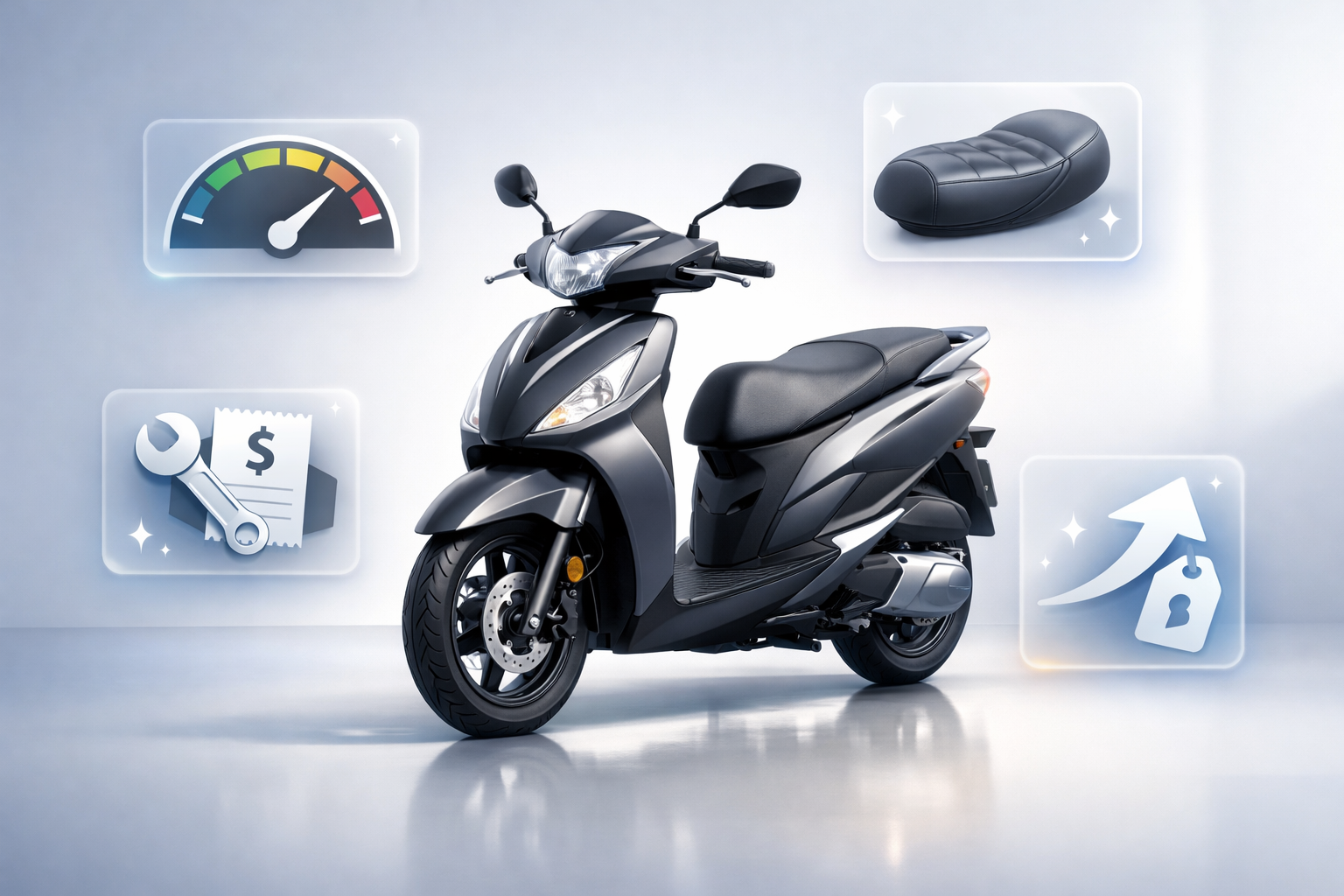
Buying a scooter looks simple—pick a model, check the mileage claim, and done. But the “best scooter” is the one that fits your daily routes, body comfort, service budget, and resale expectations. A scooter that feels perfect in a showroom can feel tiring in traffic, expensive at service time, or hard to resell later.
- Table of Contents
- Quick match: Which scooter type fits you?
- 1) Daily city commute (5–25 km/day)
- 2) Rough roads / speed breakers / broken patches
- 3) Family use (pillion often, groceries, school drop)
- 4) Budget-first buyer
- Mileage: What affects real-world scooter mileage?
- ARAI/IDC mileage vs real mileage
- What increases mileage (practical habits)
- What reduces mileage (and surprises buyers)
- Comfort: Seat, suspension, ergonomics & pillion friendliness
- 1) Seat comfort (rider + pillion)
- 2) Suspension and ride quality
- 3) Floorboard space & riding posture
- 4) Storage and practicality
- Service cost: What you’ll pay over time (and why)
- Know the service schedule (don’t guess—verify)
- Typical recurring maintenance buckets
- CVT belt: the hidden “big service” item
- Service network matters more than people think
- Resale value: How to protect your money
- Ownership cost table (example)
- Test ride checklist (10 minutes that saves you years)
- New vs used scooter: When used makes sense
- Safety & rules to know (ABS/CBS, helmet basics)
- Key Takeaways
- FAQs
- 1) What mileage should I expect from a scooter in real life?
- 2) Is a heavier scooter always less fuel efficient?
- 3) What’s the most expensive maintenance item in scooters?
- 4) How do I reduce service costs?
- 5) Which matters more: comfort or mileage?
- 6) Is buying a used scooter safe?
- 7) What documents should I check when buying used?
- 8) Should I prefer ABS or CBS?
- References & further reading
This guide breaks the decision into four big pillars—mileage, comfort, service cost, and resale—and gives you practical checklists, a cost table, and real-world tips to help you choose confidently.
Table of Contents
Quick match: Which scooter type fits you?
1) Daily city commute (5–25 km/day)
- Priority: easy handling, smooth low-speed pickup, comfortable seat, decent storage.
- Best focus: real mileage in stop-go traffic + easy service network.
2) Rough roads / speed breakers / broken patches
- Priority: suspension comfort, stronger build feel, larger wheels/tyres, stable braking.
- Best focus: ride quality + maintenance durability.
3) Family use (pillion often, groceries, school drop)
- Priority: wide seat, easy step-through, comfortable pillion footrest position, practical storage.
- Best focus: comfort + resale value.
4) Budget-first buyer
- Priority: low running cost, predictable maintenance, good parts availability.
- Best focus: service cost + tyres + fuel economy habits.
Mileage: What affects real-world scooter mileage?
Most scooters use a CVT (Continuously Variable Transmission), which is smooth and easy in traffic, but your mileage depends heavily on how and where you ride. (CVT basics: Wikipedia: CVT)
ARAI/IDC mileage vs real mileage
Official fuel-economy numbers are measured in standard test cycles (in India, variations of IDC for certain categories). These tests help compare models, but they don’t perfectly match your daily traffic, load, road quality, or riding style. If you want to understand how test cycles work, see ARAI/CMVR procedure details here:
ARAI/CMVR test procedure (PDF).
What increases mileage (practical habits)
- Gentle throttle: Smooth acceleration saves fuel more than “fast starts.”
- Steady speed: Constant speed beats repeated braking/accelerating.
- Correct tyre pressure: Under/over-inflation hurts mileage and tyre life. Michelin explains how pressure affects fuel use:
Michelin: tyres & fuel economy. - Timely servicing: Dirty air filter, old oil, and worn CVT parts reduce efficiency.
- Lighten unnecessary load: Heavy storage items permanently kept in the boot reduce mileage.
What reduces mileage (and surprises buyers)
- Short trips: Frequent 1–2 km rides often give poor mileage.
- Bad roads & frequent braking: Stop-go and potholes waste energy.
- Low tyre pressure: Can increase rolling resistance and cost you fuel over time. Extra reading:
Michelin: tyre pressure guide. - Carrying pillion regularly: Expect mileage to drop (normal physics, not a “bad scooter”).
- Worn CVT belt/rollers: As parts wear, efficiency and smoothness can drop.
Smart buyer tip: During your test ride, do one slow crawl (10–20 km/h) and one open stretch (40–60 km/h). If the scooter feels “strained” or jerky, real mileage may suffer because you’ll keep adjusting the throttle.
Comfort: Seat, suspension, ergonomics & pillion friendliness
Comfort isn’t luxury—comfort is fatigue control. If you ride daily, small discomfort becomes a big health issue over months.
1) Seat comfort (rider + pillion)
- Seat width and foam: A wider seat spreads pressure; overly soft foam can feel good short-term but painful long-term.
- Seat length: If pillion sits often, check if there’s enough room without pushing the rider forward.
- Seat height: You should place both feet confidently at stops (especially in heavy traffic).
2) Suspension and ride quality
- Speed breaker test: During test ride, cross 2–3 speed breakers at slow speed and feel the shock transfer to your spine.
- Corner stability: If the scooter feels “floaty,” you may feel unsafe at higher speeds.
3) Floorboard space & riding posture
- Flat floorboard: Helpful for grocery bags and comfortable foot placement.
- Knee room: Taller riders must check if knees hit the handle area on full steering lock.
- Handlebar reach: Too far = shoulder pain; too close = cramped posture.
4) Storage and practicality
- Underseat storage: Check if your helmet actually fits.
- Front hooks: Useful but don’t overload—bags can affect steering balance.
- Passenger comfort: Footrest angle matters; awkward footrests cause calf/ankle discomfort.
Comfort reality check: The “most comfortable scooter” for you is often the one that matches your height, weight, and daily road conditions—not the most advertised model.
Service cost: What you’ll pay over time (and why)
Service cost is where many buyers get surprised. Two scooters with similar purchase price can have very different ownership costs based on service intervals, part prices, and how widely available skilled mechanics are.
Know the service schedule (don’t guess—verify)
Always check the official service schedule for your model. Examples:
- Honda India owners manual library: Honda Owners Manual
- Sample Honda manual (PDF): Activa 6G manual (PDF)
- Yamaha periodic service schedule: Yamaha service schedule
Typical recurring maintenance buckets
- Engine oil: cost depends on oil type and interval.
- Air filter: dusty cities require more frequent cleaning/replacement.
- CVT system: belt + roller weights + clutch inspection over time.
- Brake pads/shoes: depends on braking style and traffic.
- Tyres: one of the biggest periodic costs—especially if roads are rough.
- Battery: replacement every few years depending on usage and charging health.
CVT belt: the hidden “big service” item
Most scooters use CVT belts which are wear parts. The exact replacement interval depends on your model and riding conditions—always follow your manual or authorized service guidance. A general explanation of belt care (high-level):
GarageOnCall: drive belt maintenance.
Service network matters more than people think
- Authorized service access: easier warranty support and genuine parts availability.
- Local mechanic familiarity: popular models often get cheaper repairs because parts and skills are common.
- Labour transparency: Some brands publish service-related info pages; example:
Yamaha service & maintenance.
Smart buyer tip: Before booking, call 2 local service centers and ask for approximate costs of: periodic service, brake pad replacement, tyre replacement, and CVT belt inspection charges. The call itself reveals how transparent (or confusing) the service experience will be.
Resale value: How to protect your money
Resale value depends on brand perception, maintenance records, accident history, and how “easy” it is for the next owner to trust your scooter.
What improves resale
- Popular model + strong service network: easier to sell because buyers feel safe.
- Full service history: invoices + regular oil changes.
- Clean body and original paint: heavy scratches reduce trust and price.
- Genuine parts: cheap aftermarket parts can reduce value.
- Insurance continuity: easier transfer and perceived lower risk.
What hurts resale
- Accident repairs with misaligned panels: buyers assume bigger hidden damage.
- Neglected tyres/brakes: signals poor maintenance.
- Missing documents: RC/insurance confusion delays sale and lowers price.
- Engine/CVT noise: even small noises scare buyers.
Use valuation tools as “ballpark,” not truth
Online valuation tools can give a rough range. Examples:
- Droom used scooter valuation: Droom OBV
- Orangebookvalue used scooters: Orangebookvalue
Resale hack: Save every service bill (digital photo is enough). When you sell, those bills can increase buyer trust more than any “talk.”
Ownership cost table (example)
This is a simple planning table. Your numbers will vary by city, usage, tyre brand, and fuel price—but the structure helps you compare scooters rationally.
| Cost Head | What to include | How often | Buyer tip |
|---|---|---|---|
| Fuel | Your monthly km ÷ real mileage × fuel price | Monthly | Use your own commute distance, not brochure mileage. |
| Periodic service | Labour + engine oil + basic checks | As per manual | Verify schedule from official manual before purchase. |
| Tyres | Front + rear tyre replacement | Varies | Bad roads reduce tyre life; keep correct pressure for savings. |
| Brakes | Brake pads/shoes + cable adjustments | Varies | Frequent hard braking in traffic increases cost. |
| CVT maintenance | Belt/rollers/clutch inspection | Occasional | Ask service center what a “major service” typically includes. |
| Insurance | Own-damage + third-party as applicable | Yearly | IDV/depreciation affects claim value over time. |
About insurance IDV and depreciation schedules (official policy wording examples):
IRDAI sample policy wording (PDF)
Test ride checklist (10 minutes that saves you years)
Before you start
- Sit and place both feet down. Do you feel confident and stable?
- Turn handle full left and full right. Any knee/hand interference?
- Check underseat storage with your real helmet if possible.
During the ride
- Low-speed balance: Does it wobble at 10–15 km/h?
- Throttle smoothness: Any jerk when you gently accelerate?
- Brakes: Progressive and predictable? No scary bite or spongy feel?
- Speed breaker test: Does the suspension absorb or “slam”?
- Vibration & noise: Excess vibration = long-term fatigue.
With a pillion (if your daily use includes one)
- Check pillion comfort, footrest position, and whether the scooter feels underpowered.
- Check braking confidence with extra weight.
New vs used scooter: When used makes sense
A used scooter can be a smart decision if you inspect properly and buy at a fair price.
Used scooter inspection resources
- OLX used two-wheeler inspection tips: OLX guide
- HDFC ERGO second-hand scooter buying guide: HDFC ERGO guide
Used is worth it when:
- You get a clean history + proper paperwork.
- The price difference vs new is significant.
- The scooter is a common model with easy parts availability.
Avoid used if:
- Engine or CVT makes unusual noise.
- Panels look misaligned (possible crash repairs).
- Owner avoids sharing service history or documents.
Safety & rules to know (ABS/CBS, helmet basics)
Safety features are increasingly important. In many markets, ABS and CBS standards have been mandated or expanded over time. Learn the basics:
- ABS overview: What is ABS?
- CBS overview: What is CBS?
India policy references (official/government):
- MoRTH page for ABS/CBS notification document: MoRTH: G.S.R. 310(E)
- Motor Vehicles Act Section 129 (protective headgear): India Code: Section 129
Practical safety note: A scooter that brakes predictably and feels stable in emergency braking is worth paying extra for—especially for daily commuting.
Key Takeaways
- Don’t buy on claimed mileage alone. Your real mileage depends on traffic, tyres, load, and riding style.
- Comfort is a long-term decision. Seat, suspension, and posture matter more than “features.”
- Service cost is predictable if you read the manual. Check official schedules and local service transparency.
- Resale value is protected by records. Save service bills and keep the scooter clean and original.
- Test ride smartly. A 10-minute checklist can prevent years of regret.
FAQs
1) What mileage should I expect from a scooter in real life?
Real mileage depends on traffic density, average speed, tyre pressure, load, and maintenance. Expect a gap between brochure figures and daily commuting reality. Use your commute distance and observe owner reviews as a range—not a single number.
2) Is a heavier scooter always less fuel efficient?
Not always. Weight can reduce mileage in stop-go traffic, but engine tuning, CVT efficiency, tyre choice, and riding style can change outcomes. Heavier scooters can sometimes feel more stable and comfortable on rough roads.
3) What’s the most expensive maintenance item in scooters?
Over time, tyres and major CVT-related servicing (belt/rollers/clutch inspection) can become notable costs, along with battery replacement. Exact costs depend on model and usage.
4) How do I reduce service costs?
Follow the official service schedule, keep tyres at recommended pressure, avoid aggressive acceleration, and fix small issues early. Also choose a model with a strong local service network.
5) Which matters more: comfort or mileage?
If you ride daily, comfort usually wins. A slightly lower mileage scooter that prevents back/shoulder pain is often the better “total cost” decision.
6) Is buying a used scooter safe?
Yes—if you inspect properly, verify documents, and confirm service history. Use inspection checklists and price tools for a fair range, and avoid suspicious sellers.
7) What documents should I check when buying used?
At minimum: RC, insurance, service records (if available), and a clean ownership/transfer process. Also match chassis/engine number with official documents where applicable.
8) Should I prefer ABS or CBS?
Both help braking safety in different ways. ABS prevents wheel lock during hard braking; CBS links braking force distribution. If your riding involves highways, rain, or emergency braking situations, prioritize strong braking confidence and stability.
References & further reading
- Honda owners manual library: Honda India
- Sample Honda scooter manual (PDF): Activa 6G manual
- Yamaha service schedule: Yamaha India
- Michelin on tyre pressure and fuel economy: Michelin
- Michelin tyre pressure guide: Michelin
- CVT basics: Wikipedia
- ABS basics: Wikipedia
- CBS basics: Wikipedia
- MoRTH ABS/CBS notification page: MoRTH
- Motor Vehicles Act Section 129 (helmet): India Code
- ARAI/CMVR test procedure (PDF): ARAI
- Droom used scooter valuation: Droom
- Orangebookvalue scooter pricing: Orangebookvalue
- OLX used two-wheeler inspection: OLX
- HDFC ERGO guide for second-hand scooters: HDFC ERGO
- IRDAI sample policy wording (depreciation/IDV table examples): IRDAI PDF