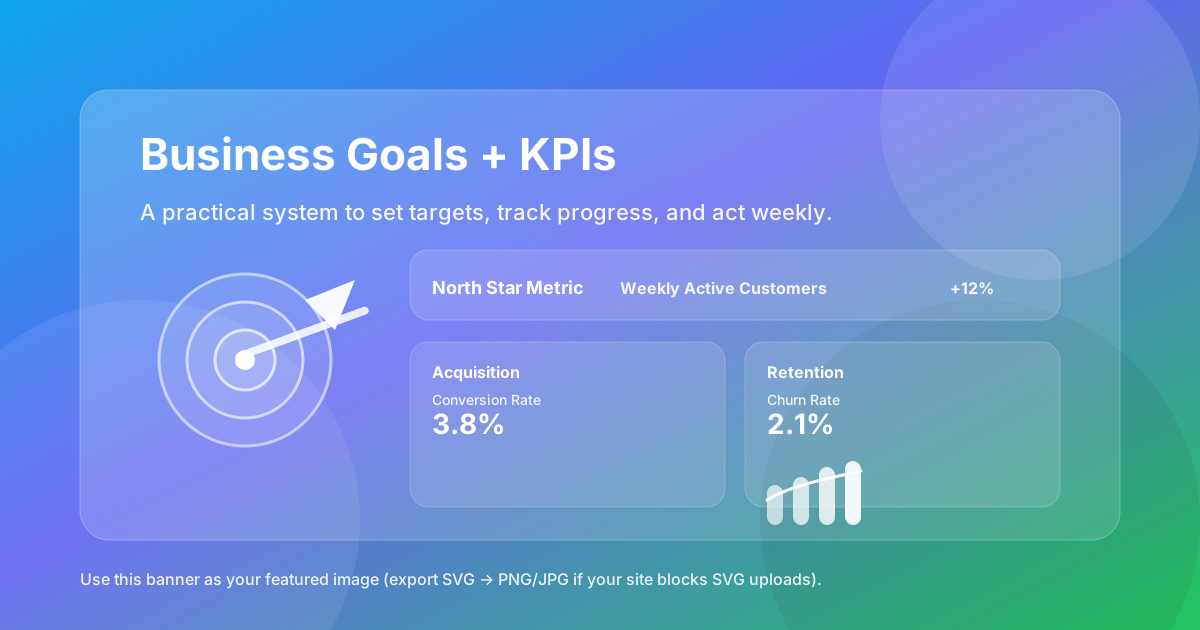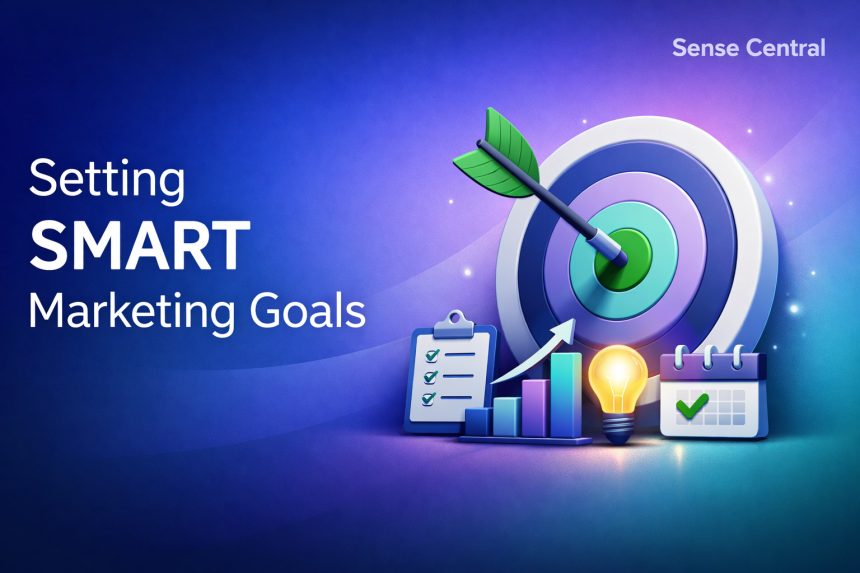

Setting marketing goals shouldn’t feel like guessing. In this guide, you’ll learn how to set SMART marketing goals that actually drive measurable results—whether you run a blog, grow an app, sell SaaS, or promote a local business. We’ll connect Digital Marketing strategy to practical execution: choosing the right metrics, defining targets, building timelines, and turning goals into weekly actions your team (or future you) can follow. Expect clear examples, copy-paste templates, checklists, and a step-by-step roadmap that helps you stop “doing marketing” and start building predictable growth.
- Table of Contents
- Why this matters
- How SMART goals improve Digital Marketing outcomes
- Who needs this most?
- What problems SMART goals solve
- Key concepts and definitions
- Core definitions (simple and practical)
- SMART breakdown with a fast checklist
- Mini glossary (useful marketing terms)
- Step-by-step roadmap
- Step 1: Start with the business outcome (not the channel)
- Step 2: Choose 1–2 primary channels and 2 supporting channels
- Step 3: Define the conversion action for each channel
- Step 4: Capture your baseline (last 30–90 days)
- Step 5: Pick a primary KPI and 2–3 supporting KPIs
- Step 6: Set SMART targets (and document assumptions)
- Step 7: Turn goals into a weekly execution plan (inputs → outputs)
- Step 8: Build tracking and dashboards (so you don’t “hope”)
- Step 9: Review weekly, optimize monthly, reset quarterly
- Step 10: Add one controlled experiment at a time
- Examples, templates, and checklists
- Copy-paste SMART marketing goals template
- Real examples (blogs, apps, SaaS, local business)
- Checklist: SMART goals setup (use before you launch any campaign)
- Table: Goal types and best KPIs (decision guide)
- Common mistakes and how to fix them
- 1) Setting vanity metrics as the main goal
- 2) No baseline (or using unrealistic peaks)
- 3) Too many goals at once
- 4) Confusing “strategy” with “tasks”
- 5) Tracking isn’t set up correctly
- 6) Goals aren’t relevant to the business stage
- 7) Timeframes are too short for the channel
- 8) No ownership (everyone is responsible)
- 9) Ignoring constraints (budget/time/creative)
- 10) Not reviewing and iterating
- 11) Misaligned incentives across teams
- 12) Not building conversion assets (landing pages, offers, onboarding)
- Tools and resources
- Free (or free tiers) — best for beginners
- Paid — best for teams, speed, and scaling
- Beginner vs advanced (what to pick)
- Advanced tips and best practices
- Use OKRs to connect team goals to SMART targets
- Build a “metrics pyramid” to avoid KPI chaos
- Use cohort thinking for apps and SaaS (retention is the hidden growth engine)
- Prioritize “high-leverage” improvements (the 80/20 inside your funnels)
- Set guardrails, not just targets (protect profitability)
- Scaling rule: prove repeatability before expanding channels
- FAQ
- 1) What is the difference between marketing goals and marketing KPIs?
- 2) How many SMART marketing goals should I set at once?
- 3) What’s a good timeframe for SMART goals in Digital Marketing?
- 4) How do I set achievable targets if I have little data?
- 5) What are the best SMART goal examples for bloggers?
- 6) What are the best SMART goal examples for apps?
- 7) What are the best SMART goal examples for SaaS?
- 8) What are the best SMART goal examples for local businesses?
- 9) What tools do I need to track SMART marketing goals?
- 10) Should I include revenue in every marketing goal?
- 11) How do I know if my goal is too ambitious or too easy?
- 12) What if I miss a SMART goal?
- Key takeaways
- Conclusion
Quick Answer: What are SMART marketing goals?
SMART marketing goals are goals that are Specific, Measurable, Achievable, Relevant, and Time-bound. In Digital Marketing, SMART goals turn vague intentions (“get more traffic”) into trackable outcomes (“grow organic sessions by 30% in 90 days”).
- Specific: Define exactly what you’ll improve (channel, offer, audience).
- Measurable: Choose a metric with a baseline and a target.
- Achievable: Set a target grounded in data and capacity.
- Relevant: Tie it to business outcomes (revenue, retention, leads).
- Time-bound: Set a deadline and review cadence (weekly/monthly).
Table of Contents
- Why this matters
- Key concepts and definitions
- Step-by-step roadmap
- Examples, templates, and checklists
- Common mistakes and how to fix them
- Tools and resources
- Advanced tips and best practices
- FAQ
- Key takeaways
- Conclusion
Why this matters
Most marketing fails for one simple reason: activity is mistaken for progress. Posting daily, running ads, and publishing content can feel productive—but without clear goals, it’s impossible to know what’s working, what to stop, and what to scale.
How SMART goals improve Digital Marketing outcomes
- Focus: You stop chasing every trend and prioritize what moves key metrics (leads, sales, retention).
- Speed: Clear targets make execution faster because decisions become “does this help the goal?”
- Measurement: You can attribute results to channels (SEO, email, social, paid, referrals).
- Accountability: Teams align on success criteria, timelines, and owners.
- Budget efficiency: You avoid spending on “nice to have” campaigns without ROI.
Who needs this most?
- Bloggers and publishers who want steady SEO traffic and email growth (not random spikes).
- App owners who need more installs, activation, retention, and paid upgrades.
- SaaS teams optimizing trials, demos, pipeline, and expansion revenue.
- Local businesses improving calls, bookings, walk-ins, and repeat customers.
- Solo founders who must choose 1–2 channels and win with limited time.
What problems SMART goals solve
- “We don’t know why growth slowed.”
- “Everyone’s busy, but results are unclear.”
- “We don’t know what to report to stakeholders.”
- “Our campaigns feel disconnected.”
- “We can’t prioritize: SEO vs ads vs social vs email.”
For related frameworks, see: Digital Marketing Metrics That Matter (Guide) and How to Build a Simple Marketing Funnel.
Key concepts and definitions
Before you set goals, you need shared language. The biggest confusion in Digital Marketing is mixing up goals, strategies, KPIs, and tasks.
Core definitions (simple and practical)
- Goal: The outcome you want (e.g., “Increase qualified leads”).
- Objective: A broader direction that may include multiple goals (e.g., “Grow B2B pipeline”).
- KPI (Key Performance Indicator): The metric that indicates success (e.g., MQLs, CAC, trial-to-paid).
- Metric: Any measurable number (pageviews, clicks, time on site).
- Baseline: Your current performance (last 30/90 days average).
- Target: The number you aim to reach (e.g., +25%).
- Constraint: Limits like budget, team size, seasonality, compliance.
- Leading indicators: Early signals (CTR, email signup rate) that predict outcomes.
- Lagging indicators: End results (revenue, subscriptions, bookings).
SMART breakdown with a fast checklist
- S — Specific: What channel? What audience? What action? What offer?
- M — Measurable: What metric proves success? How will you track it?
- A — Achievable: Is it realistic given historical performance and resources?
- R — Relevant: Will it impact revenue, retention, or strategic positioning?
- T — Time-bound: By when? How often will you review and adjust?
Mini glossary (useful marketing terms)
- Conversion rate (CVR): % of visitors who take a desired action.
- CAC: Customer acquisition cost (total acquisition spend / new customers).
- LTV: Lifetime value (revenue per customer over time).
- MQL/SQL: Marketing-qualified vs sales-qualified leads.
- Activation: The moment users reach “aha” value (app/SaaS).
- Retention: Users who continue using or buying over time.
- Organic traffic: Non-paid search traffic (SEO).
- Attribution: How you assign credit to channels and touchpoints.
Authority references for definitions and measurement standards include Google Analytics documentation, Google Ads help center, and HubSpot’s marketing resources.
Step-by-step roadmap
This roadmap works for any Digital Marketing setup. Follow the steps in order. If you skip baselines or tracking, your goals won’t be measurable—and you’ll be back to guessing.
Step 1: Start with the business outcome (not the channel)
- What to do: Decide the primary outcome: revenue, leads, installs, bookings, retention, or brand demand.
- Why it matters: Channels change. Outcomes keep you grounded.
- How to do it: Ask: “If this works, what will improve on the balance sheet?”
- Example: SaaS: “Increase paid subscriptions,” not “run more LinkedIn ads.”
- Pro tip: Pick one primary outcome per quarter to avoid scattered execution.
Step 2: Choose 1–2 primary channels and 2 supporting channels
- What to do: Select where you’ll concentrate efforts (SEO, email, paid search, social, partnerships).
- Why it matters: Focus compounds. Spreading thin kills velocity.
- How to do it: Choose based on audience intent, cycle length, and budget.
- Example: Blog: primary = SEO, supporting = email + Pinterest.
- Pro tip: Use “Best for / Avoid if” notes (below) to validate your channel picks.
Best for / Avoid if (channel quick notes):
- SEO: Best for compounding traffic; avoid if you need results in <30 days.
- Paid search: Best for high-intent offers; avoid if your landing pages are weak.
- Social: Best for awareness and community; avoid if you can’t post consistently.
- Email: Best for retention and repeat sales; avoid if you have no lead magnet.
Step 3: Define the conversion action for each channel
- What to do: Decide the “one action” each channel should drive.
- Why it matters: If everything is the goal, nothing is measurable.
- How to do it: Map each channel to a single conversion: signup, trial, call, booking, purchase.
- Example: Local business SEO page → “Call now” or “Book appointment.”
- Pro tip: Make the conversion action visible above the fold on landing pages.
Step 4: Capture your baseline (last 30–90 days)
- What to do: Record current metrics before setting targets.
- Why it matters: No baseline = no proof of improvement.
- How to do it: Pull reports from GA4, Search Console, Ads, email platform, app analytics.
- Example: Blog baseline: 50,000 organic sessions/month; 2.2% email opt-in rate.
- Pro tip: Use averages, not one-off peaks (to avoid unrealistic targets).
Step 5: Pick a primary KPI and 2–3 supporting KPIs
- What to do: Choose one KPI that defines success and supporting metrics that drive it.
- Why it matters: You need one “north star” per goal to avoid confusion.
- How to do it: For each goal, select:
- Primary KPI: outcome metric (bookings, trials, purchases, MQLs)
- Supporting KPIs: leading indicators (CTR, CVR, signup rate, activation rate)
- Example: App goal: Primary KPI = paid upgrades; Supporting KPIs = D1 retention, onboarding completion, paywall conversion.
- Pro tip: If a KPI cannot be influenced in 2–4 weeks, it’s probably too lagging for weekly management.
Step 6: Set SMART targets (and document assumptions)
- What to do: Write the goal in one sentence with metric + target + timeframe.
- Why it matters: Clarity forces alignment and reduces “interpretation.”
- How to do it: Use: “Increase [metric] from [baseline] to [target] by [date] via [channel/initiative].”
- Example: “Increase demo requests from 120/month to 180/month by May 31 using SEO landing pages and LinkedIn retargeting.”
- Pro tip: Write assumptions: budget, publishing pace, conversion rate expectations, seasonality.
Step 7: Turn goals into a weekly execution plan (inputs → outputs)
- What to do: Break the goal into weekly commitments (content, tests, outreach, ads).
- Why it matters: Outcomes are lagging; weekly inputs keep momentum.
- How to do it: Define:
- Inputs: actions you control (publish 2 articles/week)
- Outputs: results you measure (traffic, leads)
- Example: Blog: inputs = 8 SEO updates/month; outputs = +15% impressions in Search Console.
- Pro tip: Keep weekly tasks small enough to execute consistently.
Step 8: Build tracking and dashboards (so you don’t “hope”)
- What to do: Set up reporting for each KPI.
- Why it matters: Good Digital Marketing is measurement + iteration.
- How to do it: Use GA4 conversions, Search Console performance, CRM reports, and UTM tags.
- Example: UTM-tag all campaigns; track “signup_completed” as a GA4 conversion.
- Pro tip: Start simple: one dashboard that updates weekly beats complex reporting nobody checks.
External documentation: GA4 conversions overview, UTM parameters, Google Search Console performance report.
Step 9: Review weekly, optimize monthly, reset quarterly
- What to do: Create a cadence: weekly check, monthly deep dive, quarterly reset.
- Why it matters: Goals fail when measurement is irregular.
- How to do it:
- Weekly: check KPIs, blockers, next actions.
- Monthly: analyze what drove changes; run 1–2 experiments.
- Quarterly: keep/kill/scale decisions; set new SMART targets.
- Example: Local business: monthly review of calls/bookings by channel.
- Pro tip: Document decisions—future you will thank you.
Step 10: Add one controlled experiment at a time
- What to do: Test one variable (headline, offer, landing page, onboarding step).
- Why it matters: Random changes create random results.
- How to do it: Write hypothesis → define success metric → run test → learn → iterate.
- Example: SaaS: test shorter form vs longer form for demo requests; measure CVR.
- Pro tip: If you can’t explain what changed, you can’t repeat success.
Useful internal guides: Conversion Rate Optimization Checklist and SEO Content Refresh Workflow.
Examples, templates, and checklists
This section includes a copy-paste template, a practical checklist, and a decision table to help you choose the right KPIs for your business type.
Copy-paste SMART marketing goals template
SMART Goal Statement (copy/paste):
Increase [PRIMARY KPI] from [BASELINE] to [TARGET] by [DATE] by focusing on [PRIMARY CHANNEL] and supporting with [SECONDARY CHANNEL].
We will measure success weekly using [TRACKING TOOL/DASHBOARD].
Notes:
- Audience: [who exactly]
- Offer: [lead magnet / trial / booking / product]
- Key assumptions: [traffic, CVR, budget, publishing pace]
- Owner: [name/role]
- Review cadence: Weekly check-in; monthly optimization; quarterly reset
Real examples (blogs, apps, SaaS, local business)
- Blog (SEO + email): “Increase organic sessions from 50,000/month to 70,000/month by June 30 by publishing 12 SEO articles and refreshing 20 old posts; raise email opt-in rate from 2.2% to 3.0%.”
- App (growth + monetization): “Increase monthly installs from 8,000 to 10,500 by April 30 via ASO improvements and 3 influencer collaborations; increase trial-to-paid from 3.5% to 4.5% by improving paywall messaging.”
- SaaS (pipeline): “Increase qualified demo requests from 120/month to 180/month by May 31 through 8 new SEO landing pages and retargeting; maintain CAC under $350.”
- Local business (bookings): “Increase monthly bookings from 90 to 120 by March 31 by improving Google Business Profile, adding 30 new reviews, and launching a seasonal offer page; increase call conversion rate from 18% to 22%.”
Checklist: SMART goals setup (use before you launch any campaign)
- Goal is written as a single sentence with metric + target + deadline
- Baseline recorded (30–90 day average)
- Primary KPI chosen + 2–3 supporting KPIs
- Tracking set up (GA4 conversion / CRM / app events)
- Channel-to-conversion action mapped (one action per channel)
- Owner assigned + weekly commitments defined
- Budget/time constraints documented
- Review cadence scheduled (weekly/monthly/quarterly)
- One experiment planned (hypothesis + success metric)
Table: Goal types and best KPIs (decision guide)
| Business type | Primary goal focus | Best primary KPI | Supporting KPIs (leading indicators) | Best channels |
|---|---|---|---|---|
| Blog / Publisher | Traffic + subscribers | Organic sessions / Email subscribers | Impressions, CTR, opt-in rate, returning visitors | SEO, email, social distribution |
| Mobile App | Installs + retention + revenue | Paid upgrades / ARPU | Store conversion, onboarding completion, D1/D7 retention | ASO, paid UA, influencers, email/push |
| SaaS | Pipeline + conversions | Trials / Demo requests / New MRR | Landing CVR, activation rate, email nurture engagement | SEO, paid search, LinkedIn, partnerships |
| Local Business | Calls + bookings + repeat | Bookings / Calls | GBP views, direction requests, review velocity, website CVR | Google Business Profile, local SEO, paid search |
Want a deeper KPI map? See: Marketing KPI Dashboard Template.
Common mistakes and how to fix them
SMART goals fail when they’re written well—but executed poorly. These are the most common traps in Digital Marketing, plus practical fixes.
1) Setting vanity metrics as the main goal
- Problem: “Get 10,000 followers” without a plan to convert followers into customers.
- Fix: Make followers a supporting KPI and tie the primary KPI to leads, signups, or bookings.
2) No baseline (or using unrealistic peaks)
- Problem: Targets aren’t grounded in reality.
- Fix: Use 30–90 day averages; note seasonality and promotions.
3) Too many goals at once
- Problem: Execution becomes scattered; teams lose clarity.
- Fix: One primary outcome per quarter; max 2–3 SMART goals total.
4) Confusing “strategy” with “tasks”
- Problem: “Publish blog posts” is a task, not a goal.
- Fix: Goals are outcomes; strategies are plans; tasks are actions.
5) Tracking isn’t set up correctly
- Problem: You can’t measure what you’re aiming for.
- Fix: Set conversions in GA4/CRM/app events before launch; test with real traffic.
6) Goals aren’t relevant to the business stage
- Problem: Early-stage businesses chase scale without product-market fit.
- Fix: If early stage, prioritize activation, retention, and conversion rate improvements.
7) Timeframes are too short for the channel
- Problem: Expecting SEO to deliver in 2 weeks.
- Fix: Align timelines: SEO (8–16+ weeks), email (2–6 weeks), paid (days–weeks).
8) No ownership (everyone is responsible)
- Problem: Goals drift without a single accountable owner.
- Fix: Assign an owner and define weekly commitments and deadlines.
9) Ignoring constraints (budget/time/creative)
- Problem: Targets assume unlimited resources.
- Fix: Document constraints; set “minimum viable plan” inputs.
10) Not reviewing and iterating
- Problem: Goals are set once and forgotten.
- Fix: Weekly checks + monthly optimization + quarterly reset.
11) Misaligned incentives across teams
- Problem: Marketing optimizes volume while sales wants quality.
- Fix: Agree on qualification criteria (MQL/SQL), and track quality metrics.
12) Not building conversion assets (landing pages, offers, onboarding)
- Problem: Driving traffic to weak pages wastes effort.
- Fix: Improve landing pages and offer clarity before scaling acquisition.
Related reading: Landing Page Optimization for Higher Conversions.
Tools and resources
Below are practical tools to support goal-setting, tracking, and execution. Pick tools that match your stage—simple beats complex until you have consistent volume.
Free (or free tiers) — best for beginners
- Google Analytics (GA4): traffic and conversion tracking. https://analytics.google.com/
- Google Search Console: SEO performance and queries. https://search.google.com/search-console/
- Google Business Profile: local visibility and calls. https://www.google.com/business/
- Google Trends: demand and seasonality checks. https://trends.google.com/
- Looker Studio: dashboards and reporting. https://lookerstudio.google.com/
- Ahrefs Webmaster Tools (free): basic SEO audits. https://ahrefs.com/webmaster-tools
Paid — best for teams, speed, and scaling
- Ahrefs: SEO research and competitive analysis. https://ahrefs.com/
- Semrush: SEO + content + PPC insights. https://www.semrush.com/
- HubSpot: CRM + marketing automation. https://www.hubspot.com/
- Mailchimp: email marketing and automation. https://mailchimp.com/
- Hotjar: behavior analytics and heatmaps. https://www.hotjar.com/
- Optimizely: experimentation and A/B testing (advanced). https://www.optimizely.com/
Beginner vs advanced (what to pick)
- Beginner: GA4 + Search Console + Looker Studio + a spreadsheet goal tracker.
- Advanced: add a CRM, attribution modeling, experimentation, and cohort analysis.
External best-practice guidance: Google Ads measurement, Google business advice, Think with Google, Moz Beginner’s Guide to SEO, Backlinko SEO resources.
Advanced tips and best practices
Once you’ve set basic SMART goals, these frameworks help you improve quality, scale what works, and avoid common plateaus in Digital Marketing.
Use OKRs to connect team goals to SMART targets
OKRs (Objectives and Key Results) are useful when multiple teams contribute to one outcome. Your objective is the “why,” and key results are measurable targets. SMART goals can serve as key results.
- Objective: Improve trial-to-paid conversion for the SaaS product.
- Key Result (SMART): Increase trial-to-paid from 6.0% to 7.5% by June 30.
Build a “metrics pyramid” to avoid KPI chaos
- Level 1 (North Star): revenue, bookings, paid upgrades, MRR
- Level 2 (Core drivers): leads, trials, activation, repeat purchase
- Level 3 (Inputs): traffic, CTR, CVR, email clicks, outreach volume
Pro tip: If you improve Level 3 but Level 1 doesn’t move, your conversion assets or offer need work.
Use cohort thinking for apps and SaaS (retention is the hidden growth engine)
- What to measure: D1, D7, D30 retention; activation rate; churn; expansion.
- Why it matters: Acquisition without retention is a leaky bucket.
- How to apply: Create a SMART retention goal before scaling ads.
Prioritize “high-leverage” improvements (the 80/20 inside your funnels)
- High leverage examples: landing page headline, offer clarity, CTA placement, onboarding friction, pricing page.
- Avoid if: you’re trying to “optimize” tiny steps with no volume.
Set guardrails, not just targets (protect profitability)
SMART goals should include constraints like CAC, refund rate, margin, and support capacity.
- Example: “Increase new customers by 25% by May 31 while keeping CAC under $120 and churn under 4%.”
Scaling rule: prove repeatability before expanding channels
- Repeatability signals: stable conversion rate, predictable lead flow, consistent content ranking.
- When to expand: when one channel is producing consistent wins for 6–8 weeks.
FAQ
1) What is the difference between marketing goals and marketing KPIs?
A marketing goal is the outcome you want (like more bookings or trial signups). A KPI is the measurement that tells you whether you achieved that goal (like bookings per month or trial-to-paid conversion rate). In Digital Marketing, goals guide direction while KPIs keep you honest.
2) How many SMART marketing goals should I set at once?
For most individuals and small teams, 1 primary goal and 1–2 supporting goals per quarter is ideal. Too many goals dilute execution and make measurement noisy. If you can’t explain your priorities in one minute, you likely have too many.
3) What’s a good timeframe for SMART goals in Digital Marketing?
It depends on the channel. Paid campaigns can show measurable results within days or weeks, while SEO often needs 8–16+ weeks for meaningful movement. A common best practice is quarterly goal cycles with weekly check-ins.
4) How do I set achievable targets if I have little data?
Start with conservative targets and focus on building baselines first. Use industry benchmarks as a starting point, but treat them as directional—not guarantees. Your first SMART goal can be “establish baseline tracking and improve one conversion metric by X% in 30 days.”
5) What are the best SMART goal examples for bloggers?
Strong blog goals usually combine SEO growth (organic sessions, impressions) with conversion (email opt-in rate). For example: “Increase organic traffic by 25% in 90 days and grow email subscribers by 1,000 through improved CTAs and lead magnets.”
6) What are the best SMART goal examples for apps?
Apps benefit from goals that include retention and monetization, not just installs. A solid example is: “Increase D7 retention from 11% to 14% in 60 days and raise paid upgrade conversion from 3.5% to 4.2% by improving onboarding and paywall copy.”
7) What are the best SMART goal examples for SaaS?
SaaS goals often focus on pipeline (demos, trials) and conversion (activation, trial-to-paid, churn). A strong example is: “Increase qualified demo requests by 30% in 90 days while maintaining CAC under $350 through SEO landing pages and retargeting.”
8) What are the best SMART goal examples for local businesses?
Local businesses should focus on calls, bookings, and repeat customers. For example: “Increase bookings from 90 to 120 per month by March 31 by optimizing Google Business Profile, improving review velocity, and publishing local service pages.”
9) What tools do I need to track SMART marketing goals?
At minimum, you need a reliable analytics tool (GA4 or equivalent), a channel tracker (Search Console, Ads platform), and a simple dashboard or spreadsheet. As you scale, a CRM and attribution tracking become increasingly valuable for quality measurement.
10) Should I include revenue in every marketing goal?
Revenue is the end goal for most businesses, but it’s not always the best weekly management metric. Use revenue as a quarterly lagging indicator, and pair it with leading indicators you can influence quickly (conversion rate, qualified leads, activation). The key is relevance to your business stage.
11) How do I know if my goal is too ambitious or too easy?
If you’ve never achieved anything close to the target and you don’t have a plan to change inputs, it’s probably too ambitious. If you can hit it without changing anything, it’s too easy. Use baselines and capacity-based planning to find a realistic stretch target.
12) What if I miss a SMART goal?
Missing a goal is not failure if you learn and iterate. Review what moved (or didn’t), identify constraints, and adjust inputs or strategy. In Digital Marketing, consistency and improvement cycles matter more than perfect forecasting.
Key takeaways
- SMART goals turn vague marketing into measurable outcomes you can manage weekly.
- Start with business outcomes, then choose channels—never the other way around.
- Record baselines (30–90 days) before setting targets to avoid guesswork.
- Pick one primary KPI and 2–3 supporting KPIs per goal to reduce noise.
- Translate goals into weekly inputs (actions you control) and track outputs.
- Align timelines with channels: SEO needs time; paid can move fast.
- Review weekly, optimize monthly, and reset quarterly to maintain momentum.
- Use guardrails (CAC, churn, margin) so growth doesn’t destroy profitability.
- Scale only after you prove repeatability for 6–8 weeks in one channel.
Conclusion
SMART marketing goals are the bridge between strategy and results. When your Digital Marketing targets are specific, measurable, achievable, relevant, and time-bound, you make better decisions, execute faster, and build growth you can repeat. Start by recording your baseline, choosing one primary KPI, and translating your goal into weekly commitments. Then review consistently, run controlled experiments, and scale what works.