Circular permutation is the total number of ways in which n distinct objects can be arranged around a fix circle. It is of two types.
1. Case 1: – Clockwise and Anticlockwise orders are different.
2. Case 2: – Clockwise and Anticlockwise orders are same.
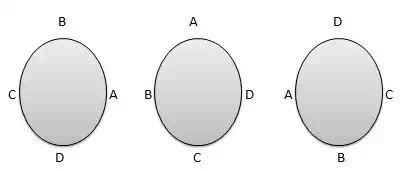
Case 1: Formula
Pn=(n−1)!Pn=(n−1)!
Where −
· PnPn = represents circular permutation
· nn = Number of objects
Case 2: Formula
Pn=n−1!2!Pn=n−1!2!
Where −
· PnPn = represents circular permutation
· nn = Number of objects
Example
Problem Statement:
Calculate circular permulation of 4 persons sitting around a round table considering i) Clockwise and Anticlockwise orders as different and ii) Clockwise and Anticlockwise orders as same.
Solution:
In Case 1, n = 4, Using formula
Pn=(n−1)!Pn=(n−1)!
Apply the formula
P4=(4−1)! =3! =6P4=(4−1)! =3! =6
In Case 2, n = 4, Using formula
Pn=n−1!2!Pn=n−1!2!
Apply the formula
P4=n−1!2! =4−1!2! =3!2! =62 =3