Linear elastic isotropic solid
The simplest type of stress-strain relation is that of the linear elastic solid, considered in circumstances for which |∂ui/∂Xj|<< 1 and for isotropic materials, whose mechanical response is independent of the direction of stressing. If a material point sustains a stress state σ11 = σ, with all other σij = 0, it is subjected to uniaxial tensile stress. This can be realized in a homogeneous bar loaded by an axial force. The resulting strain may be rewritten as ε11 = σ/E, ε22 = ε33 = −νε11 = −νσ/E, ε12 = ε23 = ε31 = 0. Two new parameters have been introduced here, E and ν. E is called Young’s modulus, and it has dimensions of [force]/[length]2 and is measured in units such as the pascal (1 Pa = 1 N/m2), dyne/cm2, or pounds per square inch (psi); ν, which equals the ratio of lateral strain to axial strain, is dimensionless and is called the Poisson ratio.
If the isotropic solid is subjected only to shear stress τ—i.e., σ12 = σ21 = τ, with all other σij = 0—then the response is shearing strain of the same type, ε12 = τ/2G, ε23 = ε31 = ε11 = ε22 = ε33 = 0. Notice that because 2ε12 = γ12, this is equivalent to γ12 = τ/G. The constant G introduced is called the shear modulus. (Frequently, the symbol μ is used instead of G.) The shear modulus G is not independent of E and ν but is related to them by G = E/2(1 + ν), as follows from the tensor nature of stress and strain. The general stress-strain relations are then
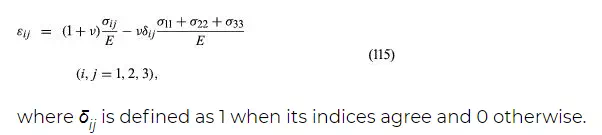
These relations can be inverted to read σij = λδij(ε11 + ε22 + ε33) + 2μεij, where μ has been used rather than G as the notation for the shear modulus, following convention, and where λ = 2νμ/(1 − 2ν). The elastic constants λ and μ are sometimes called the Lamé constants. Since ν is typically in the range 1/4 to 1/3 for hard polycrystalline solids, λ falls often in the range between μ and 2μ. (Navier’s particle model with central forces leads to λ = μ for an isotropic solid.)
Another elastic modulus often cited is the bulk modulus K, defined for a linear solid under pressure p(σ11 = σ22 = σ33 = −p) such that the fractional decrease in volume is p/K. For example, consider a small cube of side length L in the reference state. If the length along, say, the 1 direction changes to (1 + ε11)L, the fractional change of volume is (1 + ε11)(1 + ε22)(1 + ε33) − 1 = ε11 + ε22 + ε33, neglecting quadratic and cubic order terms in the εij compared to the linear, as is appropriate when using linear elasticity. Thus, K = E/3(1 − 2ν) = λ + 2μ/3.