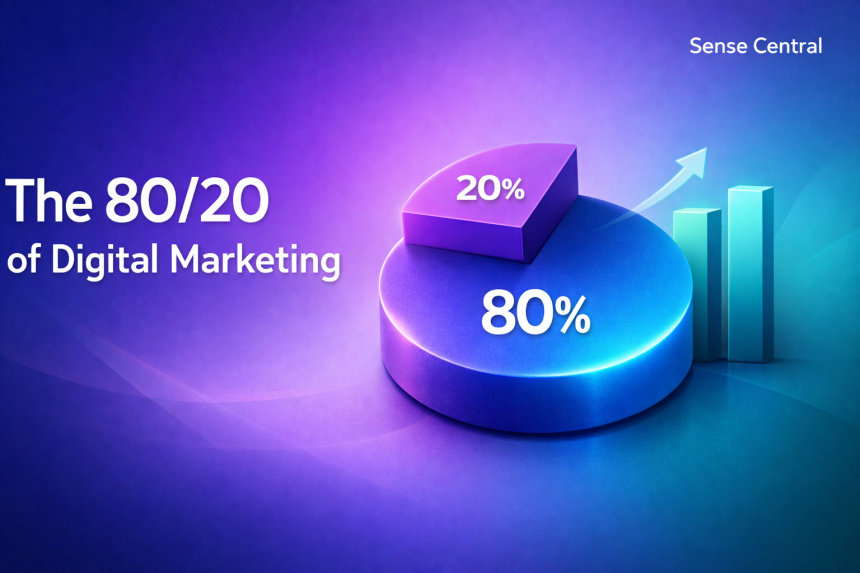

Most people don’t fail at Digital Marketing because they lack effort—they fail because they spend effort on low-impact work. The 80/20 principle (Pareto Principle) is the antidote: it helps you identify the few actions that drive the majority of outcomes, then double down with clarity and consistency.
- Why this matters
- Key concepts and definitions
- Step-by-step roadmap
- Step 1: Choose one measurable business goal (not a vague outcome)
- Step 2: Map your funnel in one page (Awareness → Conversion → Retention)
- Step 3: Identify your current “80% results” (profit driver audit)
- Step 4: Pick the highest-leverage constraint (offer, traffic, or conversion)
- Step 5: Build a “one-page scorecard” and track weekly
- Step 6: Prioritize improvements using a simple impact filter
- Step 7: Run one clean experiment at a time (and document learning)
- Step 8: Scale winners and cut losers (ruthlessly, kindly)
- Examples, templates, and checklists
- 1) Copy-paste template: 80/20 Digital Marketing Weekly Review
- 2) Checklist: 80/20 Marketing Audit (high-leverage items)
- 3) Decision table: What to focus on (80/20 priorities by stage)
- Mini case studies: what 80/20 looks like in real life
- Common mistakes and how to fix them
- Tools and resources
- Free (or free tiers): best for getting started
- Paid: best for scaling and deeper insights
- Beginner vs advanced: a practical stack recommendation
- Advanced tips and best practices
- 1) Optimize for “message-market fit” before channel expansion
- 2) Build a retention flywheel (often the highest ROI)
- 3) Treat CRO like a product discipline
- 4) Use cohort thinking (not averages)
- 5) Prefer “fewer, better” content assets
- 6) Scaling paid media: the 80/20 playbook
- FAQ
- 1) Does the 80/20 rule always apply in Digital Marketing?
- 2) What are the most common “80/20 levers” in marketing?
- 3) How do I find my top 20% activities quickly?
- 4) Is SEO or paid ads better for 80/20 growth?
- 5) What if I’m a beginner with no data yet?
- 6) How often should I review my marketing performance?
- 7) What metrics matter most for small businesses?
- 8) How do I avoid over-optimizing and missing brand building?
- 9) What’s the biggest hidden leak in most funnels?
- 10) Can 80/20 help with social media marketing?
- Key takeaways
- Conclusion
In this guide, you’ll learn how to spot your highest-leverage channels, pages, audiences, and offers; how to measure what matters; and how to build a simple system you can run weekly—whether you’re a beginner building your first funnel or an advanced marketer scaling campaigns.
Quick Answer: What is the 80/20 rule in Digital Marketing?
The 80/20 of Digital Marketing means focusing on the small set of inputs (channels, messages, audiences, pages, and offers) that produce most of your results (traffic, leads, sales, retention).
- Find your “profit drivers”: the top pages, campaigns, and segments responsible for most conversions.
- Prioritize high-leverage work: offer, landing page, conversion rate optimization (CRO), and retention over busywork.
- Measure the right metrics: conversion rate, CAC, LTV, and revenue per visitor—not vanity metrics.
- Cut or fix the rest: pause low-performing campaigns, simplify content, and remove funnel friction.
- Run weekly iterations: small experiments compound faster than occasional big “rebrands.”
Table of Contents
Why this matters
The internet rewards focus. Your audience’s attention is limited, ad costs fluctuate, algorithms change, and competitors copy tactics quickly. The only durable advantage is knowing what truly drives outcomes—and doing more of it.
What the 80/20 approach solves
- Overwhelm: Too many channels, too many tools, too many “must-do” tactics.
- Vanity metrics: Likes and impressions that don’t translate to pipeline or revenue.
- Leaky funnels: You pay for traffic, but lose people due to friction, weak offers, or unclear messaging.
- Random content: Posting frequently without a conversion plan or audience intent.
- Wasted spend: Running ads without measurement, attribution clarity, or landing page alignment.
Who needs this (and what you’ll gain)
- Beginners: A clear starting point that avoids “trying everything” and burning out.
- Creators and bloggers: A content marketing strategy tied to lead generation and monetization.
- Small businesses: A practical conversion funnel optimization plan that improves ROI.
- Advanced teams: A decision framework to scale performance marketing and retention marketing.
Best for: Anyone who wants measurable growth in traffic, leads, sales, or repeat customers with fewer moving parts.
Avoid if: You want a “hack” that works without tracking, testing, or improving your offer.
For foundational strategy, you can also review your own internal guides like Digital Marketing Basics and SEO Checklist for Beginners.
Key concepts and definitions
Before tactics, align on terms. The 80/20 method works best when you measure the same way consistently.
Simple definitions
- Pareto Principle (80/20): A pattern where a minority of inputs produce a majority of outputs. In marketing, a small set of channels, pages, offers, or audiences drives most results.
- Conversion: The action you want—email signup, demo request, purchase, booking, or upgrade.
- Conversion Rate (CVR): Conversions divided by visitors (or clicks). One of the highest-leverage metrics.
- CAC (Customer Acquisition Cost): Total acquisition spend divided by new customers acquired.
- LTV (Lifetime Value): Total profit you expect from a customer over time.
- Funnel: The journey from awareness to conversion to retention. Often tracked as stages.
- Attribution: How you assign credit for a conversion across touchpoints (ads, SEO, email, etc.).
Mini glossary (quick reference)
- Traffic quality: How likely visitors are to convert (intent matters more than volume).
- Offer: The value proposition + pricing + promise + proof + risk reversal (guarantee/returns).
- Landing page: A focused page designed to convert a specific audience from a specific source.
- CRO (Conversion Rate Optimization): Improving conversion through better messaging, UX, and testing.
- Retention marketing: Increasing repeat purchases, renewals, referrals, and customer lifetime value.
Authority references worth keeping open while you work:
- Google Analytics (GA4) documentation
- Google Search Central (Search Console resources)
- Google Ads
- Meta for Business
- Think with Google (research & insights)
- Moz Beginner’s Guide to SEO
- Ahrefs Blog (SEO and content strategy)
- HubSpot marketing resources
Step-by-step roadmap
This is the practical 80/20 roadmap you can run in cycles. The goal is to find your profit drivers, fix the biggest leaks, and scale what works—without expanding complexity.
Step 1: Choose one measurable business goal (not a vague outcome)
What to do: Pick one primary goal for the next 30–90 days (e.g., “increase qualified leads by 25%” or “raise ecommerce revenue by 15%”).
Why it matters: The 80/20 method fails when you measure everything. Focus creates clean data and faster learning.
How to do it:
- Define one primary conversion (purchase / lead / booking).
- Define one supporting metric (CVR, CAC, revenue per visitor, or trial-to-paid rate).
- Set a baseline using GA4 and your CRM/ecommerce platform.
Example: A local dental clinic sets a goal: “Increase appointment bookings from organic search from 40/month to 55/month.”
Pro tip: If you’re torn, choose the goal tied to cash flow (revenue, qualified leads, renewals) over awareness.
Step 2: Map your funnel in one page (Awareness → Conversion → Retention)
What to do: Create a simple funnel map and list the assets that support each stage.
Why it matters: Most wasted effort comes from creating content without a conversion destination or retention plan.
How to do it:
- Awareness: SEO pages, social posts, YouTube, ads, referrals.
- Conversion: landing pages, product pages, pricing pages, checkout, lead forms.
- Retention: email onboarding, post-purchase flows, community, support, upsells.
Example: A SaaS tool realizes it posts frequently on social (awareness) but has a weak trial onboarding sequence (retention), causing churn.
Pro tip: Keep the map brutally simple. One funnel per audience segment is enough to start.
For a deeper funnel structure, add your internal guide here: How Marketing Funnels Work.
Step 3: Identify your current “80% results” (profit driver audit)
What to do: Find the top sources and assets responsible for most conversions and revenue.
Why it matters: Your best growth lever is usually already working—it’s just underfunded or under-optimized.
How to do it:
- In GA4, check Traffic acquisition and Conversions by channel.
- List your top 10 landing pages by conversions (or assisted conversions).
- In ecommerce, check top products by revenue and margin.
- In email, find the top 20% of campaigns/automations producing most revenue.
Example: An ecommerce store learns 3 product pages drive 62% of revenue, and one blog post drives 40% of email signups.
Pro tip: Segment by device (mobile vs desktop). Mobile friction is a common hidden leak.
Step 4: Pick the highest-leverage constraint (offer, traffic, or conversion)
What to do: Decide what is currently limiting growth: traffic quality, conversion rate, or offer strength.
Why it matters: If you optimize the wrong constraint, you burn time and money.
How to do it:
- If traffic is low: Prioritize SEO and distribution for high-intent keywords, or targeted paid traffic.
- If traffic is high but conversions are low: Prioritize CRO, landing page clarity, trust signals, and checkout UX.
- If conversions exist but CAC is too high: Improve offer positioning, targeting, and retention to raise LTV.
Example: A service business gets website visits but few calls. The constraint is conversion (weak CTA, unclear pricing, no proof).
Pro tip: In many markets, the biggest lever is offer + landing page clarity—not another channel.
Step 5: Build a “one-page scorecard” and track weekly
What to do: Create a simple dashboard with 5–8 metrics that reflect outcomes, not noise.
Why it matters: What you measure is what you improve. A tight scorecard makes 80/20 decisions obvious.
How to do it:
- Pick 1 North Star metric (e.g., revenue, qualified leads, trial-to-paid conversions).
- Add 3–5 drivers (traffic, CVR, CAC, AOV, retention rate, email list growth).
- Track weekly trends, not daily fluctuations.
Example: A newsletter-based business tracks: new subscribers, open rate, clicks, conversions to paid, churn.
Pro tip: Use Looker Studio to keep reporting consistent and shareable.
Step 6: Prioritize improvements using a simple impact filter
What to do: Choose 1–3 actions that are most likely to move the scorecard within 14–30 days.
Why it matters: Strategy is selection. Doing more tasks is not the same as making progress.
How to do it:
- Brainstorm fixes and growth ideas.
- Score each by Impact, Confidence, and Effort (ICE scoring).
- Pick the top 1–3 and schedule them on the calendar.
Example: Instead of “post more on social,” a brand chooses “rewrite product page hero + add trust proof + improve checkout speed.”
Pro tip: Most teams under-estimate how much CRO and messaging can outperform “more traffic.”
Step 7: Run one clean experiment at a time (and document learning)
What to do: Test one change with a clear hypothesis and measure the result.
Why it matters: Multi-change chaos makes results impossible to interpret.
How to do it:
- Write: “If we change X for audience Y, then metric Z will improve because…”
- Define success criteria before launching.
- Run for long enough to reduce noise (often 1–2 weeks minimum, depending on volume).
Example: A SaaS changes onboarding email sequence (3 emails → 7 emails) to increase activation and reduce churn.
Pro tip: Keep a “Decision Log” in Notion or Google Docs so your team compounds learning.
Step 8: Scale winners and cut losers (ruthlessly, kindly)
What to do: Double down on what works; pause, fix, or remove what doesn’t.
Why it matters: Compounding only happens when you protect focus and budget.
How to do it:
- Increase spend/budget only after you’ve validated conversion and profitability.
- Repurpose winning messages across channels (SEO → ads → email → social).
- Stop low-intent content and campaigns that drain time without measurable outcomes.
Example: An ecommerce brand scales a profitable Google Shopping campaign while pausing broad, low-intent display ads.
Pro tip: If you can’t measure it, treat it as an experiment—not a core activity.
Examples, templates, and checklists
This section gives you practical assets you can copy, paste, and run today.
1) Copy-paste template: 80/20 Digital Marketing Weekly Review
Weekly 80/20 Review (15–30 minutes)
- North Star metric: [e.g., Revenue / Qualified Leads / Trials-to-Paid]
- What improved this week? (Top 3 drivers)
- What declined? (Top 3 leaks/friction points)
- Top 20% assets: List top pages/campaigns/emails by conversions.
- Decision: What will we scale? What will we fix? What will we stop?
- Next 7 days (1–3 priorities):
- Priority #1: [Action] → [Metric moved]
- Priority #2: [Action] → [Metric moved]
- Priority #3: [Action] → [Metric moved]
Add supporting process documentation via: Marketing Analytics Setup Guide.
2) Checklist: 80/20 Marketing Audit (high-leverage items)
- □ Identify top 3 channels driving conversions (not just traffic).
- □ Identify top 10 pages by conversion contribution (or assisted conversions).
- □ Identify top 3 audiences/segments by conversion rate and LTV.
- □ Review landing page clarity: headline, offer, CTA, proof, objections.
- □ Check mobile UX: page speed, form friction, readability, tap targets.
- □ Confirm conversion tracking works end-to-end (GA4 events, ad pixels, CRM).
- □ Evaluate CAC vs LTV (profitability check).
- □ Improve one retention lever: onboarding, win-back, upsell, referral.
- □ Create one “evergreen” content asset targeting high-intent search queries.
- □ Document learnings and update your scorecard weekly.
3) Decision table: What to focus on (80/20 priorities by stage)
| Funnel Stage | High-Leverage 80/20 Focus | Best Metrics | Common Low-ROI Busywork |
|---|---|---|---|
| Awareness | High-intent SEO pages, targeted paid search, distribution for proven content | Qualified sessions, CTR, engaged sessions, email signups | Posting daily without a conversion plan, chasing trends |
| Conversion | Offer positioning, landing page clarity, CRO, checkout optimization | CVR, revenue per visitor, CPA/CAC, form completion rate | Changing button colors endlessly, building pages without traffic |
| Retention | Onboarding flows, lifecycle email, customer support, upsells/referrals | LTV, repeat rate, churn, activation rate, NPS | Constant acquisition while ignoring churn and activation |
| Scaling | Budget expansion only on proven segments, creative iterations, automation | MER/ROAS, CAC payback, cohort LTV | Adding more channels before fixing measurement |
Mini case studies: what 80/20 looks like in real life
- Ecommerce: 5 SKUs drive most profit. The brand improves those product pages, adds bundles, and optimizes Shopping ads—revenue rises without more social posting.
- SaaS: One use case converts best. The team rewrites homepage messaging around that use case, improves onboarding, and reduces churn—LTV increases, allowing higher acquisition spend.
- Local services: A few “near me” keywords and one services page generate most calls. The business strengthens reviews, adds pricing clarity, improves mobile speed, and wins more bookings.
If you want a structured content plan, add your internal resource: Content Marketing Strategy Template.
Common mistakes and how to fix them
Most marketing underperformance is predictable. Here are common traps—and the practical fixes.
- Mistake: Optimizing for traffic volume instead of traffic intent.
Fix: Target high-intent queries, audiences, and placements. Prioritize keywords with clear commercial or problem-solving intent. - Mistake: Relying on vanity metrics (likes, impressions) as “success.”
Fix: Tie every channel to a measurable conversion path. Track CVR, CAC, and revenue per visitor. - Mistake: Spreading efforts across too many platforms.
Fix: Commit to 1–2 primary acquisition channels and 1 retention channel until results stabilize. - Mistake: Weak offer clarity (what you do, who it’s for, why it’s better).
Fix: Rewrite the above-the-fold section: clear promise + proof + CTA. Use testimonials, comparisons, and guarantees where appropriate. - Mistake: Sending paid traffic to generic pages.
Fix: Use dedicated landing pages matching the ad message and audience intent. - Mistake: Ignoring mobile UX and speed.
Fix: Audit using PageSpeed Insights and fix the top issues impacting load and interactivity. - Mistake: No retention system (you “re-acquire” the same customers repeatedly).
Fix: Build onboarding, post-purchase, win-back, and upsell email flows. Consider Mailchimp or similar tools for lifecycle automation. - Mistake: Not knowing what drives conversions (attribution confusion).
Fix: Standardize tracking: GA4 events, UTM parameters, and platform pixels. Use UTM guidance to keep data clean. - Mistake: Running too many experiments at once.
Fix: One hypothesis per experiment. Document before/after and stop if it doesn’t move your scorecard. - Mistake: Publishing content without a lead capture or next step.
Fix: Add contextual CTAs, lead magnets, and internal links. (Example internal guide: Lead Generation Ideas.)
Tools and resources
The right tools reduce friction and increase measurement quality. The wrong tools create noise. Use this list as a practical shortlist.
Free (or free tiers): best for getting started
- Google Analytics (GA4): core measurement for sites and funnels. Docs
- Google Search Console: SEO performance, indexing, and search queries. Overview
- Looker Studio: dashboards and scorecards. Tool
- Google Trends: demand signals and seasonality. Tool
- Microsoft Clarity: session replays and heatmaps. Tool
Best for: Beginners building measurement discipline and finding obvious UX friction.
Avoid if: You won’t check data weekly. Tools don’t create outcomes—habits do.
Paid: best for scaling and deeper insights
- Google Ads: high-intent acquisition when tracked properly. Platform
- Meta Ads: demand generation + retargeting. Platform
- Ahrefs / Semrush: SEO research and competitive analysis. Ahrefs | Semrush
- HubSpot: CRM + automation for lead nurturing. Platform
- Hotjar: behavior insights and on-page feedback. Tool
- Zapier: workflow automation across tools. Tool
Beginner vs advanced: a practical stack recommendation
- Beginner stack: GA4 + Search Console + Looker Studio + Clarity + Email platform
- Advanced stack: Add SEO suite + CRM + heatmaps + experimentation tools + automation
For channel-specific playbooks, link internally to your own resources such as Email Marketing Fundamentals and Beginner’s Guide to PPC.
Advanced tips and best practices
Once you’ve stabilized the basics, 80/20 becomes a scaling engine. These tactics are about compounding advantage, not adding complexity.
1) Optimize for “message-market fit” before channel expansion
- Test 3–5 value proposition angles (speed, cost, simplicity, outcomes, risk reduction).
- Use the winning message across SEO titles, ad creatives, landing pages, and email.
- Look for consistent lift in conversion rate across multiple channels—this is true leverage.
2) Build a retention flywheel (often the highest ROI)
Many businesses can grow faster by keeping customers longer than by acquiring more customers.
- Onboarding: reduce time-to-value with clear next steps.
- Lifecycle email: education, social proof, use cases, and nudges.
- Win-back: targeted offers for lapsed users.
- Referral loop: incentives that match your margin and audience motivation.
3) Treat CRO like a product discipline
- Fix the “first screen” on key pages: headline, promise, CTA, proof.
- Use friction killers: fewer form fields, clearer pricing, transparent shipping/returns.
- Improve page speed, especially on mobile (often immediate ROI).
4) Use cohort thinking (not averages)
Averages hide the truth. Segment your data to find your real 80/20.
- New vs returning visitors
- Mobile vs desktop
- Paid vs organic
- High-intent pages vs informational pages
- First-time buyers vs repeat buyers
5) Prefer “fewer, better” content assets
In content marketing, a handful of strong evergreen assets often outperform dozens of short posts.
- Create one “pillar” piece per topic cluster.
- Update top performers quarterly (freshness + accuracy).
- Build internal linking intentionally to strengthen topical authority.
For internal architecture, add your own resource: Internal Linking Strategy.
6) Scaling paid media: the 80/20 playbook
- Scale budgets only on campaigns with proven conversion + margin.
- Expand from winners: top audiences, top creatives, top landing pages.
- Iterate creatives more than targeting when targeting is already aligned.
- Use platform best practices and documentation, not forum myths:
FAQ
1) Does the 80/20 rule always apply in Digital Marketing?
Not as a strict mathematical law, but as a practical pattern. In many accounts, a small set of channels, pages, or audiences tends to produce the majority of conversions. The value is using it as a prioritization lens, not as a rigid formula.
2) What are the most common “80/20 levers” in marketing?
Offer clarity, landing page UX, conversion rate optimization, high-intent SEO pages, retention flows, and measurement discipline. These often outperform “more posting” or adding new channels prematurely.
3) How do I find my top 20% activities quickly?
Start with GA4: identify top channels and landing pages by conversions. Then check your CRM/ecommerce platform for top segments and products. You’re looking for concentration—where outcomes cluster.
4) Is SEO or paid ads better for 80/20 growth?
It depends on your constraint and timeline. SEO can be a powerful long-term asset, while paid ads can validate offers quickly. Many brands use paid to test messaging and SEO to compound sustainable traffic.
5) What if I’m a beginner with no data yet?
Begin with a simple funnel and tracking setup, then run a small number of focused actions for 2–4 weeks. Data doesn’t need to be perfect to reveal early signals—just consistent and comparable.
6) How often should I review my marketing performance?
Weekly is ideal for most teams. It’s frequent enough to adjust course and slow enough to avoid reacting to noise. Use a one-page scorecard and a short decision meeting.
7) What metrics matter most for small businesses?
Qualified leads (or purchases), conversion rate, CAC/CPA, and revenue per visitor are usually the most useful. If retention matters, add repeat purchase rate or churn depending on your model.
8) How do I avoid over-optimizing and missing brand building?
Separate your plan into two buckets: measurable performance work and intentional brand assets. Keep brand work purposeful (clear positioning, proof, and consistent messaging) and still connect it to funnel outcomes over time.
9) What’s the biggest hidden leak in most funnels?
Clarity and trust. Visitors often don’t convert because the offer is unclear, the next step feels risky, or proof is missing. Fixing above-the-fold messaging and adding credibility signals can create disproportionate lift.
10) Can 80/20 help with social media marketing?
Yes—most accounts find that a small set of post formats, topics, and hooks drive the majority of engagement and clicks. Identify those winners, repurpose them across platforms, and connect them to a conversion destination.
Key takeaways
- The 80/20 of Digital Marketing is about focusing on the few inputs that produce most conversions and revenue.
- Start with one measurable goal and a simple funnel map.
- Audit profit drivers: top channels, pages, segments, products, and emails.
- Identify your constraint: traffic quality, conversion rate, or offer strength.
- Track weekly with a one-page scorecard and make 1–3 high-impact decisions.
- Prioritize CRO and retention—often the fastest, highest-leverage wins.
- Scale winners, cut losers, document learnings, and compound improvement.
- Use tools to support habits, not replace strategy.
- Focus beats complexity: fewer initiatives, better execution, clearer measurement.
Conclusion
If you want better results in Digital Marketing, the fastest path is rarely “doing more.” It’s doing less—but doing the right less. The 80/20 approach helps you identify what’s already working, fix the biggest leaks, and scale the few assets that actually move outcomes.
Next steps: run the profit driver audit, set up a weekly scorecard, and choose one constraint to improve over the next 14–30 days. Once you see lift, repeat the cycle and scale carefully.
Continue learning with these internal resources: