




When a beam is subjected to a loading system or by a force couple acting on a plane passing through the axis, then the beam deforms. In simple terms, this axial deformation is called as bending of a beam. Due to the shear force and bending moment, the beam undergoes deformation. These normal stress due to bending are called flexure stresses.
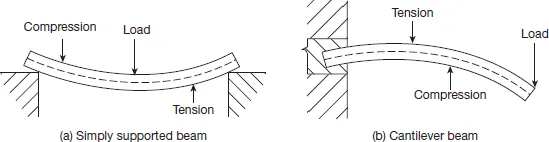
Fig 1: Types of bending stress in a beam section
Assumptions to calculate bending stress
These stresses formed in the material due to bending can be calculated using certian assumption, they are
1. Beam is initially straight , and has a constant cross-section.
2. Beam is made of homogeneous material and the beam has a longitudinal plane of symmetry.
3. Resultant of the applied loads lies in the plane of symmetry.
4. The geometry of the overall member is such that bending not buckling is the primary cause of failure.
5. Elastic limit is nowhere exceeded and ‘E’ is same in tension and compression.
6. Plane cross – sections remains plane before and after bending.


