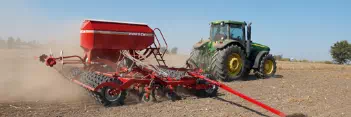
Establishing a plant population that is too high can lead to overly thick canopies, increased lodging, higher disease pressure and unnecessary expenditure on seed. Conversely, seed rates that are too low will result in lower yields and higher weed pressure. Variable rate seed can help to determine the optimum seed rate for improved crop management, health and profitability.
As well as grain weight, drilling date and variety there are many variable factors that also need to be considered such as soil texture, stoniness, cloddiness and general seed bed quality. All of these can vary across a field. By mapping this variation in the potential seed bed quality, a seed rate map can be produced that will indicate how much seed should be sown at each point across the field for maximum results.
Stage 1 – Conductivity survey
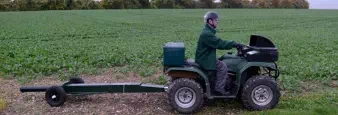
First, a survey of the soil’s physical properties is undertaken. This starts with a detailed electrical conductivity survey, as conductivity has a correlation with clay content, soil depth, stoniness and moisture content. All of these factors are important in seed bed creation.
Stage 2 – Zoning
The conductivity map is used as the basis for undertaking a physical soil survey. Areas of similar conductivity values are zoned and then ground-truthed by an experienced soil scientist.
Each zone is assessed for texture, slope, stone content, soil depth to subsoil and compaction. This allows potential seed rate zones to be created.

Stage 3 – Calculate seed rates
Each zone is then assessed for the potential seed bed quality and plant losses that could occur over winter. An area of high clay or stone content, for example, may have high plant losses and a higher seed rate is required to compensate for this. The difference in potential establishment can be used to vary the seed rate around the default rate which is controlled by drilling date and thousand grain weight.

Stage 4 – Create variable seed rate application file
The variable seed rate map, once finalised, is converted into a digital file that is compatible with GPS kit used with a seed drill controller.