

Sweep efficiency. A measure of the effectiveness of an enhanced oil recovery process that depends on the volume of the reservoir contacted by the injected fluid. The volumetric sweep efficiency is an overall result that depends on the injection pattern selected, off-pattern wells, fractures in the reservoir, position of gas-oil and oil/water contacts, reservoir thickness, permeability and areal and vertical heterogeneity, mobility ratio, density difference between the displacing and the displaced fluid, and flow rate.
Reservoirs are formed over long periods of time in a variety of depositional environments. After deposition, physical, biological, and chemical reorganization occur. As none of these processes necessarily occur uniformly in time or space, it is understandable that reservoirs are generally very heterogeneous. All intensive properties of the reservoir such as permeability, porosity, wettability, connate water saturation, crude oil properties, and pore size distributions are likely to be non-uniform. Of these, permeability variations are considered most frequently in the literature. Craig (1980)
[1] gives a detailed review of reservoir heterogeneity and considers three general types of reservoir heterogeneities. These are: areal permeability variations, vertical permeability stratification and reservoir scale fractures. Others (Allsop, 1988[2]) use alternative terminology: microscopic, mesoscopic, macroscopic or megascopic heterogeneities.
One consequence of reservoir heterogeneities is that the displacement front of any injected fluid will move as an irregular front and must be properly considered in reservoir calculations. For instance, a measure of the uniformity of water invasion is termed vertical sweep efficiency (EI) and is defined as the cross sectional area enclosed in all layers behind the injected fluid front. As such, the vertical sweep efficiency is a measure of the two dimensional (i.e. vertical cross-section) effect of reservoir non-uniformities (Figure 4‑23).
The volumetric sweep efficiency, Ev, is a measure of the three-dimensional effect of reservoir heterogeneities. It is defined as the product of the pattern areal sweep and the vertical sweep as shown in the following equation:
Where,
EA = areal sweep efficiency,
Ad = area of displacement,
AR = area of reservoir,
∅ = porosity,
S = gas or oil saturation.
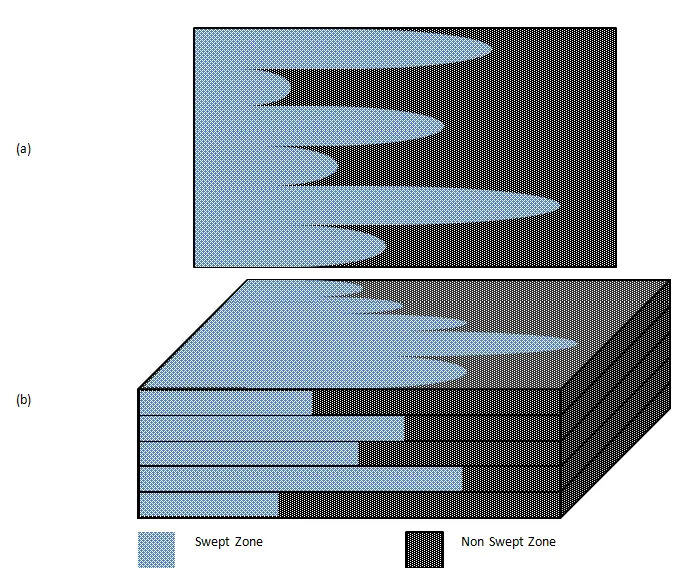
Figure 4-23: Schematic Representation of the Two Components of the Volumetric Sweep: (a) Areal Sweep; (b) Vertical Sweep in Stratified Formation