
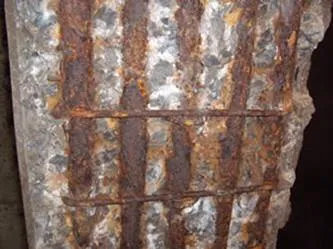
The corrosion of steel reinforcement inside a concrete structure is undesirable in the following ways:
(i) The presence of rust impairs the bond strength of deformed reinforcement because corrosion occurs at the raised ribs and fills the gap between ribs, thus evening out the original deformed shape. In essence, the bond between concrete and deformed bars originates from the mechanical lock between the raised ribs and concrete. The reduction of mechanical locks by corrosion results in the decline in bond strength with concrete.
(ii) The presence of corrosion reduces the effective cross sectional area of the steel reinforcement. Hence, the available tensile capacity of steel reinforcement is reduced by a considerable reduction in the cross sectional area.
(iii) The corrosion products occupy about 3 times the original volume of steel from which it is formed. Such drastic increase in volume generates significant bursting forces in the vicinity of steel reinforcement. Consequently, cracks are formed along the steel reinforcement when the tensile strength of concrete is exceeded.
What is the difference between carbonation and carbon dioxide attack?
For carbon dioxide attack, carbon dioxide dissolves in water to form a weak acid called carbonic acid. It would dissolve the cement matrix. However, the amount of carbon dioxide from the atmosphere is usually not sufficient to cause harm to concrete structures until additional source of carbon dioxide is available (e.g. decaying vegetable matter).
Carbonation is the process of converting alkaline hydroxides in concrete to carbonates by reaction with carbon dioxide. The significance of carbonation lies in the reduction of pH of pore water in concrete structure from 12-13 to 8-9 so that it drops the protection to steel reinforcement. The process takes place at concrete surface and spreads inwards. The passive nature play an important role in steel corrosion as it prevents corrosion even in the presence of water and oxygen. This passive nature is derived from a stable and thin layer of iron oxide formed at the surface of steel reinforcement. However, if the pH of concrete is dropped, this passive oxide layer becomes unstable and corrosion may start once water and oxygen supply is available