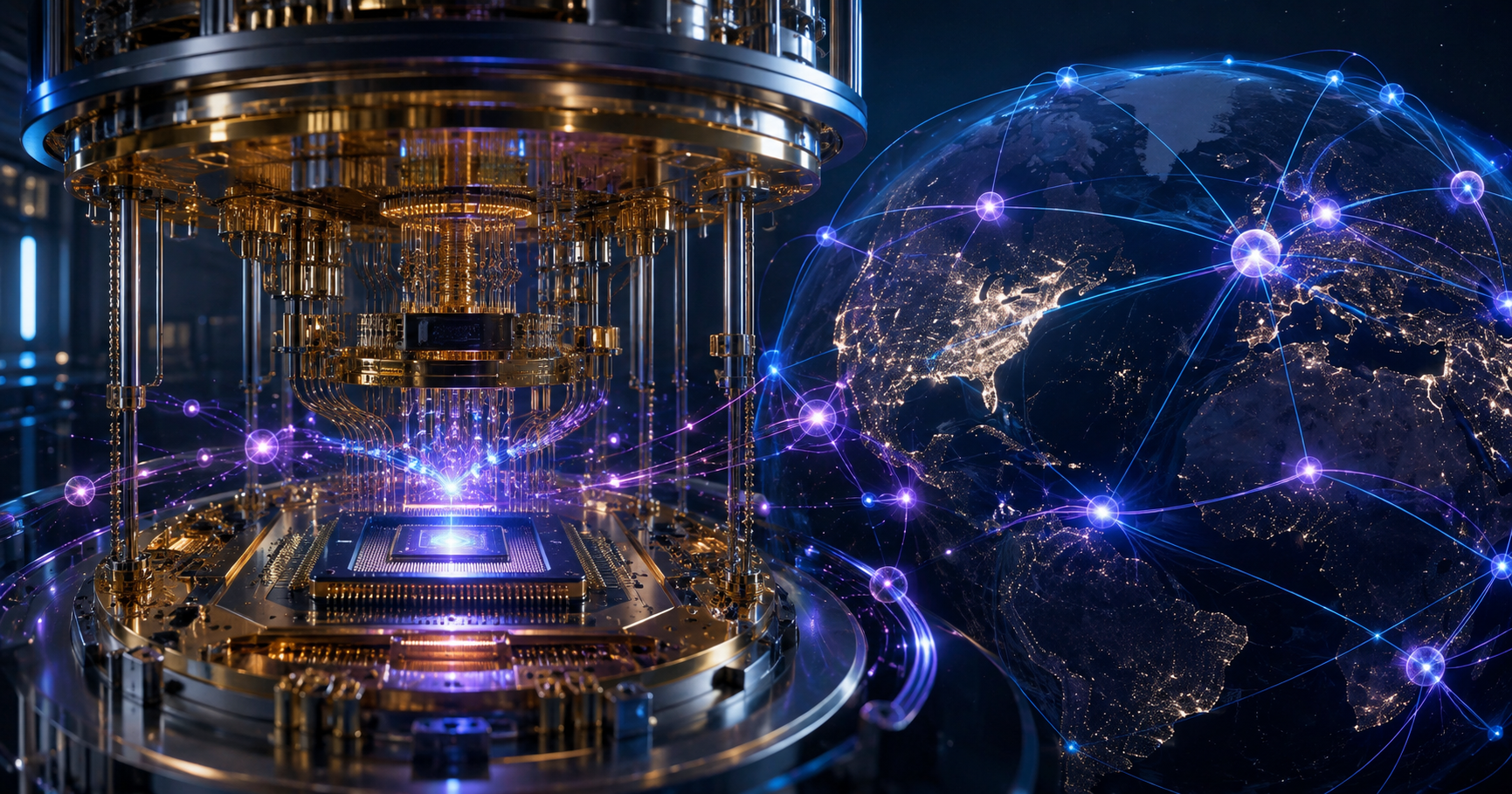
Quantum computing and quantum communication are among the most important—and most misunderstood—areas of emerging technology. They are often described as revolutionary technologies capable of transforming medicine, cybersecurity, finance, materials science and artificial intelligence. Although these possibilities are scientifically credible, many remain research goals rather than everyday commercial capabilities.
- Table of Contents
- What Is Quantum Computing?
- How Quantum Computers Differ from Classical Computers
- What Is a Qubit?
- Superposition, Entanglement and Interference
- How Quantum Calculations Are Performed
- Major Types of Quantum-Computing Hardware
- Classical Computers, Supercomputers and Quantum Computers
- Potential Applications of Quantum Computing
- Quantum Computing in Medicine and Materials Science
- Finance, Optimisation and Artificial Intelligence
- What Quantum Computers Cannot Do
- What Is Quantum Communication?
- Quantum Cryptography and Quantum Key Distribution
- The Idea of a Quantum Internet
- Quantum Communication, Quantum Encryption and Post-Quantum Cryptography
- Present Limitations of Quantum Technology
- Decoherence
- Noise and Error Rates
- Cooling and Environmental Control
- Scalability
- Software Development
- Infrastructure Costs
- Quantum Error Correction
- Cybersecurity and Post-Quantum Cryptography
- Business Implications
- Future Outlook for Quantum Computing and Quantum Communication
- Frequently Asked Questions
- 1. Are quantum computers faster than classical computers?
- 2. Can quantum computers break all encryption?
- 3. Is quantum communication completely secure?
- 4. What is the difference between a quantum internet and the normal internet?
- 5. Should businesses invest in quantum computing now?
- Conclusion
A quantum computer is not simply a faster laptop, server or supercomputer. It represents and processes information according to the principles of quantum mechanics—the branch of physics that describes how matter and energy behave at extremely small scales. Quantum systems may approach certain specialised calculations differently from classical computers, but they are not automatically superior for every task.
Quantum communication applies related physical principles to the transmission of quantum information. Its potential applications include quantum key distribution, interconnected quantum sensors and future quantum networks. However, a large-scale quantum internet capable of connecting fault-tolerant quantum computers remains a potential future development rather than a replacement for today’s internet.
What Is Quantum Computing?
Quantum computing is a form of information processing that uses controllable quantum systems as computational resources. Instead of storing information only as ordinary binary bits, quantum computers use quantum bits, or qubits. A qubit can be created from several physical systems, including trapped ions, superconducting electrical circuits, neutral atoms, photons and electron spins.
A quantum processor manipulates qubits through carefully controlled physical operations. These operations are arranged into quantum circuits designed to increase the probability of measuring useful answers. The process uses properties such as superposition, entanglement and interference, but it does not provide unrestricted access to every possible answer at once.
Quantum computing is best understood as a specialised computational approach—not as a universal replacement for classical computing.
Most future computing environments are expected to be hybrid. Classical processors will continue to manage operating systems, databases, user interfaces, networking and most everyday calculations. Quantum processors may be used as specialised accelerators for carefully selected parts of certain scientific or mathematical problems.
How Quantum Computers Differ from Classical Computers
A classical computer processes bits that are represented as definite values: either 0 or 1. Its processor performs logical operations on these bits through electronic circuits. Modern computers can perform billions or trillions of operations per second, while supercomputers combine large numbers of processors to handle enormous workloads.
A quantum computer works with amplitudes associated with quantum states. Quantum gates alter these amplitudes, including their relative phases. A well-designed quantum algorithm uses interference so that paths associated with useful results are strengthened while less useful paths are weakened.
This difference does not mean a quantum computer tries every answer, reads all of them and instantly selects the best one. Measurement produces limited classical information. The algorithm must therefore structure the computation so that the desired result is likely to appear when the qubits are measured.
Quantum speedups are also problem-dependent. Some algorithms offer major theoretical improvements for specific tasks, while many ordinary problems receive no known quantum advantage. Email, web browsing, word processing, video playback and basic business applications remain better suited to conventional hardware.
What Is a Qubit?
A qubit is the basic unit of quantum information. Like a classical bit, it produces either 0 or 1 when measured in the computational basis. Before measurement, however, its state can be described as a combination of the 0 and 1 states, each with an associated amplitude and phase.
A spinning coin is sometimes used as an analogy, but it must be treated carefully. A hidden classical coin already has an ordinary physical state, even when nobody is looking at it. A qubit is governed by quantum amplitudes that can interfere. This phase-sensitive behaviour is what makes a quantum superposition different from ordinary uncertainty.
Qubits are extremely delicate. Heat, vibration, electromagnetic radiation, manufacturing imperfections and unwanted interactions with the surrounding environment can disturb their states. Much of quantum engineering is therefore concerned with creating, controlling and measuring qubits while protecting them from noise.
Superposition, Entanglement and Interference
Superposition
Superposition allows a quantum state to contain amplitudes corresponding to multiple measurement outcomes. With several qubits, a processor can represent a state involving many possible bit strings. However, measurement does not reveal a complete list of all those possibilities. It returns one result according to probabilities determined by the state.
Entanglement
Entanglement is a quantum relationship in which the state of a group of qubits must be described collectively rather than as independent components. Measurements of entangled particles can display correlations that cannot be reproduced by ordinary classical models.
Entanglement is important in many quantum algorithms and communication protocols, but it does not enable messages to travel faster than light. Classical communication is still required to interpret or use the results of many entanglement-based protocols.
Interference
Interference is central to useful quantum computation. Quantum amplitudes can combine constructively, increasing the probability of an outcome, or destructively, reducing it. A quantum algorithm is designed to control this interference rather than merely creating a large superposition.
How Quantum Calculations Are Performed
Many quantum programs are expressed as circuits. A simplified workflow includes the following steps:
- Initialisation: The qubits are prepared in a known starting state.
- State preparation: Quantum gates create appropriate superpositions and relationships among qubits.
- Controlled operations: Additional gates perform the transformations required by the algorithm.
- Interference: The circuit changes the amplitudes so that useful outcomes become more likely.
- Measurement: The qubits are converted into classical results.
- Repetition: The circuit is usually executed many times to estimate an output distribution.
- Classical analysis: Conventional software processes, validates or optimises the measured results.
Some quantum algorithms also use a hybrid loop. A classical computer selects parameters, the quantum processor evaluates a circuit and the classical computer updates those parameters. This pattern is common in experimental optimisation and quantum simulation research.
Programming a quantum system requires more than translating ordinary software into a quantum language. Developers must consider qubit connectivity, circuit depth, gate errors, measurement noise and the mathematical structure of the target problem.
Major Types of Quantum-Computing Hardware
There is no single universally accepted hardware platform for quantum computing. Different approaches offer different trade-offs in operating temperature, control, connectivity, manufacturing and error performance. NIST identifies several major research platforms, including trapped ions, neutral atoms, superconducting circuits and photons.
- Superconducting qubits: These use microscopic electrical circuits operated at extremely low temperatures. They can support fast gate operations and use fabrication methods related to semiconductor manufacturing, but they require complex cryogenic systems.
- Trapped-ion qubits: Electrically charged atoms are suspended in electromagnetic traps and controlled with lasers or electromagnetic fields. They can provide high-quality operations, although gate speed and system scaling present engineering challenges.
- Neutral-atom qubits: Uncharged atoms are held and arranged using optical traps. Their configurable layouts make them attractive for digital quantum computing and quantum simulation.
- Photonic quantum computing: Photons carry quantum information through optical components. Photons are also natural candidates for quantum communication, although creating reliable interactions, memories and detectors remains challenging.
- Semiconductor spin qubits: These encode information in the spin states of electrons or atomic nuclei. They may benefit from established semiconductor techniques, but controlling large arrays precisely is difficult.
- Quantum annealing: Annealing systems are designed around a specialised optimisation model. They differ from universal gate-based quantum computers and are not suitable for executing every quantum algorithm.
Classical Computers, Supercomputers and Quantum Computers
| Computer Type | Information Unit | Operating Principle | Ideal Applications | Strengths | Limitations | Current Maturity |
|---|---|---|---|---|---|---|
| Classical computer | Bit represented as 0 or 1 | Electronic logic gates perform deterministic or conventionally probabilistic operations | Business software, websites, databases, communication, media and general computing | Reliable, affordable, widely available and supported by mature software | Some scientific simulations and combinatorial problems become extremely expensive as size increases | Fully mature and commercially widespread |
| Supercomputer | Classical bit | Large numbers of CPUs, GPUs and accelerators operate in parallel | Weather modelling, engineering, AI training, physics simulations and large-scale data analysis | Extremely high classical performance with established programming methods | High energy, infrastructure and operating costs; still limited by classical algorithm complexity | Highly mature and used by research institutions, governments and industry |
| Quantum computer | Qubit | Quantum gates control superposition, entanglement, phase and interference | Potentially useful for selected simulations, cryptographic algorithms, optimisation structures and scientific calculations | May provide substantial advantages for certain specialised algorithms | Noise, decoherence, error-correction overhead, limited scale, difficult programming and high infrastructure costs | Early-stage systems are available for research and experimentation; large fault-tolerant systems remain under development |
Potential Applications of Quantum Computing
The strongest potential applications are generally problems with mathematical or physical structures that can be exploited by quantum algorithms. A quantum processor must provide more than a theoretical speedup: it must also outperform the best practical classical method after accounting for error correction, data preparation, execution time and result verification.
Potential areas include:
- Molecular and chemical simulation
- Drug-discovery research
- Battery, catalyst and materials development
- Selected complex optimisation problems
- Cryptographic analysis
- Scientific modelling
- High-energy and condensed-matter physics
- Specialised linear-algebra and sampling tasks
Many proposed use cases remain experimental. Demonstrating a small quantum calculation is not the same as proving that it is faster, cheaper or more accurate than a strong classical alternative in a commercial environment.
Quantum Computing in Medicine and Materials Science
Molecules are quantum systems. Their electrons interact according to quantum mechanics, and calculating their behaviour exactly becomes extremely difficult as molecular complexity increases. Quantum computers may eventually provide more natural methods for simulating selected molecular properties.
Potential pharmaceutical applications include estimating molecular energies, examining reaction pathways, modelling interactions and helping researchers evaluate candidate compounds. These capabilities could support parts of drug discovery, but a quantum computer would not independently invent, clinically validate and manufacture a medicine. Laboratory experiments, toxicology studies and clinical trials would remain essential.
Materials researchers are investigating potential quantum methods for studying catalysts, fertilisers, superconductors, energy-storage materials and chemical reactions. Government quantum strategies identify molecular simulation and related applications in medicine, energy and agriculture as important areas of research.
Finance, Optimisation and Artificial Intelligence
Financial institutions have explored quantum computing for portfolio construction, risk modelling, derivative pricing, fraud analysis and scenario simulation. These problems can be mathematically demanding, but they also have sophisticated classical solutions. A useful quantum application must therefore compete with continually improving classical algorithms and hardware.
Optimisation is another widely discussed area. Businesses routinely solve problems involving delivery routes, factory schedules, supply chains, employee assignments and investment decisions. Quantum algorithms may help with particular optimisation structures, but a large search space alone does not guarantee quantum advantage.
Quantum machine learning studies how quantum computation might support selected learning, sampling or linear-algebra tasks. However, loading large classical datasets into a quantum system can be expensive, and measurement limits how much information can be extracted. For these reasons, claims that quantum computers will soon replace GPUs for general AI training should be treated cautiously.
What Quantum Computers Cannot Do
Correcting misconceptions is essential for understanding quantum technology responsibly. Quantum computers cannot currently do the following:
- Replace every classical computer: Most ordinary applications are more practical on conventional hardware.
- Instantly solve every difficult problem: Some computational problems remain hard even for quantum computers.
- Reveal every possible answer simultaneously: Measurement returns limited classical information from a quantum state.
- Guarantee a better optimisation result: Performance depends on the problem, algorithm, hardware and comparison method.
- Make predictions with perfect certainty: Quantum computation does not remove uncertainty from economics, weather, medicine or human behaviour.
- Break all encryption today: Current machines are not large, stable and error-corrected enough to execute major cryptographic attacks against widely deployed strong public-key systems.
- Send information faster than light: Entanglement does not permit controllable faster-than-light messaging.
- Create proven medicines without experiments: Computation may support research, but physical testing and regulatory validation remain necessary.
What Is Quantum Communication?
Quantum communication involves transmitting or distributing quantum states, correlations or quantum-generated keys between locations. Photons are frequently used because they travel through optical fibre or free space and can encode quantum information in properties such as polarisation, phase or arrival time.
Quantum communication is broader than encrypted messaging. It can include quantum key distribution, entanglement distribution, quantum teleportation protocols, connected quantum sensors and future links between quantum processors.
Quantum teleportation does not transport matter or people. It is a protocol for transferring an unknown quantum state using shared entanglement and a conventional classical message. The original state is not copied, and the protocol does not enable faster-than-light communication.
Quantum Cryptography and Quantum Key Distribution
Quantum cryptography uses principles of quantum physics in cryptographic procedures. Its best-known application is quantum key distribution, commonly abbreviated as QKD.
QKD allows two authorised parties to establish shared secret key material using quantum signals, often individual or weak pulses of photons. Attempts to measure the signals can disturb their quantum properties and create detectable statistical evidence of interception.
The generated key is classical, not a permanently quantum message. Once established, it can be used with a conventional encryption algorithm to protect data. NIST describes QKD as a family of protocols for securely generating secret keys and notes that practical implementations must still address devices, authentication and engineering vulnerabilities.
QKD does not automatically protect an entire system. Attackers may target endpoints, software, trusted nodes, identity systems, detectors or implementation defects. Organisations must therefore evaluate a complete security architecture rather than relying on the word “quantum.”
The Idea of a Quantum Internet
A quantum internet is a proposed network that would distribute quantum states and entanglement among remote devices. It would not simply be a faster version of the current internet. Classical networks transmit ordinary bits that can be copied, amplified and routed using established equipment. Unknown quantum states cannot be copied in the same unrestricted manner.
Long-distance quantum networking may require technologies such as quantum memories, entanglement swapping, high-quality photon sources, transducers and quantum repeaters. Quantum repeaters would extend entanglement across multiple links without simply copying and amplifying quantum data.
Potential future applications include distributed quantum computing, highly coordinated quantum sensors, advanced scientific experiments and new security protocols. Current projects are primarily research networks, testbeds and limited-purpose systems. The U.S. Department of Energy’s quantum-network programmes describe a quantum internet as a long-term development requiring new devices, protocols and system-level engineering.
Quantum Communication, Quantum Encryption and Post-Quantum Cryptography
These terms are related but not interchangeable:
- Quantum communication is the broad transmission or distribution of quantum information, quantum states or entanglement across a link or network.
- Quantum encryption is an informal term that may refer to cryptographic systems using quantum technology. In practice, QKD distributes keys, while conventional encryption often protects the actual message.
- Quantum cryptography uses quantum-mechanical properties in cryptographic protocols, with QKD being the best-known example.
- Post-quantum cryptography consists of mathematical algorithms designed to run on ordinary classical computers while resisting known attacks from both classical and sufficiently capable future quantum computers.
Post-quantum cryptography does not require qubits, special photon links or a quantum network. It can be implemented in software and conventional hardware, making it suitable for protecting websites, applications, devices and business systems. In 2024, NIST finalised its first three principal post-quantum cryptography standards and encouraged organisations to begin migration planning.
Present Limitations of Quantum Technology
Decoherence
Decoherence occurs when a quantum system interacts with its surroundings and loses the controlled relationships required for computation. Quantum operations must often be completed within a limited coherence period.
Noise and Error Rates
Quantum gates, state preparation and measurement are imperfect. Even small error probabilities can accumulate across a long circuit, making deep calculations unreliable without error correction.
Cooling and Environmental Control
Some platforms require temperatures close to absolute zero. Others need high-vacuum chambers, stable lasers, magnetic shielding or extremely precise optical equipment. The control system surrounding the qubits may occupy far more space than the processor itself.
Scalability
Adding qubits is not enough. A useful system needs high-quality qubits, appropriate connectivity, accurate gates, fast measurement, control electronics and manageable calibration. Raw qubit count alone does not describe useful computational capability.
Software Development
Quantum programming requires specialised algorithms and development tools. Applications must be mapped to hardware with particular gate sets, connectivity restrictions and noise characteristics. Debugging is difficult because measuring a state changes it.
Infrastructure Costs
Quantum systems may require specialised fabrication, cryogenics, lasers, vacuum equipment, shielding, networking components and expert staff. These factors currently make direct ownership impractical for many organisations.
These limitations explain why available quantum processors are primarily used for research, education, testing and application exploration rather than routine replacement of enterprise systems.
Quantum Error Correction
Quantum error correction aims to protect useful quantum information from noise without directly measuring and destroying the encoded state. Instead of storing one logical qubit in one physical qubit, an error-correcting code distributes the logical information across multiple physical qubits.
Additional measurements called error syndromes reveal information about errors without revealing the protected logical value itself. Classical control systems interpret these syndromes and determine how the computation should account for the detected errors.
A fault-tolerant quantum computer must keep logical error rates low enough for long calculations. This generally requires many physical qubits, repeated syndrome measurements, accurate controls and fast decoding. The exact overhead depends on the hardware, error rates, code and target algorithm.
Error mitigation is different from full error correction. Mitigation methods attempt to estimate or reduce the influence of noise in experimental results. They can improve selected calculations but do not provide the scalable protection expected from fault-tolerant quantum error correction.
Cybersecurity and Post-Quantum Cryptography
A sufficiently capable fault-tolerant quantum computer could threaten widely used public-key systems based on integer factorisation or discrete logarithms. These systems help protect web connections, digital signatures, software updates, identity systems and financial transactions.
The risk is not limited to the day such a machine becomes available. An attacker could collect encrypted information now and attempt to decrypt it later. Long-lived confidential data may therefore require earlier protection.
Organisations can begin by:
- Creating an inventory of cryptographic algorithms, certificates, keys and dependencies
- Identifying information that must remain confidential for many years
- Evaluating vendor plans for post-quantum migration
- Designing systems for cryptographic agility
- Testing standardised post-quantum algorithms
- Planning hybrid migration methods where appropriate
- Updating governance, procurement and incident-response processes
NIST’s migration guidance emphasises cryptographic discovery because organisations must understand where encryption and digital signatures are used before they can replace vulnerable components safely.
Business Implications
Most organisations do not need to purchase a quantum computer. They should instead evaluate how the technology may affect their security, research strategy, workforce and industry over time.
Practical actions include:
- Prioritise post-quantum readiness: Cybersecurity migration is generally more immediate than deploying quantum business applications.
- Identify relevant problem classes: Focus on molecular simulation, optimisation, cryptography or scientific workloads with a credible connection to business objectives.
- Use cloud and partnership models: Universities, research centres and cloud platforms may provide access without direct hardware ownership.
- Build internal literacy: Technical leaders should understand both quantum opportunities and limitations.
- Benchmark against strong classical methods: Every quantum experiment should include a fair comparison with modern classical algorithms.
- Avoid vendor-driven exaggeration: A demonstration, patent or high qubit count does not automatically establish commercial value.
- Develop cryptographic agility: Systems should support algorithm replacement without complete redesign.
Companies should treat quantum computing as a strategic research and risk-management topic rather than a guaranteed source of immediate revenue or competitive advantage.
Future Outlook for Quantum Computing and Quantum Communication
Potential developments include more reliable logical qubits, modular quantum processors, improved error-correcting codes, better control electronics and hybrid systems that combine several hardware technologies. Researchers are also working on quantum memories, repeaters, transducers and networking protocols.
If fault-tolerant systems become sufficiently large, they may enable calculations that are impractical on classical hardware. Promising areas include quantum chemistry, materials research, cryptanalysis and specialised scientific simulations. The timing, scale and economic impact of these capabilities remain uncertain.
Quantum communication may progress through metropolitan testbeds, specialised QKD deployments, networked sensors and research links before anything resembling a global quantum internet exists. Classical networks will remain necessary for coordination, authentication and ordinary data transmission.
The future is therefore unlikely to involve quantum technology replacing classical technology. A more realistic possibility is a layered ecosystem in which CPUs, GPUs, supercomputers, quantum processors and quantum networks serve different roles.
Frequently Asked Questions
1. Are quantum computers faster than classical computers?
Not for every task. Quantum computers may perform certain specialised algorithms more efficiently, but classical computers remain better for most everyday applications. Speed depends on the problem, algorithm, error rate, hardware and cost of preparing and interpreting the data.
2. Can quantum computers break all encryption?
No. A sufficiently capable fault-tolerant quantum computer could threaten several widely used public-key algorithms. Symmetric encryption is affected differently, and post-quantum algorithms are being introduced to resist known quantum attacks. Present quantum computers are not capable of breaking all modern encryption.
3. Is quantum communication completely secure?
No technology guarantees complete security. QKD can provide strong methods for detecting interception of quantum signals, but endpoints, authentication systems, trusted nodes, hardware and software can still be attacked. Security depends on the full implementation.
4. What is the difference between a quantum internet and the normal internet?
The normal internet transfers classical bits that can be copied and amplified. A quantum internet would distribute quantum states or entanglement and would require specialised components such as quantum memories and repeaters. It would complement rather than simply replace classical networks.
5. Should businesses invest in quantum computing now?
Businesses should invest first in education, relevant experiments and post-quantum security planning. Direct investment in quantum applications makes the most sense when an organisation has a suitable scientific or optimisation problem and can compare results with strong classical alternatives.
Conclusion
Quantum computing introduces a fundamentally different approach to information processing. By controlling qubits through superposition, entanglement and interference, quantum systems may eventually handle certain specialised problems in ways that are impractical for classical machines. Potential applications include molecular simulation, drug-discovery research, advanced materials, cryptography, optimisation and scientific modelling.
Quantum communication extends quantum principles into networking. Quantum key distribution is already an active area of development, while distributed quantum processors and a large-scale quantum internet remain potential future capabilities. Quantum communication, quantum encryption and post-quantum cryptography must be distinguished: the first uses quantum links, the second refers broadly to quantum-enabled cryptographic methods, and the third protects classical systems with quantum-resistant mathematical algorithms.
Major obstacles remain, including decoherence, noise, error rates, cooling requirements, scalability, difficult software development and high infrastructure costs. Quantum error correction may eventually support reliable fault-tolerant computing, but it requires significant hardware and engineering overhead.
Organisations should follow quantum computing and quantum communication because the technologies may affect research, cybersecurity and long-term competition. At the same time, they should avoid assuming that every difficult problem needs a quantum solution or that commercial quantum advantage is guaranteed. A balanced strategy combines technical education, post-quantum security preparation, carefully selected experiments and realistic comparisons with rapidly advancing classical computing.