Edge AI and On-Device Intelligence: How Local AI Processing Is Transforming Connected Devices
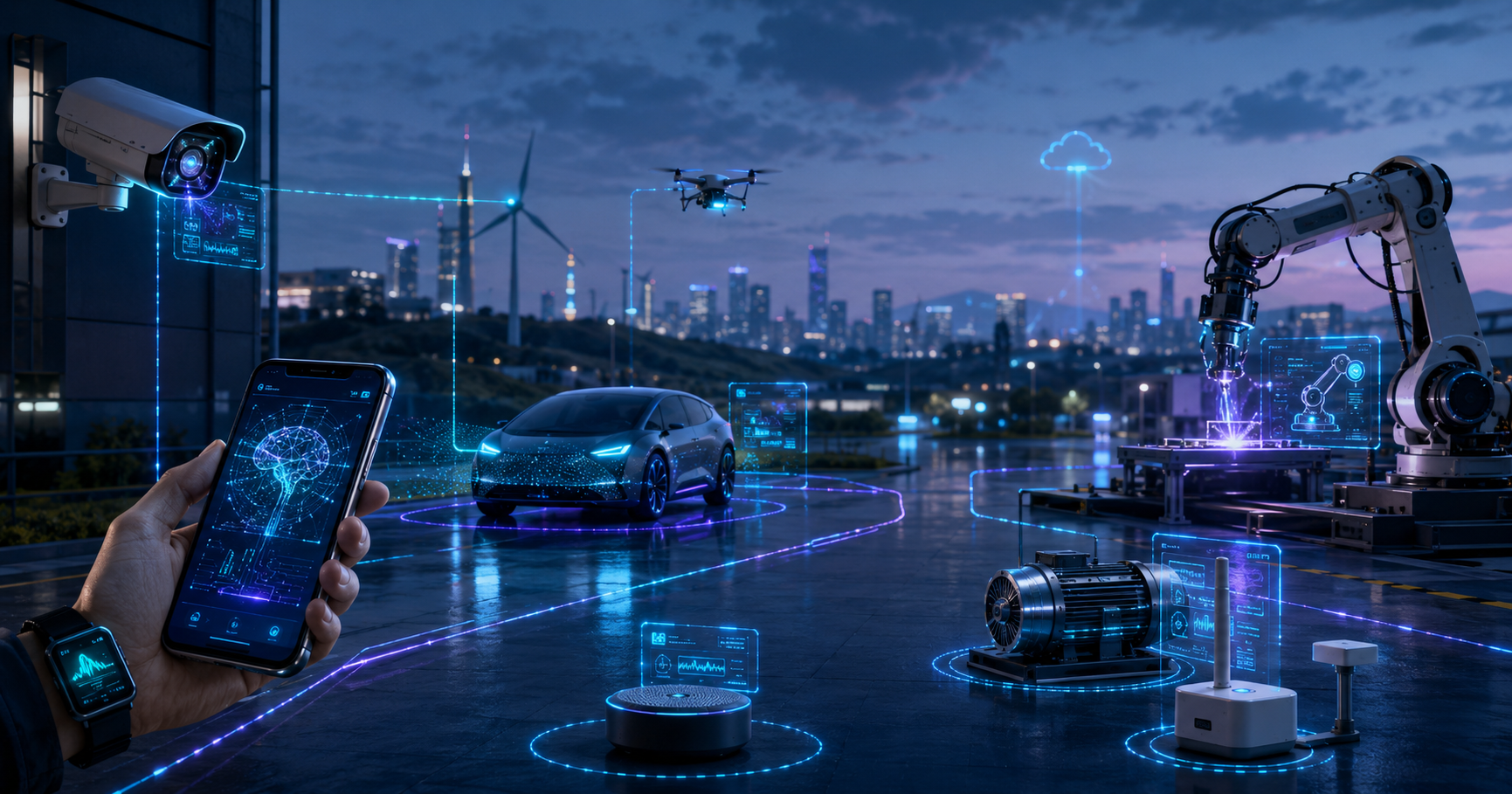
Edge AI is changing where and how artificial intelligence operates. Instead of sending every image, sound, sensor reading or user interaction to a distant cloud server, AI models can run directly on smartphones, cameras, vehicles, industrial machines, medical devices, wearables and Internet of Things sensors. This approach enables faster decisions, improved privacy, lower bandwidth consumption and dependable operation even when internet connectivity is limited.
- Table of Contents
- What Is Edge AI?
- What Is On-Device Intelligence?
- Edge AI Versus Cloud AI
- How Edge AI Systems Work
- Hardware Used for On-Device AI
- Central Processing Units
- Graphics Processing Units
- Neural Processing Units
- Microcontrollers and Embedded Processors
- Edge Gateways
- Why Latency Matters
- Privacy and Data-Sovereignty Benefits
- Edge AI in Smartphones and Consumer Electronics
- Edge AI in Healthcare and Wearables
- Smart Factories and Industrial Automation
- Autonomous Vehicles and Transportation
- Smart Cities, Retail and Security Systems
- Real-World Scenario: How a Smart Camera Processes Video Locally
- Benefits of Edge AI
- Faster Responses
- Reduced Bandwidth Consumption
- Offline AI
- Improved Data Control
- Lower Cloud Workload
- Greater Operational Resilience
- Context-Aware Intelligence
- When Edge AI Is the Better Choice
- Limitations and Implementation Challenges
- Restricted Computing Power
- Battery Consumption
- Heat Generation
- Model Updates
- Hardware Fragmentation
- Limited Storage
- Accuracy Trade-Offs
- Monitoring Difficulties
- Security Risks at the Edge
- How Hybrid Architectures Combine Edge and Cloud AI
- How Organisations Can Adopt Edge AI
- 1. Define the Business Problem
- 2. Evaluate Edge, Cloud and Hybrid Options
- 3. Select Representative Data
- 4. Choose Suitable Hardware
- 5. Optimise the Model
- 6. Design for Failure
- 7. Build Security into the Device
- 8. Establish Model Monitoring
- 9. Plan the Model Lifecycle
- 10. Start with a Controlled Pilot
- Future Developments in Edge AI
- Frequently Asked Questions About Edge AI
- 1. What is the main difference between Edge AI and cloud AI?
- 2. Can Edge AI work without an internet connection?
- 3. Is Edge AI more private than cloud AI?
- 4. What types of AI models can run on edge devices?
- 5. Is hybrid AI better than using only edge or cloud processing?
- Conclusion: Choosing Edge AI, Cloud AI or Hybrid AI
As connected devices become more capable, on-device AI is moving from a specialised technology into a practical computing model. A smart camera can identify unusual activity locally, a wearable can analyse health-related signals without continuously uploading raw information, and a factory sensor can detect equipment problems in real time. These systems combine edge computing, embedded AI, efficient machine-learning models and specialised processors to bring intelligence closer to where data is created.
What Is Edge AI?
Edge AI is the use of artificial-intelligence models on devices located close to the source of data. The “edge” may be a smartphone, security camera, vehicle computer, industrial controller, gateway, medical device, retail terminal or embedded sensor.
Traditional cloud AI usually transfers data to a remote data centre, where powerful servers process it and return a result. Edge AI moves some or all of that processing to the local device. The device can therefore interpret information and make decisions without waiting for a continuous exchange with a cloud platform.
Most edge systems focus on inference. Inference is the stage at which a trained AI model receives new input and produces a prediction, classification, recommendation or action. For example, a model may examine a camera frame and classify an object as a person, vehicle or animal.
Training a large AI model can require substantial computing resources. In many edge deployments, model training takes place in a cloud environment or data centre, while the trained model is optimised and deployed to local hardware for inference.
What Is On-Device Intelligence?
On-device intelligence refers to the ability of a device to analyse data, understand context and perform AI-related tasks using its own computing resources. It is closely related to Edge AI, although the terms may be used in slightly different contexts.
On-device AI often describes intelligence built directly into consumer or personal devices. Examples include speech recognition on a smartphone, activity classification on a wearable, image enhancement on a camera or predictive text on a tablet.
Embedded AI is another related term. It generally refers to AI models operating inside dedicated systems such as machines, sensors, appliances, robots or controllers. These systems may have strict limits on power consumption, memory, processing capacity and storage.
On-device intelligence can support:
- Voice and sound recognition
- Image and object detection
- Gesture recognition
- Predictive maintenance
- Health-signal analysis
- Fraud or anomaly detection
- Personalised recommendations
- Navigation and obstacle detection
- Automatic control of connected equipment
Edge AI Versus Cloud AI
Edge AI and cloud AI are not necessarily competing technologies. Each model is suited to different requirements. Edge processing is valuable when speed, privacy, reliability or offline operation is important. Cloud computing remains useful when applications require large models, extensive storage, centralised analytics or powerful computing infrastructure.
A hybrid AI architecture combines both approaches. Time-sensitive inference can happen locally, while the cloud supports model training, fleet management, long-term analytics and software updates.
| Comparison Area | Edge AI | Cloud AI | Hybrid AI |
|---|---|---|---|
| Processing location | On a device, local gateway or nearby edge server | In a remote cloud data centre | Divided between local devices and cloud platforms |
| Speed | Usually suitable for low-latency and real-time processing | Depends on network speed, server availability and data-transfer time | Local processing handles urgent tasks while the cloud handles complex workloads |
| Internet dependency | Can support offline AI or limited-connectivity operation | Usually requires reliable network access | Core functions may work locally while advanced features use the internet |
| Privacy | Raw data can remain on or near the device | Data is commonly transferred to a remote platform | Sensitive data may remain local while selected information is sent to the cloud |
| Computing capacity | Limited by device hardware, memory, battery and thermal conditions | Can access scalable computing and storage resources | Uses local efficiency and cloud scalability together |
| Cost considerations | May require capable device hardware but can reduce bandwidth and cloud-processing costs | May reduce device requirements but can increase data-transfer, storage and cloud-computing expenses | Requires coordination between device and cloud costs but can optimise both |
| Suitable applications | Smart cameras, vehicles, wearables, robotics, industrial control and offline assistants | Large-scale training, central analytics, complex generative AI and enterprise data processing | Connected products, smart factories, transportation systems and managed IoT intelligence |
How Edge AI Systems Work
An Edge AI system begins with data generated by a local source. The input may come from a camera, microphone, temperature sensor, radar unit, motion detector, machine controller or user interaction.
The device prepares the data before passing it to an AI model. Image data may be resized, audio may be converted into features, and sensor readings may be normalised. This preparation makes the input compatible with the model.
The model then performs inference. Depending on the application, it may classify an object, identify an anomaly, estimate a value, recognise a command or recommend an action.
After inference, the system applies decision logic. A smart machine might stop a production process, a wearable might generate an alert, or a camera might save a short event recording. Only selected results or summaries may be transferred to the cloud.
Typical Edge AI Processing Flow
- A sensor or connected device captures new data.
- The device cleans, filters or transforms the input.
- An optimised AI model performs local inference.
- The system evaluates the model output using application rules.
- The device takes an action, stores a result or generates an alert.
- Selected metadata may be synchronised with a cloud platform.
- Updated models may later be delivered back to the device.
Model Compression
Model compression reduces the size and computing requirements of an AI model. A large model developed in a data centre may not fit within the memory or processing limits of a small device. Compression techniques help create a more efficient version.
Common approaches include removing unnecessary model connections, reducing the number of parameters, using a smaller architecture and transferring knowledge from a larger model to a compact model. The aim is to preserve useful performance while reducing memory, storage, energy use and inference time.
Quantisation
Quantisation reduces the numerical precision used to store model weights and perform calculations. A model may originally use high-precision numerical values. Quantisation can represent those values using smaller numerical formats that are more efficient for embedded processors.
This can reduce model size and accelerate inference. However, aggressive quantisation can reduce accuracy, so models must be tested on realistic data before deployment.
Hardware Used for On-Device AI
Edge AI depends on hardware that can perform machine-learning calculations efficiently. The right hardware varies according to the complexity of the model, the required response time, energy limits and operating environment.
Central Processing Units
A central processing unit can run smaller AI models and manage general application logic. CPUs are flexible and widely available, but they may be less efficient than specialised accelerators for intensive neural-network operations.
Graphics Processing Units
Graphics processing units can perform many calculations in parallel. They are useful for image processing, computer vision and more demanding inference workloads. Some edge servers, vehicles and industrial systems use compact GPUs for local AI processing.
Neural Processing Units
A neural processing unit, or NPU, is designed to accelerate neural-network calculations. NPUs are increasingly included in mobile processors, consumer electronics, embedded systems and other connected devices.
An NPU can improve AI performance while using less power than a general-purpose processor for supported workloads. This makes it useful for battery-powered devices and applications requiring continuous inference.
Microcontrollers and Embedded Processors
Small sensors and low-power products may use microcontrollers or embedded processors. These devices have limited memory and computing capacity, so they require highly compact models.
Embedded AI on a microcontroller may support tasks such as wake-word detection, vibration analysis, simple gesture recognition or equipment-state classification.
Edge Gateways
An edge gateway processes data from several local devices. Instead of adding advanced processors to every sensor, an organisation can connect multiple sensors to a nearby gateway that performs inference, filtering and communication.
Gateways are common in factories, buildings, farms, retail sites and transportation networks.
Why Latency Matters
Latency is the delay between receiving an input and producing a useful response. Even a relatively small delay can matter in systems that control equipment, support navigation or detect safety-related events.
A cloud-based system must capture data, transfer it through a network, wait for server processing and receive a response. Network congestion, limited coverage or service interruptions can increase the delay.
Edge AI reduces this dependency by processing data locally. Real-time processing can help a machine react to a dangerous condition, assist a vehicle in interpreting its environment or allow a user interface to respond immediately.
Edge AI is most valuable when the intelligence must operate where the event occurs, especially when waiting for a remote server could reduce reliability, privacy or usefulness.
Privacy and Data-Sovereignty Benefits
Many connected devices handle sensitive information. Cameras capture people and locations, wearables collect personal signals, and industrial systems generate confidential operational data.
Local AI processing can reduce the need to transmit raw data. A camera can send an event label instead of a continuous video stream. A wearable can share a summary instead of every sensor measurement. A voice-enabled device can process selected commands without sending complete recordings to a cloud service.
This approach can support privacy by minimising the amount of data transferred and stored remotely. It can also help organisations address data-sovereignty requirements, where information must remain within a particular device, facility, organisation or geographic region.
Local processing does not automatically guarantee privacy. Organisations must still apply access controls, encryption, retention policies and secure software practices. However, processing data close to its source can reduce unnecessary exposure.
Edge AI in Smartphones and Consumer Electronics
Smartphones are important platforms for on-device intelligence because they combine cameras, microphones, motion sensors, location capabilities and specialised AI processors.
On-device AI can support image enhancement, voice commands, text prediction, translation assistance, biometric authentication, accessibility features and application personalisation. Local processing can improve responsiveness and allow selected functions to continue without an active internet connection.
Other consumer electronics also use Edge AI. Smart televisions can optimise sound and images, headphones can detect environmental audio, appliances can adapt to usage patterns, and home devices can interpret commands or sensor readings locally.
For developers, the challenge is creating models that work across devices with different processors, operating systems, memory capacities and power limits.
Edge AI in Healthcare and Wearables
Healthcare and wearable systems can use Edge AI to analyse sensor signals close to the user. A wearable may classify movement, recognise activity patterns or identify changes that require further review.
Medical equipment may use local inference to support image analysis, equipment monitoring or workflow assistance. Devices operating in clinics, ambulances or remote locations may benefit from offline AI when reliable connectivity is unavailable.
Local processing can reduce the transfer of sensitive raw data, but healthcare applications require careful validation. AI output should be evaluated for accuracy, reliability, bias and safety. Systems used for clinical decisions may also need to meet relevant regulatory and quality requirements.
Edge AI should support qualified professionals rather than create unverified medical conclusions. Organisations must define exactly how model output will be reviewed and used.
Smart Factories and Industrial Automation
Smart factories generate continuous data from machines, production lines, cameras, robots and environmental sensors. Sending every data point to the cloud may be costly, slow or unnecessary.
Embedded AI can analyse machine vibration, temperature, sound, pressure or electrical behaviour. A model may detect patterns that suggest abnormal operation. Maintenance teams can then investigate before a problem becomes more serious.
Computer-vision systems can inspect products for visible defects. Local inference helps the inspection system make rapid decisions without continuously uploading high-resolution production images.
Industrial Edge AI can also support:
- Predictive maintenance
- Quality inspection
- Worker-safety monitoring
- Energy optimisation
- Robotic guidance
- Inventory tracking
- Production-process control
- Equipment anomaly detection
Factories may use a hybrid architecture in which urgent machine decisions happen locally while central platforms analyse long-term performance across multiple sites.
Autonomous Vehicles and Transportation
Vehicles generate data from cameras, radar, positioning systems, motion sensors and internal control units. Many transportation decisions must be made locally because network access may be delayed or unavailable.
Edge AI can help interpret road conditions, detect objects, monitor vehicle components, support driver-assistance functions and analyse passenger or operator behaviour. Local inference is especially important when a system must respond within a limited period.
Cloud platforms still have an important role. They can support fleet analytics, route planning, model training, software distribution and the analysis of historical operating data. The vehicle performs immediate perception and control, while the cloud supports broader optimisation and management.
Smart Cities, Retail and Security Systems
Smart-city systems use cameras, environmental sensors, traffic devices, public infrastructure and connected equipment. Edge computing allows these systems to filter and interpret local data before transmitting selected results.
A traffic system might count vehicles and detect congestion locally. An environmental sensor might identify unusual air-quality readings. A connected lighting system might adjust operation based on movement and local conditions.
Retail environments can use Edge AI for queue analysis, shelf monitoring, footfall estimation, equipment monitoring and checkout assistance. Local processing may reduce bandwidth consumption and limit the transfer of raw customer video.
Security systems can detect motion, identify restricted-area activity or recognise unusual patterns. However, organisations must consider privacy, consent, data retention, accuracy and the risk of misuse.
Real-World Scenario: How a Smart Camera Processes Video Locally
Consider a smart camera installed near the entrance of a warehouse. A conventional cloud-based camera may continuously upload raw video to a remote server. This consumes bandwidth, creates storage requirements and may introduce delays.
An Edge AI camera uses a different process.
- The camera captures video frames locally.
- An embedded processor prepares each frame for analysis.
- A compact computer-vision model performs inference on the device.
- The model identifies relevant objects or activities, such as a person entering a restricted zone.
- The camera applies predefined rules to determine whether the event requires action.
- If no relevant event occurs, the raw footage may remain local or be deleted according to the retention policy.
- If an event occurs, the camera can save a short clip and send an alert with the time, location and event category.
- A cloud platform may receive only the alert, metadata and selected footage rather than the complete video stream.
This architecture reduces bandwidth usage and allows rapid detection even if the internet connection is interrupted. It can also improve privacy because unnecessary raw footage is not continuously transferred.
The cloud may still manage the camera fleet, distribute updated models, review selected events and analyse trends across several locations. This is an example of a hybrid AI system.
Benefits of Edge AI
Faster Responses
Local inference reduces the need for network communication. This supports real-time processing for interactive, operational and safety-related applications.
Reduced Bandwidth Consumption
Devices can filter data and transmit only useful results. This is valuable for high-volume sources such as cameras, microphones and industrial sensors.
Offline AI
Some functions can continue without internet connectivity. This is helpful in vehicles, remote facilities, rural environments, underground locations and temporary network outages.
Improved Data Control
Keeping raw data on a device or within a local facility can support privacy, confidentiality and data-governance requirements.
Lower Cloud Workload
Local AI processing can reduce cloud-computing, storage and data-transfer requirements. The financial benefit depends on device costs, deployment scale and workload design.
Greater Operational Resilience
Critical functions can continue when a remote service is unavailable. Devices may synchronise with the cloud after connectivity is restored.
Context-Aware Intelligence
An edge device can respond to local sensor information and environmental conditions. This can create more relevant and immediate behaviour.
When Edge AI Is the Better Choice
Edge AI is not required for every AI application. Organisations should select it when local processing provides a clear operational, privacy or financial advantage.
Choose Edge AI When:
- The system requires immediate or near-real-time responses.
- Internet connectivity is unreliable, expensive or unavailable.
- Raw data is sensitive and should remain on the device or premises.
- Continuous data transfer would consume excessive bandwidth.
- The application must continue operating during a cloud outage.
- Data volume is high, but only a small number of events are important.
- The device performs a focused task that can use a compact model.
- Local regulations or organisational policies restrict data movement.
- The cost of repeated cloud inference is greater than the value it provides.
- The system controls physical equipment that cannot wait for a remote response.
Choose Cloud AI When:
- The application requires very large or frequently changing models.
- Processing demands exceed the capacity of local hardware.
- Centralised data analysis is more important than immediate response time.
- The device has stable connectivity and limited processing resources.
- The workload changes significantly and needs elastic computing capacity.
Choose Hybrid AI When:
- Urgent inference should happen locally, but advanced analysis requires the cloud.
- Devices need central model updates, monitoring and configuration.
- Raw data should remain local while summaries are analysed centrally.
- Several edge locations must contribute to organisation-wide insights.
- The system needs offline operation as well as cloud-based services.
Limitations and Implementation Challenges
Restricted Computing Power
Edge devices cannot always match the computing capacity of cloud data centres. Large models may need to be compressed, simplified or divided between local and remote systems.
Battery Consumption
Continuous inference can consume significant energy. Battery-powered products must balance AI performance with operating time. Developers may need to reduce inference frequency, use efficient processors or activate models only when necessary.
Heat Generation
Intensive calculations generate heat. Smartphones, wearables, cameras and compact embedded systems have limited cooling capacity. Excessive heat may reduce performance or affect device reliability.
Model Updates
AI models may need updates when operating conditions change, new data becomes available or errors are discovered. Managing updates across thousands of devices can be difficult.
Organisations need secure delivery, version control, rollback procedures and compatibility testing. A failed update should not disable essential device functions.
Hardware Fragmentation
Edge devices use different processors, accelerators, memory configurations and operating systems. A model that performs well on one device may be slow or incompatible on another.
Development teams may need multiple optimised model versions and a deployment system that selects the correct version for each hardware platform.
Limited Storage
Small devices may not have enough storage for multiple models, historical data or detailed logs. The system must decide what information to retain, compress, transfer or delete.
Accuracy Trade-Offs
Compression and quantisation can improve efficiency but may affect model accuracy. Teams must test the optimised model under real operating conditions rather than relying only on laboratory datasets.
Monitoring Difficulties
Cloud services can be monitored centrally, but edge devices may be distributed across vehicles, factories, homes or remote environments. Some may remain offline for long periods.
Organisations need ways to monitor model performance, software versions, hardware health and security status without collecting unnecessary personal or operational data.
Security Risks at the Edge
Edge devices can be physically accessible to attackers. A camera, sensor, gateway or control unit may be stolen, modified or examined. Unlike protected cloud infrastructure, connected devices may operate in public or uncontrolled environments.
Common security risks include:
- Unauthorised access to stored data
- Theft or extraction of AI models
- Malicious firmware modifications
- Insecure update mechanisms
- Default or weak passwords
- Unencrypted communication
- Manipulated sensor input
- Adversarial examples designed to confuse a model
- Compromised devices joining a larger network
- Outdated software remaining active in the field
Edge AI security should include secure boot processes, signed software, encrypted storage, protected communication, device identity, access controls and verified updates. Sensitive keys should be protected using appropriate hardware or operating-system security features.
Developers should also consider what happens when the AI model is uncertain. Safety-critical systems need fallback rules, human oversight or conventional control mechanisms rather than relying entirely on a prediction.
How Hybrid Architectures Combine Edge and Cloud AI
A hybrid architecture assigns each task to the most appropriate location. Local devices handle urgent, private or bandwidth-intensive processing. The cloud handles large-scale training, central analytics, storage and device management.
For example, an industrial machine may analyse vibration locally and stop itself when it detects a dangerous pattern. It may send a small event record to the cloud. The cloud then compares events across several machines and identifies broader maintenance trends.
Local Inference
The edge device performs immediate predictions using a deployed model. It can continue operating during network interruptions and avoid transmitting every raw data point.
Cloud-Based Training
Training usually requires more computing power and larger datasets than an edge device can provide. Approved and properly governed data can be used in the cloud to improve the model.
Central Analytics
The cloud can combine summaries from many devices. This helps organisations understand long-term performance, regional patterns, equipment reliability and model behaviour.
Model Management
A central platform can track model versions, approve updates, distribute new models and monitor deployment status. Devices can download updates when connectivity and operating conditions permit.
Federated Learning
Federated learning allows devices to contribute to model improvement without necessarily sending their complete raw datasets to a central server. Devices train or adjust a model using local data and share selected model updates.
A central system combines these updates to create an improved shared model. Federated learning can reduce raw-data movement, although it still requires strong security, privacy controls, quality checks and protection against manipulated updates.
How Organisations Can Adopt Edge AI
1. Define the Business Problem
Begin with a specific problem rather than adopting Edge AI only because it is a popular technology. Identify the required decision, acceptable response time, data source and expected operational value.
2. Evaluate Edge, Cloud and Hybrid Options
Determine whether the workload must run locally. Consider latency, privacy, connectivity, model size, device cost, bandwidth and management complexity.
3. Select Representative Data
Collect data that reflects real operating environments. A model trained on ideal images or clean sensor readings may perform poorly in low light, noisy factories, changing weather or unusual equipment conditions.
4. Choose Suitable Hardware
Match the processor, memory, storage and power requirements to the model. Avoid selecting hardware based only on theoretical performance. Test it under realistic temperature, battery and workload conditions.
5. Optimise the Model
Use model compression, quantisation, efficient architectures and hardware-aware optimisation. Compare speed, energy use, memory consumption and accuracy before deployment.
6. Design for Failure
Plan for network loss, sensor failure, uncertain predictions, software errors and incomplete updates. Critical systems should have fallback behaviour and safe operating limits.
7. Build Security into the Device
Protect model files, credentials, stored data and update channels. Apply secure configuration from the beginning instead of adding security after deployment.
8. Establish Model Monitoring
Track whether model performance changes over time. New environments, changing user behaviour or equipment wear can cause model drift.
9. Plan the Model Lifecycle
Define how models will be tested, approved, deployed, updated and retired. Maintain an inventory of devices and model versions.
10. Start with a Controlled Pilot
Deploy the system in a limited environment before expanding. Measure operational value, reliability, accuracy, bandwidth use, energy consumption and maintenance requirements.
Future Developments in Edge AI
Edge AI is likely to benefit from more efficient processors, improved model-compression methods and better development tools. Devices will be able to run more capable models while using less energy and memory.
Smaller language, vision and multimodal models may support more advanced on-device assistants. These systems could understand text, speech, images and sensor data while keeping more information local.
AI accelerators are also likely to become more common in embedded processors. Developers may gain access to standardised tools that simplify deployment across different hardware platforms.
Federated learning and privacy-preserving computation may help organisations improve models without centralising all raw data. However, these approaches will still require careful security and governance.
Another development is adaptive inference. A device may use a small local model for common tasks and contact a larger cloud model only when the request is complex. This can reduce cost and latency while preserving access to more advanced capabilities.
Edge orchestration will also become important. Organisations operating large fleets of devices will need central systems for model distribution, monitoring, security updates and hardware management.
Frequently Asked Questions About Edge AI
1. What is the main difference between Edge AI and cloud AI?
Edge AI processes data on a local device, gateway or nearby server, while cloud AI sends data to a remote data centre for processing. Edge AI is generally better suited to low-latency, offline and privacy-sensitive applications. Cloud AI is useful when an application needs large models, centralised storage or scalable computing capacity.
2. Can Edge AI work without an internet connection?
Yes. A properly designed Edge AI system can perform local inference without an active internet connection. Some features, such as cloud synchronisation, software updates or advanced analytics, may become temporarily unavailable until connectivity returns.
3. Is Edge AI more private than cloud AI?
It can be more privacy-friendly because raw data may remain on the device. However, privacy depends on the complete system design. Devices still need secure storage, access controls, encryption, safe update mechanisms and responsible data-retention policies.
4. What types of AI models can run on edge devices?
Edge devices can run image-classification models, object detectors, sound recognisers, anomaly-detection models, forecasting systems, recommendation models and compact language models. The practical model size depends on the device processor, memory, power supply and required response time.
5. Is hybrid AI better than using only edge or cloud processing?
Hybrid AI is often the most flexible option, but it is not automatically the best choice. It is valuable when local processing is required for speed or privacy while cloud services are needed for training, analytics and model management. Simpler applications may work effectively with only edge or only cloud processing.
Conclusion: Choosing Edge AI, Cloud AI or Hybrid AI
Edge AI brings intelligence closer to smartphones, cameras, vehicles, machines, sensors and other connected devices. By performing inference near the source of data, it can support real-time processing, offline AI, improved privacy, reduced bandwidth consumption and greater operational reliability.
However, Edge AI also introduces challenges. Devices have restricted computing power, limited storage, battery constraints, heat-management requirements and fragmented hardware. Organisations must also secure distributed devices, manage model updates and monitor performance across the complete deployment lifecycle.
Cloud AI remains appropriate when applications need large-scale computing, extensive storage, centralised analytics or highly complex models. It can simplify processing for devices that have dependable connectivity and limited local hardware.
Hybrid AI combines the strengths of both approaches. Local AI processing can handle immediate decisions, while cloud platforms manage training, long-term analytics, updates and fleet-wide intelligence.
The best choice depends on the application. Select Edge AI when speed, privacy, offline operation or bandwidth reduction is essential. Select cloud AI when computing scale and centralised processing matter most. Choose a hybrid architecture when devices need immediate local intelligence together with cloud-based learning and management.
By evaluating latency, privacy, connectivity, hardware, security, model complexity and operating cost, organisations can build an Edge AI strategy that is practical, secure and aligned with their real-world requirements.