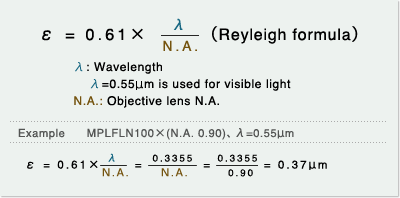
The resolving power of an objective lens is measured by its ability to differentiate two lines or points in an object. The greater the resolving power, the smaller the minimum distance between two lines or points that can still be distinguished. The larger the N.A., the higher the resolving power.
The basic limitations of the bright field microscope is one not of magnification but of resolving power, the ability to distinguish two adjacent points as distinct and separate. More increase in size (greater magnification) without the ability to distinguish structural details (greater resolution) is not beneficial. To state it differently, the largest magnification produced by a microscope may not be the most useful because the image obtained may be unclear or fuzzy. The more lines or dots per unit area that can be seen distinctly as separate lines or dots, The greater is the resolving power of the microscope system. The resolving power of a microscope is the ability of lences to distinguish the two points as distinct and separate (function of the wavelength of light used and the numerical aperture (NA) of the lens system.
Resolving Power Formula
The following formula is generally used for determing resolution.