Suppose I have a system of equations like
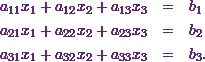
How it would be if I want to write it in a matrix form?
Well, in the matrix form, it will be
![\[ \begin{pmatrix} a_{11} & a_{12} & a_{13}\\ a_{21} & a_{22} & a_{23}\\ a_{31} & a_{32} & a_{33} \end{pmatrix}\begin{pmatrix} x_1\\ x_2\\ x_3 \end{pmatrix} = \begin{pmatrix} b_1\\ b_2\\ b_3 \end{pmatrix}. \]](https://appassets.softecksblog.in/engineering_mathematics/assets/em2/14_files/image002.webp)
Here the coefficient matrix is
![\[ \begin{pmatrix} a_{11} & a_{12} & a_{13}\\ a_{21} & a_{22} & a_{23}\\ a_{31} & a_{32} & a_{33}\end{pmatrix}, \]](https://appassets.softecksblog.in/engineering_mathematics/assets/em2/14_files/image003.webp)
the variable matrix is
![\[ \begin{pmatrix} x_1\\ x_2\\ x_3 \end{pmatrix} \]](https://appassets.softecksblog.in/engineering_mathematics/assets/em2/14_files/image004.webp)
and the constant matrix is
![\[ \begin{pmatrix} b_1\\ b_2\\ b_3 \end{pmatrix}.\]](https://appassets.softecksblog.in/engineering_mathematics/assets/em2/14_files/image005.webp)
Now there are several methods to solve a system of equations using matrix analysis.
One of these methods is the Gaussian elimination method.
Since here I have three equations with three variables, I will use the Gaussian elimination method in 3 × 3 matrices.
If interested, you can also check out the Gaussian elimination method in 4 × 4 matrices.
METHOD
In this method, first of all, I have to pick up the augmented matrix.
The augmented matrix is the combined matrix of both coefficient and constant matrices.
In this case the augmented matrix  is
is
![\[ \textbf{A}_b = \begin{pmatrix} a_{11} & a_{12} & a_{13} & b_1\\ a_{21} & a_{22} & a_{23} & b_2\\ a_{31} & a_{32} & a_{33} & b_3 \end{pmatrix}. \]](https://appassets.softecksblog.in/engineering_mathematics/assets/em2/14_files/image007.webp)
Now the job is to get an equivalent upper triangular matrix.
That will be similar to
![\[ \begin{pmatrix} a_{11} & a_{12} & a_{13} & b_1\\ 0 & a & b & c\\ 0 & 0 & d & f \end{pmatrix}\text{or}~\begin{pmatrix} a_{21} & a_{22} & a_{23} & b_2\\ 0 & a & b & c\\ 0 & 0 & d & f \end{pmatrix}\]](https://appassets.softecksblog.in/engineering_mathematics/assets/em2/14_files/image008.webp)
![\[ \text{or}~\begin{pmatrix} a_{31} & a_{32} & a_{33} & b_3\\ 0 & a & b & c\\ 0 & 0 & d & f \end{pmatrix}.\]](https://appassets.softecksblog.in/engineering_mathematics/assets/em2/14_files/image009.webp)
After that, I’ll use the backward substitution method to get the values of  .
.
Now I’ll give you an example.
EXAMPLE
According to Stroud and Booth (2011)* “By the method of Gaussian elimination, solve the equations  where
where
![\[ \textbf{A} = \begin{pmatrix} 1 & -2 & -4\\ 2 & 1 & -3\\ 1 & 3 & 2 \end{pmatrix}~\text{and}~\textbf{b} = \begin{pmatrix} -3\\ 4\\ 5 \end{pmatrix}. \]](https://appassets.softecksblog.in/engineering_mathematics/assets/em2/14_files/image012.webp)
”
SOLUTION
In this example, the set of equations is .
Also, I know that the coefficient matrix  is
is
![\[ \textbf{A} = \begin{pmatrix} 1 & -2 & -4\\ 2 & 1 & -3\\ 1 & 3 & 2 \end{pmatrix}. \]](https://appassets.softecksblog.in/engineering_mathematics/assets/em2/14_files/image014.webp)
In the same way, I also know that the constant matrix  is
is
![\[ \textbf{b} = \begin{pmatrix} -3\\ 4\\ 5 \end{pmatrix}. \]](https://appassets.softecksblog.in/engineering_mathematics/assets/em2/14_files/image016.webp)
Now I have to solve this set of equations. This means I have to get the value of the matrix  .
.
Let me choose as
![\[ \textbf{X} = \begin{pmatrix} x_1\\ x_2\\ x_3 \end{pmatrix}. \]](https://appassets.softecksblog.in/engineering_mathematics/assets/em2/14_files/image018.webp)
As I have mentioned earlier, the first step is to convert the augmented matrix to an upper triangular matrix.
STEP 1
Now the augmented matrix is
![\[ \textbf{A}_b = \begin{pmatrix} 1 & -2 & -4&-3\\ 2 & 1 & -3&4\\ 1 & 3 & 2&5 \end{pmatrix}. \]](https://appassets.softecksblog.in/engineering_mathematics/assets/em2/14_files/image019.webp)
First of all, I’ll subtract twice row 1 from row 2.
Simultaneously, I’ll also subtract row 1 from row 3.
In mathematical term, I’ll write it like this:
Row 2 – 2(Row 1), Row 3 – Row 1.
Thus the equivalent matrix will be
![\[ \textbf{A}_b \thicksim \begin{pmatrix} 1 & -2 & -4&-3\\ 0 & 5 & 5&10\\ 0& 5 & 6&8 \end{pmatrix}. \]](https://appassets.softecksblog.in/engineering_mathematics/assets/em2/14_files/image020.webp)
Next, I’ll divide row 2 by 5.
 Row 2 gives
![\[ \textbf{A}_b \thicksim \begin{pmatrix} 1 & -2 & -4&-3\\ 0 & 1 & 1&2\\ 0& 5 & 6&8 \end{pmatrix}. \]](https://appassets.softecksblog.in/engineering_mathematics/assets/em2/14_files/image022.webp)
Then I’ll subtract 5 times row 2 from row 3.
Thus Row 3 – 5 (Row 2) gives
![\[ \textbf{A}_b \thicksim \begin{pmatrix} 1 & -2 & -4&-3\\ 0 & 1 & 1&2\\ 0& 0 & 1&-2 \end{pmatrix}. \]](https://appassets.softecksblog.in/engineering_mathematics/assets/em2/14_files/image023.webp)
This is the upper triangular form of the matrix.
Therefore the system of equations in the matrix form is
![\[ \begin{pmatrix} 1 & -2 & -4\\ 0 & 1 & 1\\ 0& 0 & 1 \end{pmatrix}\begin{pmatrix} x_1\\ x_2\\ x_3 \end{pmatrix} = \begin{pmatrix} -3\\ 2\\ -2 \end{pmatrix}. \]](https://appassets.softecksblog.in/engineering_mathematics/assets/em2/14_files/image024.webp)
Now my next job is to solve this system.
STEP 2
Here I’ll use the backward substitution to solve these equations.
This means I’ll start from the bottom.
Now the equations are



Therefore from equation (3), I can say that
![\[x_3 = -2.\]](https://appassets.softecksblog.in/engineering_mathematics/assets/em2/14_files/image028.webp)
Next, I’ll substitute  in equation (2).
Thus it will be

Now I’ll simplify it to get the value of 
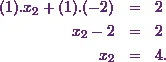
At the end, I’ll substitute  and in equation (1) to get
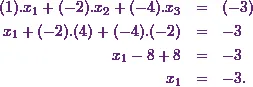
Hence I can conclude that the variable matrix is ![[-3, 4, -2]^T.](https://appassets.softecksblog.in/engineering_mathematics/assets/em2/14_files/image035.webp)
This is the solution to this example.