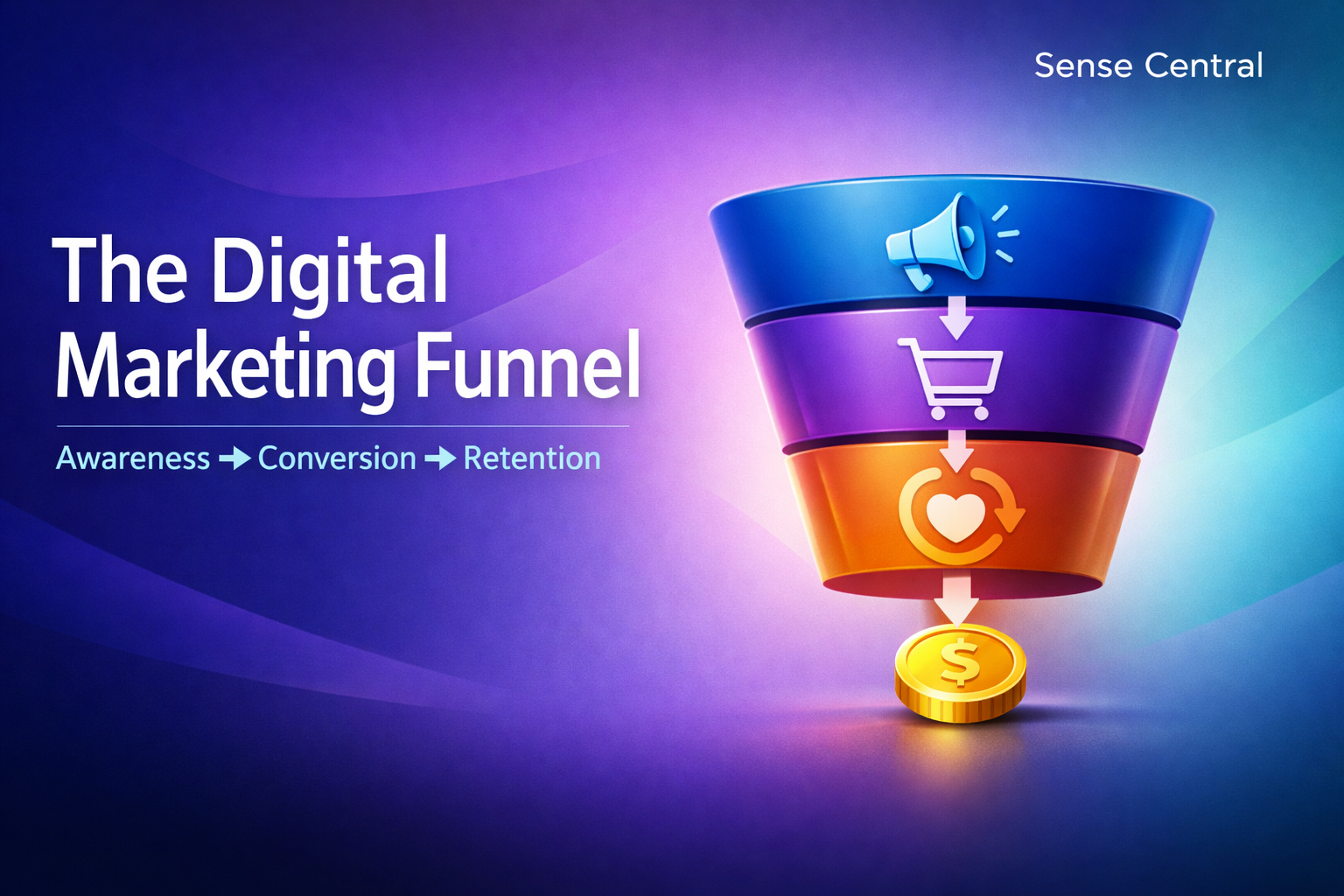
Digital Marketing can feel chaotic—channels everywhere, metrics everywhere, and content competing for attention. This guide makes it simple. You’ll learn how the digital marketing funnel actually works, how to map tactics to each stage (Awareness → Conversion → Retention), and how to measure what’s working without drowning in dashboards. Whether you’re a beginner building your first funnel or an experienced marketer optimizing ROAS and LTV, you’ll walk away with a clear roadmap, real examples, copy-paste templates, and checklists you can implement today.
- Quick Answer
- Table of Contents
- Why this matters
- Key concepts and definitions
- Core funnel stages (simplified)
- Mini glossary (fast, practical)
- Secondary keyword variations (used naturally throughout this guide)
- How to think about intent (the hidden engine of the funnel)
- Step-by-step roadmap
- Step 1: Define one clear outcome (per funnel)
- Step 2: Map your audience to 3 core segments
- Step 3: Build the Awareness engine (reach + trust)
- Step 4: Create a “bridge” offer (from Awareness to Conversion)
- Step 5: Build the Conversion asset stack
- Step 6: Add retargeting to capture high-intent visitors
- Step 7: Measure the funnel with the right KPIs
- Step 8: Build your retention system (email + experience)
- Step 9: Optimize conversion with small, consistent tests
- Step 10: Scale what works (without breaking trust)
- Examples, templates, and checklists
- Copy-paste funnel planning template
- Checklist: “Funnel-ready” page checklist
- Table: Funnel stage decision matrix (what to use, what to measure)
- Mini example: What a full funnel looks like (Sense Central-style)
- Common mistakes and how to fix them
- 1) Using one message for every stage
- 2) Treating traffic as success
- 3) No bridge offer (no way to follow up)
- 4) Sending people to the homepage
- 5) Weak proof and trust signals
- 6) Too many CTAs on one page
- 7) Ignoring mobile experience
- 8) Retargeting without segmentation
- 9) No retention system
- 10) Overcomplicated analytics setup
- 11) “Set and forget” content
- 12) Scaling acquisition before fixing conversion
- Tools and resources
- Free or low-cost tools (great for beginners)
- Paid tools (best for scaling)
- Beginner vs advanced (how to choose)
- Advanced tips and best practices
- 1) Use the “message ladder” framework
- 2) Build content clusters that mirror the funnel
- 3) Optimize for “time to value” (especially retention)
- 4) Treat objections as content ideas
- 5) Use a simple experimentation cadence
- 6) Upgrade measurement when it changes decisions
- FAQ
- 1) What is the digital marketing funnel in simple terms?
- 2) Is the funnel still relevant with modern Digital Marketing?
- 3) What’s the difference between TOFU, MOFU, and BOFU?
- 4) Which stage should I focus on first?
- 5) What are the most important funnel metrics and KPIs?
- 6) How long does it take to build a working funnel?
- 7) Do I need paid ads to make a funnel work?
- 8) What’s the best content for the Awareness stage?
- 9) What’s the best way to improve conversions quickly?
- 10) What is retention marketing, and why does it matter?
- 11) How do funnels work for affiliate marketing sites?
- 12) How do I know if my funnel is “healthy”?
- Key takeaways
- Conclusion
Quick Answer
Definition: A Digital Marketing funnel is a structured journey that turns strangers into customers and customers into repeat buyers by aligning messaging, offers, and measurement across three stages: Awareness, Conversion, and Retention.
- Awareness: Capture attention and build trust (content, SEO, social, video, PR).
- Conversion: Turn intent into action (landing pages, email sequences, retargeting, CRO).
- Retention: Increase lifetime value (onboarding, lifecycle email, loyalty, community).
- Core rule: Each stage needs its own message, metric, and offer.
- Winning funnels: Track full-funnel KPIs (CAC, ROAS, LTV, retention rate), not just clicks.
Table of Contents
- Why this matters
- Key concepts and definitions
- Step-by-step roadmap
- Examples, templates, and checklists
- Common mistakes and how to fix them
- Tools and resources
- Advanced tips and best practices
- FAQ
- Key takeaways
- Conclusion
Why this matters
A funnel is not a buzzword—it’s a way to make Digital Marketing predictable. Without a funnel, you’ll often see random spikes (viral posts, one-off campaigns) but struggle to create steady growth. With a funnel, every channel has a job, every piece of content has a purpose, and every metric connects to revenue.
What problems the funnel solves
- Wasted spend: Paying for traffic that doesn’t match your offer or landing page.
- Low conversions: High clicks, low leads/purchases because the message doesn’t fit the stage.
- Inconsistent results: You grow when you post/launch, then stall.
- Short-term mindset: Only optimizing for immediate sales and ignoring retention and LTV.
Benefits (what you gain)
- Clarity: You know what to create, where to publish, and what “good” looks like.
- Efficiency: Better CAC and ROAS by matching intent to the right offer.
- Scalability: Systematic growth through testing and full-funnel optimization.
- Customer experience: People feel understood at every step, boosting trust.
Who needs this (and when)
- Creators and bloggers: If traffic is growing but income isn’t.
- Small businesses: If referrals are strong but online acquisition is unclear.
- E-commerce brands: If first-time purchases happen but repeat rate is weak.
- SaaS / subscriptions: If trials are decent but activation/retention is low.
Best for: teams or solo marketers who want a simple, measurable structure for growth.
Avoid if: you’re only running one-off promotions with no plan for follow-up or retention (the funnel will expose the gaps quickly—which is a good thing, but it requires commitment to fix).
Related: Digital Marketing Strategy: A Practical Framework
Key concepts and definitions
Before you build or optimize your funnel, you need clean definitions. Most “funnel confusion” comes from using the same tactic for multiple stages, or using the wrong metric for the goal.
Core funnel stages (simplified)
- Awareness: People discover you (or the problem you solve).
- Conversion: People take a measurable action (subscribe, request demo, purchase).
- Retention: People stay, return, buy again, and recommend you.
Mini glossary (fast, practical)
- Top-of-funnel (TOFU): Awareness content and reach-building activity.
- Middle-of-funnel (MOFU): Education, comparison, and intent-building touchpoints.
- Bottom-of-funnel (BOFU): Purchase-ready campaigns and conversion assets.
- CTA (Call to Action): The next step you ask people to take.
- Offer: What you exchange for attention or action (guide, trial, discount, demo, consult).
- Landing page: A focused page designed for one goal (not a general website page).
- CRO: Conversion Rate Optimization—testing improvements to raise conversions.
- Activation: The “aha moment” where a user experiences value (common in SaaS).
- LTV: Lifetime Value—total revenue a customer generates over time.
- CAC: Customer Acquisition Cost—total cost to acquire one customer.
Secondary keyword variations (used naturally throughout this guide)
- marketing funnel stages
- customer journey funnel
- full-funnel marketing strategy
- conversion funnel optimization
- awareness to conversion framework
- lead generation funnel
- sales funnel for online marketing
- retention marketing tactics
- lifecycle email marketing
- funnel metrics and KPIs
How to think about intent (the hidden engine of the funnel)
The funnel works best when you match intent to your content and CTA:
- Low intent (Awareness): “I’m curious.” CTA = subscribe, follow, read more.
- Medium intent (Consideration): “I’m comparing options.” CTA = download guide, view comparison, sign up.
- High intent (Conversion): “I’m ready.” CTA = buy now, book call, start trial.
Useful internal reading: What Is a Landing Page? Examples and Best Practices
Step-by-step roadmap
This is a complete, implementable roadmap to build (or rebuild) your funnel. Each step includes what to do, why it matters, how to do it, an example, and a pro tip.
Step 1: Define one clear outcome (per funnel)
What to do: Choose one primary conversion goal (purchase, lead, trial, booking).
Why it matters: Funnels break when they try to optimize for multiple “main” goals at once.
How to do it:
- Write the goal in one sentence: “Convert who into what action within what timeframe.”
- Pick the primary KPI (e.g., purchases/week, qualified leads/month).
Example: “Convert SEO traffic from ‘best managed WordPress hosting’ into affiliate clicks to Kinsta.”
Pro tip: If you have multiple products, build separate funnels by intent cluster—don’t mix them on the same landing page.
Step 2: Map your audience to 3 core segments
What to do: Create three segments that reflect funnel stages: new, considering, ready.
Why it matters: Messaging that converts “ready” users often repels “new” users.
How to do it:
- New: unaware or problem-aware (learning stage).
- Considering: solution-aware (comparing tools/options).
- Ready: product-aware (needs proof, confidence, and a clear offer).
Example: For Sense Central: “New” = reading a guide, “Considering” = reading comparisons, “Ready” = reviewing pricing/performance.
Pro tip: Build a message bank: 10 pain points, 10 desired outcomes, 10 objections. Use it across ads and content.
Step 3: Build the Awareness engine (reach + trust)
What to do: Publish content designed to earn attention and credibility.
Why it matters: Awareness creates the cheapest long-term acquisition—especially with SEO and shareable content.
How to do it:
- Create topic clusters: “what is,” “how to,” and “best tools.”
- Use multi-format distribution: blog + short video + email + social.
- Optimize pages for search intent and skimmability.
Example: “What Is Digital Marketing?” (education) → “Digital Marketing Funnel Stages” (framework) → “Best Email Marketing Tools” (solution discovery).
Pro tip: Awareness content should not feel salesy. Your CTA is usually: “Get the template,” “Subscribe,” or “Read the next guide.”
Internal guide: SEO Content Checklist for Faster Rankings
Authority reading: Google Search: Creating helpful, reliable, people-first content
Step 4: Create a “bridge” offer (from Awareness to Conversion)
What to do: Offer something valuable that moves users closer to action.
Why it matters: Most visitors won’t buy on their first visit. A bridge offer captures leads and builds intent.
How to do it:
- Pick one offer: checklist, comparison sheet, free email course, calculator, trial.
- Place it inside your best awareness content with a relevant CTA.
- Connect it to an email sequence (5–7 emails is plenty).
Example: “Download the Funnel Metrics Cheat Sheet” or “Get the Free WordPress Speed Audit Template.”
Pro tip: The best bridge offers reduce uncertainty. Templates and checklists usually outperform generic newsletters.
External reference: Nielsen Norman Group: Usable forms
Step 5: Build the Conversion asset stack
What to do: Create the pages and messages that drive action.
Why it matters: Traffic without conversion assets is just expensive visibility.
How to do it:
- One dedicated landing page per offer or intent cluster.
- Clear headline: “Who it’s for + outcome.”
- Proof: testimonials, benchmarks, screenshots, data.
- Objection handling: FAQ, “what’s included,” guarantee (if applicable).
Example: A comparison page: “Kinsta vs WP Engine: Speed, Pricing, Support” → CTA button to affiliate link.
Pro tip: Use “message match”: ad or article promise must match the landing page headline.
Internal: Conversion Copywriting: Headlines That Get Clicks and Sales
Authority reading: Google Ads: About landing page experience
Step 6: Add retargeting to capture high-intent visitors
What to do: Retarget visitors who showed intent but didn’t convert.
Why it matters: Retargeting often delivers the best ROI because the audience already knows you.
How to do it:
- Segment retargeting audiences: viewed product page, visited checkout, visited comparison page.
- Show stage-appropriate creatives: proof, benefits, objections, limited incentive.
- Use frequency caps to avoid ad fatigue.
Example: Someone reads “Best Managed WordPress Hosting” but doesn’t click—retarget with “Speed test results + support highlights.”
Pro tip: If you can’t retarget with ads yet, retarget with email: capture the lead first via the bridge offer.
External reference: Meta Business Help Center: About the Meta Pixel
Step 7: Measure the funnel with the right KPIs
What to do: Track one primary metric per stage and a few supporting metrics.
Why it matters: Overtracking creates noise; undertracking creates blind spots.
How to do it:
- Awareness KPIs: impressions, organic clicks, engaged sessions, email signups.
- Conversion KPIs: conversion rate, CPA/CAC, ROAS, sales-qualified leads.
- Retention KPIs: repeat purchase rate, churn, retention rate, LTV.
Example: Awareness target: 20% growth in organic clicks. Conversion target: 3% landing-page CVR. Retention target: 25% repeat purchase rate.
Pro tip: Always connect marketing metrics to a business metric. Traffic is a means, not the outcome.
Authority reading: Google Analytics: Understand metrics
Step 8: Build your retention system (email + experience)
What to do: Set up simple retention flows that keep customers engaged.
Why it matters: Retention is often the fastest way to increase revenue because acquisition is expensive.
How to do it:
- Create a welcome/onboarding sequence.
- Send usage/value emails (tips, next steps, best practices).
- Use segmentation: new buyers vs repeat buyers vs inactive users.
Example: For a digital product: “How to use it” (Day 1) → “Best practices” (Day 3) → “Advanced tips” (Day 7) → “Upsell/Bundle” (Day 10).
Pro tip: Retention content should reduce friction and increase results. Teach people how to win with what they bought.
External reference: Mailchimp: Customer retention resources
Step 9: Optimize conversion with small, consistent tests
What to do: Run ongoing CRO tests on your highest-impact pages.
Why it matters: A small lift in conversion rate can outperform a big lift in traffic.
How to do it:
- Pick one page with high traffic and low conversion.
- Change one variable at a time: headline, CTA, proof placement, form length.
- Document results and keep winners.
Example: Test CTA text: “Get the template” vs “Download free sheet.”
Pro tip: Start with “no-brainer” improvements: clarity, speed, trust signals, and fewer distractions.
Authority reading: web.dev: Core Web Vitals
Step 10: Scale what works (without breaking trust)
What to do: Scale by expanding winners, not by adding random channels.
Why it matters: Scaling the wrong part of the funnel amplifies inefficiency.
How to do it:
- Double down on the best content topics and highest-converting pages.
- Expand into adjacent keywords and comparison pages.
- Add partnerships and affiliates once conversion assets are proven.
Example: If “Kinsta vs SiteGround” converts well, create “Kinsta vs Cloudways,” then a “Best Managed Hosting” hub.
Pro tip: Scale retention too: improving LTV makes paid acquisition easier to profitably expand.
Internal next step: Marketing Analytics Dashboard: What to Track Weekly
Examples, templates, and checklists
This section gives you practical assets you can copy, adapt, and publish.
Copy-paste funnel planning template
Use this template in a doc or notes app. Keep it simple and measurable.
Funnel Name:
Primary Goal (conversion):
Ideal Audience:
Main Offer (what people get):
Bridge Offer (lead magnet / trial / template):
Primary Channels (max 3):

AWARENESS
- Content themes (3–5):
- Distribution plan:
- CTA (low intent):
- KPI:

CONVERSION
- Landing page URL:
- Proof elements (data, testimonials, demo):
- CTA (high intent):
- KPI:

RETENTION
- Onboarding sequence (3–7 emails):
- Value content (tips, use cases):
- Upsell/cross-sell (optional):
- KPI:

Objections to address (top 5):
Tests to run this month (top 3):
Internal: Free Funnel Template Library
Checklist: “Funnel-ready” page checklist
- Clear headline that matches the source (search query, ad, or email)
- One primary CTA above the fold
- Fast load speed (especially on mobile)
- Trust signals (about, contact, policies, proof)
- Benefit-focused bullets (not feature dumps)
- Objections handled (FAQ, comparisons, guarantees where appropriate)
- Clean design with minimal distractions
- Tracking installed (analytics + conversion events)
Table: Funnel stage decision matrix (what to use, what to measure)
| Funnel Stage | Primary Goal | Best Content/Assets | Best Channels | Primary KPIs | Avoid If |
|---|---|---|---|---|---|
| Awareness | Attention + trust | Guides, explainers, short videos, social posts, PR mentions | SEO, YouTube, social, communities | Organic clicks, engaged sessions, followers, email signups | You’re forcing hard sales too early |
| Conversion | Action (lead/sale) | Landing pages, comparisons, demos, case studies, webinars | Email, PPC, retargeting, intent keywords | CVR, CAC/CPA, ROAS, qualified leads | Your landing page is generic or slow |
| Retention | Repeat + loyalty | Onboarding, lifecycle email, community, loyalty offers | Email, in-app, SMS (where relevant) | Repeat rate, churn, retention, LTV | You’re neglecting customer experience |
Mini example: What a full funnel looks like (Sense Central-style)
- Awareness: “How the Digital Marketing Funnel Works” (this post) + SEO cluster posts.
- Bridge offer: “Funnel Metrics Cheat Sheet” (email signup).
- Conversion: Tool comparison page with “Try” buttons and clear pros/cons.
- Retention: Weekly newsletter with “best tools this week” + updates + use-case tutorials.
External authority references:
Common mistakes and how to fix them
Most funnels underperform for predictable reasons. Fix these, and you’ll usually see improvements fast.
1) Using one message for every stage
Fix: Create stage-based copy: Awareness = educate; Conversion = prove + simplify; Retention = support + expand value.
2) Treating traffic as success
Fix: Align metrics to goals: traffic is Awareness; conversions are Conversion; repeat and churn are Retention.
3) No bridge offer (no way to follow up)
Fix: Add a lead magnet, trial, or template with a simple email sequence.
4) Sending people to the homepage
Fix: Send to a dedicated landing page with one job.
5) Weak proof and trust signals
Fix: Add data, screenshots, benchmarks, “about” credibility, and transparent cons.
6) Too many CTAs on one page
Fix: Pick one primary CTA and one secondary CTA. Remove everything else.
7) Ignoring mobile experience
Fix: Test on mobile first. Improve speed and spacing; reduce form fields.
8) Retargeting without segmentation
Fix: Retarget based on behavior: viewed pricing vs read a guide vs abandoned checkout.
9) No retention system
Fix: Build onboarding + a simple lifecycle email flow. Retention is a growth lever.
10) Overcomplicated analytics setup
Fix: Track 5–7 KPIs weekly. Add complexity only when decisions require it.
11) “Set and forget” content
Fix: Refresh top posts quarterly: update screenshots, tools, benchmarks, and comparisons.
12) Scaling acquisition before fixing conversion
Fix: Improve landing pages and offer clarity first; then scale traffic and spend.
Internal: Common SEO Mistakes That Block Rankings
Tools and resources
Below are reliable tools grouped by budget and skill level. Use what fits your stage and constraints.
Free or low-cost tools (great for beginners)
- Google Analytics: traffic and behavior insights. https://analytics.google.com/
- Google Search Console: SEO performance and indexing. https://search.google.com/search-console/
- Google Trends: demand and seasonality research. https://trends.google.com/
- Canva: quick visuals for social and lead magnets. https://www.canva.com/
- Hotjar (free tier): heatmaps and recordings for CRO. https://www.hotjar.com/
Paid tools (best for scaling)
- Ahrefs: keyword research and competitive SEO. https://ahrefs.com/
- Semrush: SEO + PPC research suite. https://www.semrush.com/
- HubSpot: CRM + marketing automation. https://www.hubspot.com/
- Mailchimp: email marketing and automation. https://mailchimp.com/
- Optimizely: experimentation and A/B testing. https://www.optimizely.com/
Beginner vs advanced (how to choose)
- Beginner: prioritize clarity and execution—Analytics + Search Console + a simple email tool.
- Advanced: prioritize experimentation—CRO tooling, attribution, segmentation, and retargeting scale.
Best for: marketers building a full-funnel marketing strategy with measurable steps.
Avoid if: you’re buying tools to replace fundamentals (offer, message match, proof, and consistency).
Advanced tips and best practices
Once the basics work, these practices help you optimize and scale without sacrificing trust.
1) Use the “message ladder” framework
- Awareness message: the problem and why it matters.
- Conversion message: the solution and proof it works.
- Retention message: how to get better results and what to do next.
2) Build content clusters that mirror the funnel
- Awareness: definitions, beginner guides, myths, frameworks.
- Consideration: comparisons, best-of lists, alternatives, benchmarks.
- Conversion: reviews, pricing breakdowns, “is it worth it,” use-case pages.
3) Optimize for “time to value” (especially retention)
Retention improves when customers experience value sooner.
- Simplify onboarding.
- Provide guided steps (checklists, tutorials).
- Send “next best action” emails based on behavior.
4) Treat objections as content ideas
Every objection can become a section, a FAQ, or a standalone post.
- “Is it worth the price?”
- “Will it work for beginners?”
- “How does it compare to alternatives?”
5) Use a simple experimentation cadence
- Weekly: review KPIs; identify 1 bottleneck.
- Biweekly: run 1–2 CRO tests.
- Monthly: refresh 1–3 top-performing pages.
6) Upgrade measurement when it changes decisions
Advanced attribution is useful, but only when it changes what you do next. Start lean, then expand.
Authority reading:
- Google Ads: Conversion tracking
- Intercom: Customer onboarding concepts
- CXL Blog: CRO and experimentation
FAQ
1) What is the digital marketing funnel in simple terms?
It’s the customer journey from discovering you (Awareness), to taking action (Conversion), to staying and buying again (Retention). Good funnels match the right message and offer to what people need at each stage.
2) Is the funnel still relevant with modern Digital Marketing?
Yes, but it’s less linear than older models. People move between stages, compare on multiple devices, and revisit content. The funnel is still the best way to organize strategy, measurement, and messaging.
3) What’s the difference between TOFU, MOFU, and BOFU?
TOFU is Awareness content, MOFU is consideration/education content, and BOFU is conversion-focused content. In practice, MOFU often bridges Awareness and Conversion through comparisons, templates, and email follow-up.
4) Which stage should I focus on first?
Start where your biggest bottleneck is. If you have traffic but low results, focus on Conversion and offers. If you have sales but low repeat, focus on Retention. If nobody knows you, focus on Awareness.
5) What are the most important funnel metrics and KPIs?
Awareness: engaged sessions and email signups. Conversion: conversion rate and CAC/CPA. Retention: repeat rate or churn and LTV. Track a small set weekly so you can act on what you see.
6) How long does it take to build a working funnel?
You can build a basic funnel in days, but it typically takes weeks to refine messaging and offers. SEO-driven funnels take longer to ramp, while paid traffic funnels can validate faster if tracking is set up correctly.
7) Do I need paid ads to make a funnel work?
No. Many funnels are built primarily through SEO, email, and partnerships. Ads can speed up validation and scaling, but they amplify weaknesses if your landing pages and offer clarity are not ready.
8) What’s the best content for the Awareness stage?
Beginner-friendly guides, definitions, frameworks, and problem-solving content tend to work best. Your goal is to earn trust and move readers to a low-friction next step like a template or newsletter.
9) What’s the best way to improve conversions quickly?
Improve message match (headline aligns with the source), increase proof (data, benchmarks, testimonials), simplify the CTA, and reduce friction (fewer form fields, faster load times). Small changes often produce meaningful lifts.
10) What is retention marketing, and why does it matter?
Retention marketing focuses on helping customers succeed after the first conversion. It matters because it increases LTV, reduces reliance on constant acquisition, and makes paid growth more profitable over time.
11) How do funnels work for affiliate marketing sites?
Awareness comes from SEO content and social distribution. Conversion often means click-through to affiliate partners via comparison and review pages. Retention comes from email lists, updates, and returning visitors who trust your recommendations.
12) How do I know if my funnel is “healthy”?
A healthy funnel shows consistent movement through stages: growing qualified traffic, improving conversion rates, and increasing repeat engagement or LTV. If one stage grows but the next stays flat, that’s your bottleneck.
Key takeaways
- A Digital Marketing funnel turns attention into conversion and conversion into repeat growth.
- Awareness, Conversion, and Retention each require different messaging and metrics.
- Bridge offers (templates, checklists, trials) are often the missing link between traffic and sales.
- Measure the funnel with a small KPI set; connect metrics to revenue and LTV.
- Retargeting works best when segmented by intent and behavior.
- Retention is a profit lever—onboarding and lifecycle email matter.
- Optimize conversion before scaling acquisition to avoid wasting spend.
- Use consistent testing and content refresh cycles to grow steadily.
Conclusion
The digital marketing funnel is not about forcing people to buy—it’s about guiding them through the right experience at the right time. When your Awareness content builds trust, your Conversion assets simplify decisions, and your Retention system helps customers succeed, growth becomes measurable and repeatable.
Your next steps:
- Pick one funnel goal and one bridge offer.
- Create one conversion-focused landing page and one retention sequence.
- Track stage-based KPIs weekly and run one improvement test every two weeks.