Retired machinists reading this might reminisce over the hand-sharpened bits of Carboloy 883 carbide lying dusty and begrunged in the backs of their toolboxes. Compared to the high-speed steel tool bits these one-time Cincinnati Milacron and Davenport operators cut their teeth on, tungsten carbide’s widespread adoption back in the day meant faster feeds and speeds, longer tool life, higher part quality and a bigger pile of parts on the bench at the end of each shift.
Times have changed, as has carbide, more properly known as tungsten carbide or sometimes cemented carbide. We won’t explore its long history here except to say that this most important of all cutting tool materials’ 100th birthday is approaching, and as with all centenarians, it behooves us to evaluate whether it’s time to turn this machine shop veteran out to pasture.
The Next 10 Years
Au contraire, said a host of cutting tool manufacturers; each of the suppliers interviewed for this article is in full agreement that carbide has a long and productive life ahead of it.
“Solid carbide use is growing, and growing tremendously,” said Thomas Raun, chief technical officer at Iscar USA, Arlington, Texas. “Granted, indexable and interchangeable systems enjoy a big piece of the pie, but there’s still a huge number of applications where you can’t replace a solid-carbide end mill or drill.”
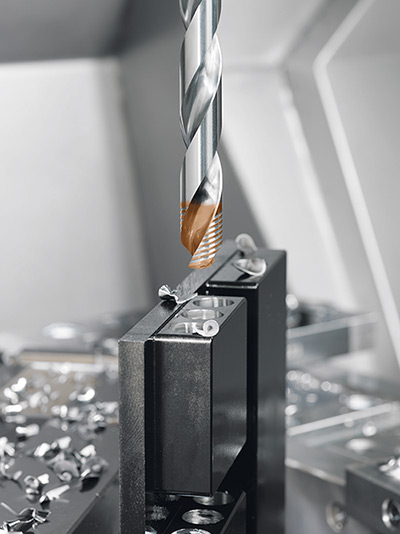
Substrate and coating technology continues to advance, enabling ever more capable tooling that will significantly improve efficiency and profitability for the machining industry. That is according to Sarang Garud, product manager at Walter USA LLC, Waukesha, Wis. “That being said, we expect to see more aluminum used in the automotive and other industries, so polycrystalline diamond (PCD) will also grow quite a bit, although carbide will remain number one.”
And Steve Lind, vice president of solid round tools for the Americas at Sandvik Coromant, Mebane, N.C., said his company expects to see continued growth in the solid-carbide market for the foreseeable future. “I attribute much of this to cutting tool manufacturers’ increased design capabilities, along with more advanced grinding equipment. The result is a wide selection of products that allow the industry to take full advantage of today’s sophisticated machining technology.”
That’s just a sampling of the overall enthusiasm for solid-carbide cutting tools and the productivity gains they bring to the table. Competition notwithstanding, experts at Kennametal, Ingersoll Cutting Tools, Horn USA, Ceratizit, and Scientific Cutting Tools all concurred that carbide use will continue to prosper over the next decade and beyond.
Old School Still Good School
But as Walter’s Garud alluded to, what about advanced cutting tools made of PCD and cubic boron nitride (CBN)? And whatever happened with all the hoopla over solid-ceramic end mills, with glossy magazine photographs showing flames spouting from Inconel workpieces seeming to spell certain doom for carbide, at least when it came to the milling of superalloys? Surely carbide can’t compete against these ultra-hard and abrasion-resistant cutting tool materials?
“Solid ceramics can be used in place of solid carbide in some applications, especially for roughing,” said Danny Davis, senior staff engineer at Pittsburgh-based Kennametal Inc. “However, carbide is typically still needed in conjunction with ceramics to complete many parts. In addition, ceramics require very high surface speeds to plasticize the material properly and make the tools work as they should. Not every machining center has the necessary spindle rpm, nor the rigidity. That equation will change as we and other suppliers introduce ceramic end mills in larger diameters and develop ceramics able to cope with less stringent operating parameters. Even so, it’s not always the perfect solution.”
Ceratizit USA Inc., Warren, Mich., is another cutting tool manufacturer active in the ceramic milling arena. And while Dr. Uwe Schleinkofer, head of research and development at the Ceratizit Group, agreed that ceramics development is ongoing, he doesn’t see it challenging solid-carbide cutting tools anytime soon. “Ceramic does have a place and is often the best solution in dry conditions and accelerated spindle speeds, but its use in the future will continue to be in these niche applications.”
As for PCD tooling, Todd White, sales director for Scientific Cutting Tools (SCT) Inc., Simi Valley, Calif., echoed what others here said: With automakers and especially the aerospace industry shifting more materials to composites, cutting tool makers should expect increased demand for PCD products as well as solid-carbide tools with special diamond-like coatings (DLC) to help cut them.
“Carbon fiber and aluminum workpieces continue to become more prevalent,” said Ed Woksa, director of product management and marketing at Ingersoll Cutting Tools Inc., Rockford, Illinois. “Because of this, PCD and DLC tools will continue to replace solid-carbide end mills and drills in some nonferrous and composite applications, particularly in high-volume production. As anyone who’s used it knows, PCD allows significantly higher cutting speeds compared to solid carbide, leading to increased productivity. This is especially important on modern CNC equipment, where faster spindles and look-ahead software technology enables greater throughput. When properly applied, PCD tooling also provides much longer tool life in these materials, providing many opportunities for lights-out manufacturing.”
Zeroing In on Materials
The tooling experts at Sandvik Coromant think so as well. “Where ceramics and other advanced materials are designed to work well, they typically do,” said Lind. “Oftentimes, they’re then used in conjunction with solid-carbide tooling for roughing. In both cases, it points to the industry’s growing use of more material- and application-specific cutting tools. This is particularly true for the heat-resistant superalloys (HRSA) material groups, but also in composites and for high-volume applications where consistent tool life and cost per part are critical.”
Like his peers, Davis of Kennametal thinks material-specific cutting tools make good sense. Yes, general-purpose or so-called “GP” tools have their place, particularly for job shops and others that machine diverse materials and workpiece geometries. Yet it’s tools tailored to a specific application that often provide the greatest return on investment.
“High-performance tooling means fewer tool changes, longer tool life, faster cycle times and more predictable processes,” said Davis. “When you add it all up, the slightly higher cost for one of these tools is very easy to justify. And contrary to what many might think, cutting tools represent such a small fraction of a part’s overall manufacturing cost that it would be a shame not to maximize a CNC machine tool’s performance as much as possible by using the proper tooling.”
Engines Remain Important—For Now
White, Lind and Davis noted that much of this demand for PCD and other material-specific cutting tools will come from the automotive market, where electric vehicle (EV) production will continue to increase as the world moves away from internal combustion engines (ICE). Duane Drape, national sales manager for Horn USA, Inc., Franklin, Tenn., sees much the same trend, although he tempered his remarks by stating that gas-electric hybrids will likely serve as the bridge to all-out EVs.
“Electric vehicles are indeed beginning to have an effect on the overall amount of carbide that automakers are using,” he said. “However, EVs are still a very small portion of the market, and I think we’re probably two decades away from their taking a meaningful share. Until then, the need to produce ICE, hybrids and EVs concurrently will likely increase the demand for cutting tools of all kinds.”
When the shift does go into full effect, however, the decrease could be dramatic. Drape and others explained that, where a typical gas engine might contain 120 to 140 components and require 30 to 40 unique carbide tools to machine, an EV reduces both of these by perhaps 80 percent or more. And while that’s a large figure, “the biggest impact on carbide usage will come from transmissions,” he said. “These contain far more parts that will likely be unnecessary as automakers transition to EVs. Engines are small potatoes by comparison.”
The Ceratizit Group’s Schleinkofer seconded this, citing studies from Europe that compared the number of components from a traditional powertrain engine to a fully electric one in order to determine the volume and amount of machine materials. “The results showed that, for electric powertrain vehicles, there was 70 percent less machining compared to traditional automobiles,” he said. “This will significantly affect the metal cutting industry.”
Yet Walter Tools suggested that an EV’s greater percentage of aluminum components also puts the squeeze on cast iron, the automotive industry’s longtime darling. Ironically, this trend will cut into this sector’s consumption of ceramic and especially CBN tooling, the latter of which can withstand far higher cutting speeds in cast iron and hardened steels, and has therefore gained market share over recent years. Here again, carbide is expected to emerge victorious.
“Carbide has a unique combination of hardness and toughness that is hard to match in other cutting tool materials,” Garud said. “When combined with the advanced coatings that we currently have and will continue to develop, it offers a very large application range that can’t be matched.”
Near-Net Shapes Impact Cutting
Changing automotive technology aside, other factors are also at play. Ingersoll Cutting Tools’ Design Engineering Manager Dennis Roepsch pointed to improvements in plastic injection molding, additive manufacturing and investment casting technology, noting that “some workpiece components no longer require machining or have minimal machining requirements. For example, aluminum intake manifolds are often being replaced by molded composite plastics. Also, near-net shape workpieces reduce the amount of material that needs to be roughed, further reducing carbide use.”
Most of the experts here mentioned a similar corollary in the additive manufacturing space. Here, 3D printed parts emerge from the resin tank or build chamber not quite complete. Critical surfaces must be machined, holes reamed or bored, and even relatively open tolerance features brought into specification. Due to the relatively high value of these parts—some of which take hours or days to print—it’s likely that carbide cutting tools will be the preferred solution for finishing them.
“Also, any 3D printed part that needs a thread will likely require a trip to the machining center or lathe,” said SCT’s White. “From my side, the most cost-effective way to achieve this—especially given the lower production quantities associated with 3D printing—is with a solid-carbide thread mill.”
That’s true for parts made of both metal and polymer, yet Iscar’s Raun said it’s the former that will present the greatest challenge for cutting tool manufacturers. “Additive technologies such as metal powder bed and binder jet raise the potential for entirely new alloys, ones that are both stronger and more wear-resistant than existing metals. I’ve heard of tungsten blended with aluminum, for instance, which I imagine would be quite difficult to machine. As more and more of these hybrid materials come online, it’s going to tax cutting tool companies to come up with solutions able to productively machine those materials.”
It’s Drape at Horn who perhaps best sums up the situation, stating that “3D printing will eventually take some business away from machine shops and cutting tool manufacturers, but until it’s able to provide greater accuracy and surface quality, you’re still going to need solid-carbide tools for the finishing work.”
The takeaway is clear: Even though 3D printing might eventually accomplish what many in the industry have feared since its inception more than three decades ago—namely, less demand for traditional manufacturing—it’s more likely that additive and subtractive will complement one another.
Print a Cutting Tool?
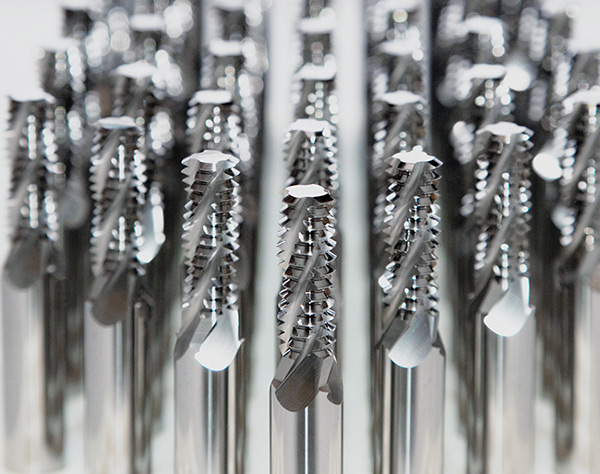
According to Garud at Walter Tools, the two will probably need each other in other ways as well. As with all new technologies, he suggested that it can be difficult to see the universe of possibilities and effects 3D printing will have on solid carbide tooling over the long term. And yet, additive has already gained the ability to print titanium and Inconel components for aerospace and other industries—and done so far quicker than most would have expected. Printed cutting tools seem a possibility.
“If it can be done, 3D printed carbide will open up new possibilities for tool design and give us the ability to quickly customize them for specific applications,” he said. “It certainly has the potential to change the playing field for the industry overall, providing advantages to those that can effectively use it.”
Ceratizit disagreed, at least from a production perspective. “Keep in mind, we and others are pressing inserts in two seconds, so I don’t see how this would work with 3D printing,” Schleinkofer said. “The process is far too expensive. Also, consider that dense cemented carbide cannot be produced by laser sintering. You can only print green parts, so a trip to the furnace for sintering after the 3D printing process is always necessary. However, 3D printing does provide us with more flexibility in terms of implementing customer requirements and opens new design possibilities, which we can use to offer our customers highly optimized, individual solutions in minimum time. It is an ideal solution for small volumes and high component complexity.”
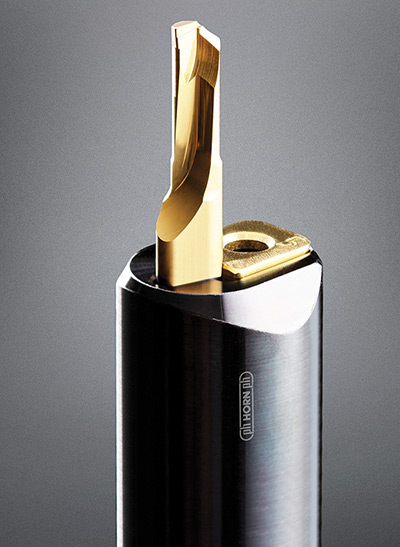
Woksa of Ingersoll painted a similar picture. He noted that, while the technology to 3D print solid-carbide and indexable tooling is under development, it is virtually impossible to compete with current carbide production technology. However, carbide insert product development will be impacted, since specials and small batch carbide tools and inserts can be produced faster and more economically if a die set is not required. “Also, there’s the potential to develop unique capabilities such as coolant-through holes with pinpoint accuracy that would otherwise be impossible,” he said.
Sandvik Coromant’s response was much the same as Ingersoll’s. “Like other cutting tool manufacturers, we’re very much in the development stage, although we do expect 3D printing to contribute to our offering in some unique and very productive ways,” said Lind. “That could be from a prototyping standpoint, as one might expect, but there’s also the potential for complex, advanced engineering solutions. As I said, it’s still early in the game—but stay tuned.”
The Road Ahead
Staying tuned is good advice for any technology, and carbide cutting tools are no exception. SCT’s White assures us that carbide substrates and tool coatings will continue to evolve to keep pace with material advancements.
And Drape of Horn said carbide and carbide cutting tools are always getting better, “but unless there’s some new mineral that’s found in abundant supply and is relatively easy to get, it will be in baby steps rather than leaps and bounds.” He suggested that these improvements will primarily come in the form of more advanced edge preps and coatings more so than the carbide, although all three are necessary pillars of high-performance cutting tools.
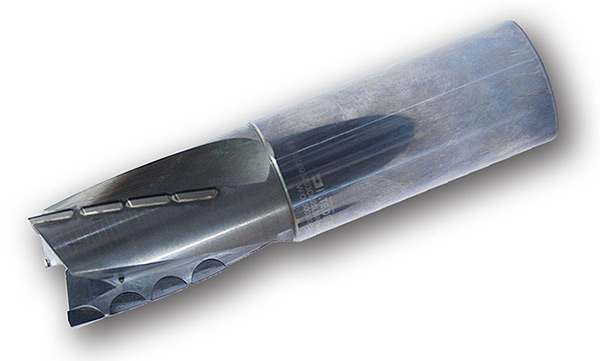
Kennametal’s Davis is in full agreement and thanked advances in computer software and machine tool technology for the past decade or two of continuous improvement. With that in mind, he also thinks the carbide tooling industry will see some fundamental changes in the near future. “All of us continue to develop better cutter geometries and coatings, but the key will be to bring those down to the micro level rather than the macro,” he said.
Cutting tool manufacturers are using finite element analysis (FEA) to understand how much heat and force will be generated during the cut, and determine optimal helix angles and chip formation long before the tool is made. Machine tools are improving as well, with many suppliers using CNC grinders able to hold 1 μm or better accuracy. Both enable the production of cutting tools that, not so long ago, were impossible to manufacture. Said Davis, “Since I started with Kennametal nearly four decades ago, the technology has advanced by leaps and bounds.”
Raun of Iscar has a similarly long history in the cutting tool business. “Compared to the carbide rod that was available when I entered the industry, the hardness and density have risen to a very high level,” he said. “Because of this, it can withstand wear and cutting forces far better than it once did. Couple that with today’s advanced coatings and, as others have mentioned, the geometries and edge preps that are now available, and you’re left with far more capable cutting tools than were previously available. I feel those advancements will only continue as the technology behind them improves.”