




The reservoir consists of one or several interconnected geological flow units. While the shape of a well and converging flow have created in the past the notion of radial flow configuration, modern techniques such as 3-D seismic and new logging and well testing measurements allow for a more precise description of the shape of a geological flow unit and the ensuing production character of the well.
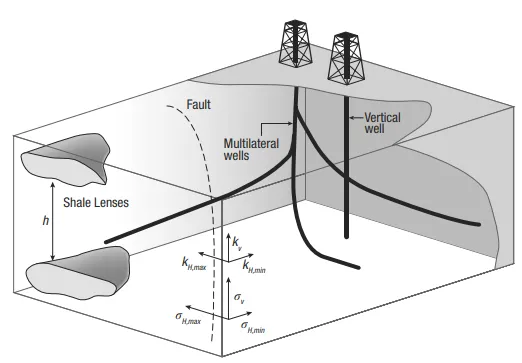
This is particularly true in identifying lateral and vertical boundaries and the inherent heterogeneities. Appropriate reservoir description, including the extent of heterogeneities, discontinuities, and anisotropies, while always important, has become compelling after the emergence of horizontal wells and complex well architecture with total lengths of reservoir exposure of many thousands of feet. Figure 1-1 is a schematic showing two wells, one vertical and the other horizontal, contained within a reservoir with potential lateral heterogeneities or discontinuities (sealing faults), vertical boundaries (shale lenses), and anisotropies (stress or permeability).
While appropriate reservoir description and identification of boundaries, heterogeneities, and anisotropies is important, it is somewhat forgiving in the presence of only vertical wells.
These issues become critical when horizontal and complex wells are drilled. The encountering of lateral discontinuities (including heterogeneous pressure depletion caused by existing wells) has a major impact on the expected complex well production.
The well branch trajectories vis à vis the azimuth of directional properties also has a great effect on well production. Ordinarily, there would be only one set of optimum directions.
Understanding the geological history that preceded the present hydrocarbon accumulation is essential. There is little doubt that the best petroleum engineers are those who understand the geological processes of deposition, fluid migration, and accumulation. Whether a reservoir is an anticline, a fault block, or a channel sand not only dictates the amount of hydrocarbon present but also greatly controls well performance.
