All types of computers follow the same basic logical structure and perform the following five basic operations for converting raw input data into information useful to their users.
| S.No. | Operation | Description |
| 1 | Take Input | The process of entering data and instructions into the computer system. |
| 2 | Store Data | Saving data and instructions so that they are available for processing as and when required. |
| 3 | Processing Data | Performing arithmetic, and logical operations on data in order to convert them into useful information. |
| 4 | Output Information | The process of producing useful information or results for the user, such as a printed report or visual display. |
| 5 | Control the workflow | Directs the manner and sequence in which all of the above operations are performed. |
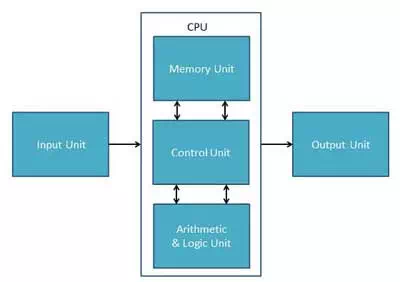
Input Unit
This unit contains devices with the help of which we enter data into the computer. This unit creates a link between the user and the computer. The input devices translate the information into a form understandable by the computer.
CPU (Central Processing Unit)
CPU is considered as the brain of the computer. CPU performs all types of data processing operations. It stores data, intermediate results, and instructions (program). It controls the operation of all parts of the computer.
CPU itself has the following three components −
- ALU (Arithmetic Logic Unit)
- Memory Unit
- Control Unit
Output Unit
The output unit consists of devices with the help of which we get the information from the computer. This unit is a link between the computer and the users. Output devices translate the computer’s output into a form understandable by the users.