




In the previous section, “Absolute Permeability,” it was stated that permeability at 100% saturation of a fluid (other than gases at low pressure) is a characteristic of the rock and not a function of the flawing fluid. Of course, this implies that there is no interaction between the fluid and the rock (such as interaction between water and mobile or swelling clays). When permeabilities to gases are measured, corrections must be made for gas slippage which occurs when the capillary openings approach the mean free path of the gas. Rlinkenberg [128] observed that gas permeability depends on the gas composition and is approximately a linear function of the reciprocal mean pressure. Figure 5-50
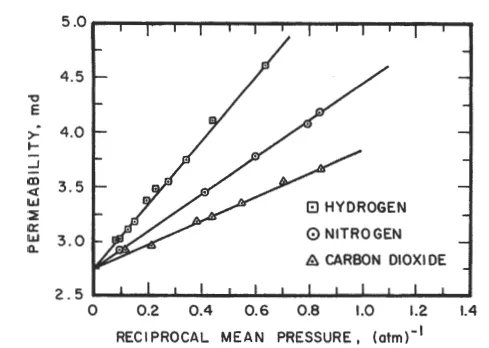
shows the variation in permeability as a function of mean pressure for hydrogen, nitrogen, and carbon dioxide. Klinkenberg found that by extrapolating all data to infinite mean pressure, the points converged at an equivalent liquid permeability (kJ, which was the same as the permeability of the porous medium to a nonreactive single-phase liquid. From plots of this type, Klinkenberg showed that the equivalent liquid permeability could be obtained from the slope of the data, m, the measured gas permeability, kg, at a mean flowing pressure ji, at which k, was observed

where b is a constant for a given gas in a given medium and is equal to m divided by kp. The amount of correction, known as the Klinkenberg effect, varies with permeability and is more significant in low permeability formations. In recent studies [ 129,1301 with very low permeability sandstones, liquid permeabilities were found to be less than gas permeabilities at infinite mean pressure, which is in contrast with the prior results of Klinkenberg. Furthermore, it has been shown [ 1301 that liquid permeabilities decreased with increasing polarity of the liquid, For gas flow or brine flow in low-permeability sandstones, permeabilities were independent of temperature at all levels of confining pressure [130].
The data [l30] showed that for a given permeability core sample at a given confining pressure, the Klinkenberg slip factors and slopes of the Klinkenberg plots were proportional to the product of viscosity and the square root of absolute temperature.

