Engine sizes are compared on the basis of total cylinder swept volume, which is known as engine cylinder capacity. Thus the engine cylinder capacity is equal to the piston displacement of each cylinder times the number of cylinders,

where VE = engine cylinder capacity (litre)
V = piston displacement (cm3 ) and
n = number of cylinders
Piston displacement is derived from the combination of both the cross-sectional area of the piston and its stroke. The relative importance of each of these dimensions can be demonstrated by considering how they affect performance individually.
The cross-sectional area of the piston crown influences the force acting on the connecting-rod, since the product of the piston area and the mean effective cylinder pressure is equal to the total piston thrust;
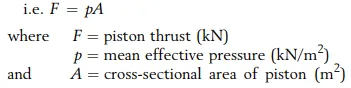
The length of the piston stroke influences both the turning-effort and the angular speed of the crankshaft. This is because the crank-throw length determines the leverage on the crankshaft, and the piston speed divided by twice the stroke is equal to the crankshaft speed;
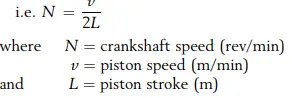
This means that making the stroke twice as long doubles the crankshaft turning-effort and halves the crankshaft angular speed for a given linear piston speed.
The above shows that the engine performance is decided by the ratio of bore to stroke chosen for a given cylinder capacity.