
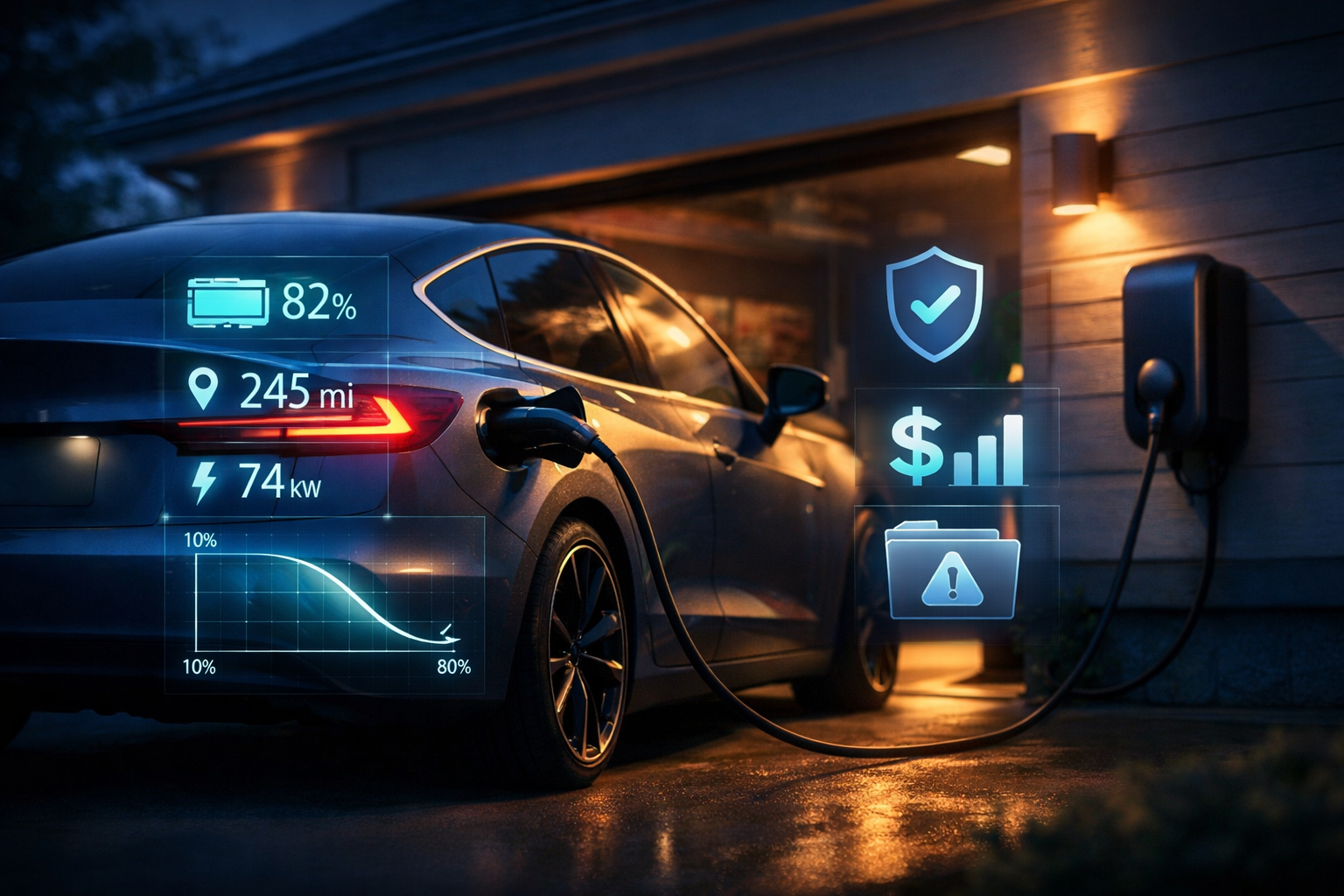
Electric vehicles are simple to drive and surprisingly cheap to “fuel” at home—but they’re also full of details that can make or break your ownership experience. This guide is built to help you buy the right EV the first time. We’ll cover batteries, real-world range, charging (home + public), costs you don’t see on the sticker, and the quiet truths many dealerships skip.
- Table of Contents
- 1) Is an EV actually right for you?
- 2) Battery basics (chemistry, size, degradation)
- Battery size (kWh) is your “fuel tank”
- Battery chemistry: LFP vs NMC/NCA (why you should care)
- Degradation: the calm truth (and what’s normal)
- Warranty: what you’re really protected against
- 3) Range: the real-world truth
- 4) Charging 101: home vs public
- Level 1 (standard wall outlet)
- Level 2 (home charger / wallbox)
- DC fast charging (public)
- Charging cost reality: it’s not always “cheap” everywhere
- 5) Fast charging: speed, curves, and the “10–80%” rule
- Peak kW is marketing—charging curves are reality
- Why everyone talks about 10–80%
- What to test-drive for fast charging readiness
- 6) Connectors & standards: CCS vs NACS (and why it matters)
- 7) What dealers won’t tell you (hidden costs & gotchas)
- 1) The “cheap to run” story depends on how you charge
- 2) Home charger installation can cost more than you expect
- 3) “Fast charging capable” doesn’t mean “fast charging great”
- 4) Tires can wear faster (and cost more)
- 5) Insurance may be higher than you expect
- 6) Depreciation varies wildly by model and market
- 7) “Full charge range” isn’t your daily range
- 8) Dealer add-ons can be worse on EVs
- 8) EV test-drive + inspection checklist
- 9) Used EV buying: battery health and red flags
- Key Takeaways
- FAQs
Table of Contents
- 1) Is an EV actually right for you?
- 2) Battery basics (chemistry, size, degradation)
- 3) Range: the real-world truth
- 4) Charging 101: home vs public
- 5) Fast charging: speed, curves, and the “10–80%” rule
- 6) Connectors & standards: CCS vs NACS (and why it matters)
- 7) What dealers won’t tell you (hidden costs & gotchas)
- 8) EV test-drive + inspection checklist
- 9) Used EV buying: battery health and red flags
- Key Takeaways
- FAQs
1) Is an EV actually right for you?
EVs are amazing for the right lifestyle and frustrating for the wrong one. Before you compare models, ask these questions:
✅ EVs are a great fit if:
- You can charge at home (even a basic wall outlet helps).
- Your daily driving is predictable (commute + errands).
- You want low day-to-day maintenance (no oil changes, fewer moving parts).
- You like smooth, quiet driving and instant torque.
⚠️ Think twice if:
- You have no reliable home/work charging and will depend mostly on public fast chargers.
- You routinely drive long distances in very hot/cold climates and need maximum winter highway range.
- You live in an apartment where charger access is uncertain or expensive.
Quick rule: If you can charge where you sleep (or where you work), EV ownership becomes effortless. If you can’t, your EV experience will depend heavily on local charging infrastructure and pricing.
2) Battery basics (chemistry, size, degradation)
Battery size (kWh) is your “fuel tank”
The battery capacity is measured in kilowatt-hours (kWh). More kWh usually means more range, but it can also mean more weight and cost. Don’t buy the biggest battery automatically—buy the battery that matches your routine with a comfort buffer.
Battery chemistry: LFP vs NMC/NCA (why you should care)
- LFP (Lithium Iron Phosphate): Often supports charging to 100% more regularly, tends to be durable and stable, but usually has lower energy density (can be heavier for the same range).
- NMC/NCA (Nickel-based chemistries): Often higher energy density (more range potential), but many manufacturers recommend daily charging to ~80–90% for longevity, using 100% mainly for trips.
Ask the brand’s official guidance for daily charge limits—this alone can change how much “usable” range you get day-to-day.
Degradation: the calm truth (and what’s normal)
All lithium batteries degrade, but modern EV packs are holding up better than many people think. A large 2024 telematics-based analysis found average battery degradation around 1.8% per year, improved from earlier years. :contentReference[oaicite:0]{index=0}
What that means in real life: If an EV starts with 400 km of real-world range, a typical path might look like ~392 km after year 1, ~385 km after year 2, etc. (not exact—climate, charging habits, and model design matter).
Warranty: what you’re really protected against
In the U.S., EV battery regulations include minimum performance expectations (commonly referenced as keeping at least ~70% usable energy at 8 years/100,000 miles for certain programs). :contentReference[oaicite:1]{index=1} Many automakers align their battery warranties around that general level and timeframe. :contentReference[oaicite:2]{index=2}
Dealer tip: Ask for the battery warranty document and confirm (1) years, (2) mileage, and (3) capacity retention threshold (if specified).
3) Range: the real-world truth
Range is the #1 EV buying factor—and also the #1 source of disappointment—because “rated range” and “your range” are not the same thing.
What reduces range the most?
- Highway speed: Faster driving increases aerodynamic drag dramatically.
- Cold weather: Battery chemistry slows down and cabin heating uses energy.
- Heat + AC: Usually less damaging than cold, but still a factor.
- Big wheels/tires: Larger wheels often reduce efficiency.
- Weight & cargo: Roof racks, heavy loads, towing (if supported) can cut range sharply.
A better way to shop: “Needed range,” not “maximum range”
Instead of asking, “Which EV has the most range?” ask:
- What is my daily distance?
- What is my worst-case day (traffic + detours + weather)?
- How often do I do long trips (and where do I stop)?
Practical buffer: Aim for an EV that covers your worst regular day using roughly 60–70% of the displayed battery. That keeps life easy and reduces stress.
4) Charging 101: home vs public
Level 1 (standard wall outlet)
Slow, but real. Great for light daily driving. If you drive 20–40 km/day, Level 1 might keep up overnight depending on your setup.
Level 2 (home charger / wallbox)
This is the “EV ownership unlock.” Level 2 can refill a large portion of the battery overnight. It’s also where hidden costs appear: wiring, breaker upgrades, permits, and installation complexity.
DC fast charging (public)
Fast chargers are for road trips and time-sensitive top-ups—not a daily lifestyle if you can avoid it. Pricing varies wildly, stations can be busy, and not every EV charges equally fast.
Charging cost reality: it’s not always “cheap” everywhere
At home, EV charging is typically cheaper than gasoline per km/mile. But public fast charging can sometimes approach (or exceed) the cost of efficient gas driving depending on local pricing and your EV’s efficiency—especially at peak rates.
5) Fast charging: speed, curves, and the “10–80%” rule
Peak kW is marketing—charging curves are reality
Many EVs advertise a high peak charging rate (kW). But EVs don’t charge at that maximum for long. Most have a charging curve: fast at low battery, then gradually slower as the battery fills to protect the pack.
Why everyone talks about 10–80%
On road trips, you often get the best time efficiency by charging from roughly 10% to 80%, then driving again. Going from 80% to 100% can take disproportionately longer at a fast charger.
What to test-drive for fast charging readiness
- Battery preconditioning: Can the car warm/cool the battery before you arrive at a fast charger?
- Navigation integration: Does route planning include chargers and estimate arrival %?
- Real-world speed: Look for independent tests that show “added km/miles in 10–15 minutes,” not just peak kW.
6) Connectors & standards: CCS vs NACS (and why it matters)
Charging standards are changing fast—especially in North America. The connector on your car affects where you can charge, how convenient it is, and whether you’ll need adapters.
CCS (Combined Charging System)
CCS has been common for many non-Tesla EVs and supports AC + DC charging (with a bulkier connector design in many cases). :contentReference[oaicite:3]{index=3}
NACS (North American Charging Standard / SAE J3400)
NACS is the Tesla-origin connector now standardized by SAE (often referenced as SAE J3400) and uses one compact connector for both AC and DC charging. :contentReference[oaicite:4]{index=4}
Many automakers announced moves toward NACS ports on new vehicles and access to Tesla Superchargers via adapters during the transition. Tesla also states that its Supercharging network is opening to more automakers throughout 2025. :contentReference[oaicite:5]{index=5}
Buyer advice: Ask the dealer:
- What port is on this exact trim?
- Do I get an adapter included? If not, what does it cost?
- Which Superchargers (if any) are supported for this model?
Example of the transition reality: some brands have offered timelines for adapter access and future NACS ports (e.g., Hyundai described CCS-to-NACS adapter access starting in early 2025 for certain models and NACS ports appearing on new models). :contentReference[oaicite:6]{index=6}
7) What dealers won’t tell you (hidden costs & gotchas)
1) The “cheap to run” story depends on how you charge
Home charging is the win. But if you rely on public fast charging often, costs can rise—and convenience can drop—especially if chargers near you are busy or priced at peak rates.
2) Home charger installation can cost more than you expect
The charger unit is only part of it. Your real cost depends on:
- Distance from electrical panel to parking spot
- Whether your panel needs an upgrade
- Permit requirements
- Trenching or conduit needs (houses vs apartments)
3) “Fast charging capable” doesn’t mean “fast charging great”
Two EVs can plug into the same 150 kW station and have totally different real charging times because of their charging curves, thermal management, and battery size.
4) Tires can wear faster (and cost more)
EVs are heavier and deliver instant torque. Many use special low-rolling-resistance tires or performance tires that can be expensive. If you drive enthusiastically, budget for tire replacement sooner than you would in a similar gas car.
5) Insurance may be higher than you expect
Depending on model, battery replacement costs, repair complexity, and parts availability, insurance premiums can be higher. Get quotes before you buy.
6) Depreciation varies wildly by model and market
Some EVs hold value well; others drop fast due to new model updates, incentive changes, or pricing adjustments. Always compare used prices of the same model from 1–3 years ago to estimate your downside risk.
7) “Full charge range” isn’t your daily range
If the car recommends charging to 80–90% for daily use (common for some chemistries), your daily practical range is lower than the headline number. Don’t be surprised—plan for it.
8) Dealer add-ons can be worse on EVs
Extended warranties that overlap battery coverage, overpriced paint protection, and “charging accessory bundles” can inflate the deal. Ask for an itemized breakdown and remove anything you don’t want.
8) EV test-drive + inspection checklist
- Phone app: Does it show charging status, schedule charging, and precondition cabin?
- Route planning: Does navigation estimate arrival battery % and recommend chargers?
- One-pedal driving: Try it in traffic—some love it, some don’t.
- Visibility & comfort: EVs can be quiet; check wind noise and seat support on highway.
- Charging port placement: Front/side/rear placement affects real-world charging convenience.
- Trunk space: Some EVs have a “frunk” (front trunk). Use it!
- Driver-assistance: Test lane keeping and adaptive cruise on a safe road.
9) Used EV buying: battery health and red flags
Ask for battery health info (if available)
Not all brands show battery health clearly. But you can still shop smart:
- Check remaining battery warranty.
- Prefer models with documented service history and software updates.
- Avoid vehicles with repeated fast-charging-only usage if you can verify it (hard to confirm, but sometimes visible in ownership logs or usage reports).
Red flags
- Warning lights related to battery/charging system
- DC fast charging fails or stops repeatedly
- Seller can’t explain charging behavior or included adapters
- Salvage title (can complicate charging access, warranties, and insurance)
Key Takeaways
- Home charging = happiness. If you can charge where you park, EV life becomes simple.
- Shop for real-world range, not the biggest number on paper.
- Charging speed is about the curve, not just peak kW.
- Know your connector. CCS vs NACS affects where and how easily you can fast charge. :contentReference[oaicite:7]{index=7}
- Battery degradation is real but manageable; modern fleets show ~1.8% average annual degradation in recent analysis. :contentReference[oaicite:8]{index=8}
- Get insurance and charger-install quotes before you buy to avoid surprise monthly costs.
FAQs
1) How long will an EV battery last?
Many EV batteries can last a long time, and modern data suggests average degradation is slower than earlier estimates (around 1.8% per year in a large 2024 analysis). :contentReference[oaicite:9]{index=9} Real life depends on climate, charging habits, and model design.
2) Should I always charge to 100%?
It depends on battery chemistry and the manufacturer’s guidance. Some EVs (often LFP-based) are more tolerant of regular 100% charging, while others recommend a lower daily limit and using 100% mainly for trips. Always follow the brand’s official recommendation.
3) Is fast charging bad for the battery?
Occasional fast charging is normal. Heavy, frequent fast-charging—especially in extreme heat—can increase stress over time. The bigger practical issue is cost and convenience: fast charging is often more expensive than charging at home.
4) What’s the difference between CCS and NACS?
NACS is a compact connector standardized by SAE and widely associated with Tesla’s charging ecosystem, while CCS has been used broadly by many non-Tesla EVs. The difference matters because it affects what chargers you can use directly and whether you’ll need adapters. :contentReference[oaicite:10]{index=10}
5) Will I need an adapter to use Tesla Superchargers?
Sometimes, yes—especially during the transition period. Tesla states its Supercharging network is opening to more automakers through 2025, and many brands have used adapters as a bridge to future NACS ports. :contentReference[oaicite:11]{index=11}
6) What’s the #1 mistake first-time EV buyers make?
Buying based on the biggest “rated range” instead of planning around real-world driving + charging access. A well-matched EV with reliable home/work charging usually beats a higher-range EV that’s inconvenient to charge.