How to Create a Simple Freelance Profile
Affiliate note: This article may include affiliate or referral links. Sensecentral may earn a commission when you use those links, at no extra cost to you. Recommendations are included as useful resources for readers building side hustles, online income systems, freelancing workflows, digital products, courses, and productivity routines.

Starting a side income path can feel confusing when every online guide promises quick money, effortless passive income, or overnight success. A better approach is to treat How to Create a Simple Freelance Profile as a small, practical project: choose one simple offer, validate that people need it, deliver useful results, and improve based on feedback. This guide is written for beginners who want practical, low-risk ways to build online or side income.
The goal is not to chase every trend. The goal is to build a repeatable earning system around making your offer clear, credible, searchable, and easy to buy. When you start this way, you avoid wasting time on random apps, risky schemes, or skills that take months before they can be sold. You also protect your confidence because progress becomes measurable: one sample, one profile, one message, one client conversation, one small payment, and one improvement.
Use this post as a beginner-friendly playbook. You will find a table of contents, comparison tables, step-by-step actions, common mistakes, monetization ideas, internal resources from Sensecentral, and useful external references. The examples are intentionally realistic: small services, beginner digital products, simple content assets, freelance offers, tutoring, creator products, and low-investment online work that can be started without quitting your current routine.
What This Really Means for Beginners
How to Create a Simple Freelance Profile is best understood as a practical income experiment. You are not trying to build a perfect brand on day one. You are trying to understand who needs help, what they value, what you can deliver reliably, and how you can improve the offer over time. This approach keeps the process realistic and reduces the pressure to become an expert overnight.
Beginner filter
Choose an idea that is low-cost, explainable in one sentence, testable within 7 days, and useful to a buyer who already spends money.
Freelancing works best when you stop describing yourself as “available for anything” and start describing one outcome you can deliver. A beginner does not need a huge portfolio to be useful. You can help a founder clean up a messy document, rewrite a product description, create a simple thumbnail set, organize spreadsheet data, design a basic landing page section, schedule social posts, research competitor pages, or turn rough notes into a readable article. These are real business problems, and many of them do not require advanced coding.
The important shift is from skill-based thinking to problem-based thinking. Instead of saying “I know Canva” or “I can write,” say “I create five clean Instagram carousel posts for local service businesses” or “I rewrite service pages so customers understand the offer faster.” Clients pay for clarity, speed, reliability, and reduced stress. Your first offer should therefore be narrow enough to explain in one sentence and simple enough to deliver repeatedly.
For beginners, the best freelance niche is usually found at the overlap of four things: tasks you can learn quickly, buyers who already spend money, work that can be shown with samples, and a delivery process you can complete after work or on weekends. This is why writing, virtual assistance, Canva design, WordPress support, data cleanup, simple automation, social media operations, and course setup support are strong starting points.
Quick Comparison: Beginner-Friendly Paths
The table below gives you a practical way to compare options before choosing where to spend your first week. Do not choose only by income potential. Choose by speed to proof, comfort level, available tools, and the type of buyer you can reach.
| Freelance path | Typical work | Best beginner fit | Time to first proof | Useful tools |
|---|---|---|---|---|
| Freelance writing | Blog posts, product descriptions, newsletters | Beginners with clear language skills | 1–2 weeks with samples | Google Docs, Grammarly, LinkedIn |
| Virtual assistant | Inbox support, research, scheduling, data cleanup | Organized beginners | 3–7 days | Google Workspace, Trello, Zee Sharp tools |
| Canva design support | Social posts, thumbnails, simple presentations | Visual learners | 1–2 weeks with templates | Canva, InfiniteMarket assets |
| No-code website help | Landing pages, WordPress edits, basic setup | Tech-comfortable beginners | 2–4 weeks | WordPress, page builders, checklists |
| Course or digital product setup | Upload lessons, sales pages, downloads | Creators and educators | 2–4 weeks | Teachable, payment pages, email tools |
Step-by-Step Plan to Start
Step 1: Pick one buyer and one problem
Do not begin by asking, “What can make money?” Ask, “Who has a problem I can solve this week?” Choose one buyer group such as students, coaches, local shops, YouTubers, bloggers, real estate agents, teachers, Etsy sellers, startup founders, or busy professionals. Then choose one painful problem: messy content, poor design, slow admin work, weak product descriptions, unorganized files, confusing landing pages, inconsistent social posts, or lack of simple templates.
Step 2: Convert the problem into a tiny offer
A tiny offer is easier to sell than a vague service. Examples include “I will create 10 product description improvements,” “I will design 5 clean social media templates,” “I will format your spreadsheet dashboard,” “I will review your website homepage and send 10 fixes,” or “I will set up your first Teachable product structure.” Keep the first version narrow. You can expand later after you understand what buyers actually request.
Step 3: Create proof before waiting for clients
Beginners often feel stuck because they think proof only comes from paid work. You can create proof using sample projects. Rewrite an imaginary product page, design a sample social post pack, build a demo spreadsheet, create a mock course outline, record a short screen walkthrough, or publish a mini case study showing before and after. Your proof should answer one question: “Can this person help me?”
Step 4: Send simple outreach
Outreach should be respectful, specific, and easy to ignore. Avoid long paragraphs about your dreams. Mention one observation, one useful idea, and one simple offer. For example: “I noticed your product page has great photos but the benefits are hard to scan. I made three sample headline improvements. Would you like me to send them?” This style is better than begging because it starts with value.
Step 5: Deliver quickly and ask for feedback
Your first goal is not maximum profit. Your first goal is a clean delivery process. Confirm the scope, deadline, file format, revision limit, and payment method. When the work is complete, ask what was useful, what could be clearer, and whether they know someone else with the same problem. This is how a small freelance service turns into referrals, testimonials, and repeat work.
Step 6: Improve the offer every week
At the end of each week, review three numbers: how many people saw your offer, how many conversations started, and how many people paid or showed serious interest. If nobody replies, improve your buyer choice or message. If people reply but do not buy, improve the offer or proof. If people buy but delivery is stressful, simplify the package.
Useful Tools and Resources
Tools should support your freelance process, not replace your thinking. Use templates to speed up repetitive work, but customize the final output for each client. A good beginner setup may include a notes app for client requirements, a spreadsheet for leads and follow-ups, a file storage system for samples, a proposal template, a simple invoice template, and a checklist for delivery. When your process is organized, clients feel safer because they can see that you are not guessing.
Digital products can also help freelancers create deliverables faster. For example, a designer can start with template bundles and customize them for a client’s brand. A writer can use content calendars, outline templates, and research checklists. A virtual assistant can use spreadsheet trackers, client onboarding forms, and standard operating procedure documents. The value is not the template alone; the value is how you adapt it to the client’s situation.
Useful Resource: Explore Our Powerful Digital Products
Explore Our Powerful Digital Products — Browse these high-value bundles for website creators, developers, designers, startups, content creators, and digital product sellers. If your side hustle involves launching a website, creating social media visuals, selling templates, building landing pages, or packaging digital downloads, ready-made assets can save hours of setup time.
Free Tool Hub: Zee Sharp
Zee Sharp is a growing suite of free online tools for productivity, development, and creativity. No sign-up. No watermarks. Just tools. Use it for quick text cleanup, productivity tasks, developer utilities, and creator workflows while you are building your side income system.
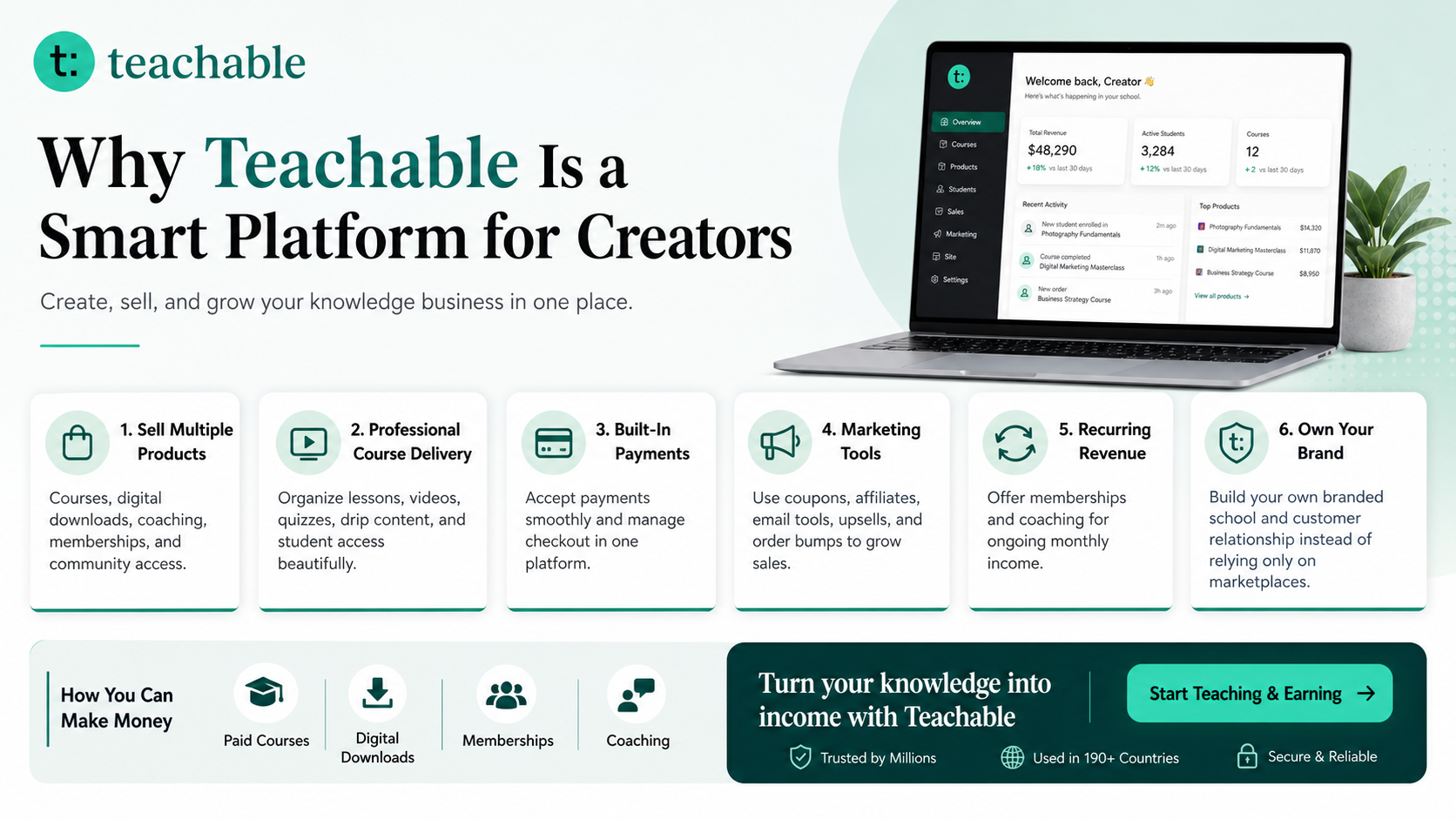
Recommended Creator Platform: Teachable
Affiliate disclosure: This section contains an affiliate referral link. If you purchase through it, Sensecentral may earn a commission at no extra cost to you. Teachable is an online platform that lets creators build, market, and sell courses, digital downloads, coaching, and memberships. It helps educators and entrepreneurs turn their knowledge into a branded digital business without needing complex coding.
Learn more: How to Make Money with Teachable: A Complete Creator’s Guide
Common Beginner Mistakes to Avoid
- Starting too broad: “I can do anything online” sounds flexible, but it makes buyers confused. A clear small offer is easier to trust.
- Spending before testing: Avoid buying expensive courses, software, domains, themes, or ads until you know what you are selling and who wants it.
- Copying trends blindly: A side hustle that works for one person may fail for another because schedule, skills, location, language, and audience are different.
- Ignoring disclosure rules: If you promote affiliate links, referral links, sponsored products, or paid recommendations, disclose the relationship clearly near the link.
- Underestimating delivery time: Beginners often price too low because they forget revisions, communication, research, formatting, and admin time.
- Quitting too early: The first version of an offer is rarely perfect. Improve the message, sample, platform, price, or niche before assuming the idea is bad.
Remember this simple principle: freelancing platforms and direct outreach both reward clear positioning, not desperation. The people who win are usually not the people who start with the most experience; they are the people who pick one path, learn fast, communicate clearly, and keep improving.
30-Day Beginner Action Plan
| Week | Main Focus | Action |
|---|---|---|
| Week 1 | Clarity | Pick one freelance service, write a one-sentence offer, create two sample projects, and list 30 possible buyers. |
| Week 2 | Proof | Create or improve your freelance profile, publish one case-study style post, and send 10 personalized messages. |
| Week 3 | Conversations | Refine your proposal, offer a small starter package, follow up politely, and track objections in a simple spreadsheet. |
| Week 4 | Improvement | Deliver one test project or sample audit, request a testimonial, improve your package, and plan repeat-client outreach. |
FAQs
Can a beginner really start with no experience?
Yes, but no experience does not mean no effort. A beginner can start by creating samples, practicing on mock projects, helping someone at a discounted starter rate, or packaging a simple skill into a clear offer. The key is to build proof before expecting trust.
How long does it take to make money?
Freelancing can start earning faster than content-based income because you sell a direct service, but the timing depends on your offer, proof, outreach quality, and buyer demand. Avoid guaranteed-income claims. Focus on controllable actions such as creating proof, sending outreach, improving your profile, and following up.
Do I need a website?
A website helps, especially when you want to look professional, publish case studies, or sell digital products. However, you can start with a simple profile, Google Drive portfolio, LinkedIn page, marketplace profile, or one-page landing page. Build the website once your offer is clearer.
Should I use freelancing platforms or direct outreach?
Both can work. Platforms bring buyer traffic but also competition and fees. Direct outreach gives you more control but requires research and patience. Beginners can use both: create a profile for credibility and send targeted messages to people who already need the service.
Is affiliate income a good beginner path?
Affiliate income can be useful if you create honest reviews, comparisons, tutorials, and resource guides. It is usually slower than services because traffic and trust take time. Always disclose affiliate relationships clearly near the referral link.
What should I do if nobody replies?
Improve one variable at a time. Make your offer more specific, choose a clearer buyer, add a better sample, shorten your message, or show a stronger reason why the person might need help. Silence is data, not failure.
Key Takeaways
- How to Create a Simple Freelance Profile works best when treated as a small experiment, not a magic income shortcut.
- Start with one buyer, one painful problem, and one simple offer that can be explained quickly.
- Create proof before waiting for paid clients: samples, audits, mock projects, screenshots, templates, or mini case studies.
- Use digital products, free tools, and creator platforms carefully to save time, but do not overspend before testing demand.
- Protect trust by using clear affiliate disclosures when recommending tools, platforms, or referral links.
- Review progress weekly and improve the offer based on conversations, not assumptions.
SEO Keywords for This Post
freelancing, freelance clients, freelance tips, work from home, online income, side hustle, freelance portfolio, beginner freelancing, remote work, freelance pricing, client management, digital services
Further Reading on Sensecentral
- How to Write a Freelance Proposal That Gets Replies
- How to Price Your Freelance Services
- Common Freelancing Mistakes Beginners Should Avoid
- How to Make Money with Teachable: A Complete Creator’s Guide