How to Create an ETF Watchlist
A checklist turns ETF investing from a mood-based activity into a repeatable process. It helps beginners slow down, compare facts, and avoid buying or selling only because the market is noisy.
Important note: This article is for investor education only. It is not financial advice, a recommendation, or a promise of returns. ETFs are market-linked products, and investors should consult a qualified financial adviser before making decisions based on personal goals, tax position, and risk capacity.
Key Takeaways
Before choosing an ETF, decide whether the money is for wealth creation, education, retirement, a short-term goal, or portfolio diversification.
Most beginners should understand broad index ETFs before adding factor, sector, international, gold, or debt ETFs.
Expense ratio, tracking error, liquidity, bid-ask spread, holdings, and benchmark methodology can affect real investor experience.
A written buying, selling, and rebalancing rule can protect you from market noise, recent-performance chasing, and emotional overtrading.
What This ETF Topic Means
How to Create an ETF Watchlist means checking the facts behind an ETF before or after you invest. ETFs are transparent products, but transparency helps only when investors read the factsheet, scheme document, index methodology, holdings, expense ratio, tracking data, liquidity, and portfolio changes.
Exchange-traded funds are bought and sold on stock exchanges, but the investor should not treat them like random trading instruments. A good ETF decision connects three things: the underlying index, the role in the portfolio, and the holding period. When those three are clear, the ETF becomes easier to evaluate. When those three are unclear, even a low-cost ETF can become a source of confusion.
For SenseCentral readers who compare products carefully, the best way to approach ETFs is similar to reviewing any useful tool: ask what problem it solves, what it costs, what risks come with it, and what alternatives exist. This mindset keeps beginners away from hype and closer to practical decision-making.
Why It Matters for Beginners
A low-cost ETF can still be a poor fit if it has weak liquidity, high tracking difference, an index change you do not understand, or holdings that overlap with the rest of your portfolio. Monthly and annual documents help you check whether the ETF still behaves the way you expected when you bought it.
Beginners often look first at past returns. Past returns are easy to understand, easy to compare, and easy to screenshot. But they are also incomplete. An ETF can show impressive recent returns because one sector, one factor, one country, or one commodity had a strong phase. That does not mean the same pattern will continue. A better beginner process compares the ETF against a suitable benchmark, checks whether the index methodology is understandable, and asks whether the product still makes sense during weak years.
Another reason this topic matters is behavior. ETFs give flexibility, but flexibility can become overactivity. Because ETFs trade during market hours, investors may check prices too often, place unnecessary orders, and confuse long-term investing with short-term prediction. The solution is not to avoid ETFs. The solution is to use them with a written process.
Practical Comparison Table
| ETF / Approach | What It Focuses On | Main Benefit | Main Risk | Best Use |
|---|---|---|---|---|
| Expense ratio | Annual fund cost | Lower cost improves compounding | Can change over time | Check yearly |
| Tracking error | Gap versus benchmark | Shows replication quality | Low cost alone is not enough | Check factsheet |
| Liquidity / spread | Ease of buying and selling | Reduces hidden trading cost | Can worsen in stress | Check before buying |
This table is not a recommendation. It is a thinking tool. Use it to compare the role of each ETF type before you compare returns. A portfolio becomes stronger when every product has a reason to exist.
How to Use This Idea in a Portfolio
Create a small ETF review folder or spreadsheet. Track the ETF name, ticker, benchmark, expense ratio, AUM, average volume, bid-ask spread, tracking error, premium/discount, top holdings, sector weights, and your reason for owning it. The goal is not to analyze daily. The goal is to catch meaningful changes before they become portfolio problems.
Step 1: Define the financial job
Write one sentence explaining why this ETF is needed. For example: “This ETF gives broad domestic equity exposure for retirement,” or “This ETF adds gold exposure for risk balance,” or “This ETF is a small factor tilt that I will review yearly.” If you cannot write the purpose clearly, you may not need the ETF yet.
Step 2: Check the index, not just the fund name
ETF names can sound simple, but the underlying index decides what you actually own. Read the index facts, selection method, weighting method, rebalancing frequency, sector exposure, and top holdings. Two ETFs with similar names can behave differently if their indices are built differently.
Step 3: Compare real investing costs
Expense ratio is important, but it is not the only cost. ETF investors should also think about bid-ask spread, brokerage, taxes, tracking difference, and liquidity. A very low expense ratio does not help much if the ETF is hard to buy or sell at a fair price.
Step 4: Decide allocation before purchase
Allocation should come before order placement. Decide whether the ETF is core, satellite, stabilizer, or temporary parking. Then set a maximum allocation. This prevents a popular ETF from becoming too large in the portfolio simply because it performed well recently.
Step 5: Review on schedule
Most long-term ETF investors do not need daily tracking. A quarterly check and an annual deep review are enough for many portfolios. During review, check whether the ETF still tracks the desired index, whether costs changed, whether liquidity remains acceptable, and whether your goal timeline changed.
Beginner Rules and Checklist
- Read the latest factsheet before adding money.
- Check benchmark and index methodology.
- Watch tracking error and tracking difference.
- Compare liquidity and spreads among similar ETFs.
- Keep notes so future selling decisions are not emotional.
Quick Buying Checklist
| Question | Why It Matters | Your Answer |
|---|---|---|
| Do I understand the index? | The index decides what the ETF owns and how it behaves. | Write the benchmark name. |
| Is this core or satellite? | Core holdings should be simple and diversified; satellites should stay limited. | Core / Satellite / Stabilizer |
| Is the goal short-term or long-term? | Equity ETFs can be unsuitable for near-term essential goals. | Write the target year. |
| Have I checked liquidity? | Low liquidity and wide spreads can increase trading cost. | Check volume and spread. |
| What will make me sell? | Pre-written rules reduce panic selling and random switching. | Write selling conditions. |
Common Mistakes to Avoid
Mistake 1: Buying only because the chart looks strong
A rising chart can attract beginners, but it rarely explains risk. Before buying, ask what drove the return. Was it a broad market rally, a sector cycle, currency movement, commodity movement, or a one-time factor phase? Understanding the driver matters more than admiring the line.
Mistake 2: Ignoring overlap
Many investors own multiple ETFs, mutual funds, and direct stocks that hold similar companies. The portfolio then appears diversified on paper but is concentrated in reality. Compare top holdings and sector weights across your full portfolio.
Mistake 3: Treating ETFs as guaranteed safe products
ETFs can be diversified, transparent, and low-cost, but they are not guaranteed. Equity ETFs can fall sharply, debt ETFs can face interest rate risk, gold ETFs can underperform for long periods, and international ETFs can be affected by currency and foreign market movements.
Mistake 4: Forgetting taxes and transaction costs
Frequent switching can create taxes, brokerage, spreads, and record-keeping problems. A low-cost ETF strategy works best when combined with low-turnover behavior.
Simple Portfolio Examples
The following examples are educational illustrations, not recommendations. Actual allocation should depend on income stability, emergency fund, debt, insurance, taxes, and goal dates.
| Investor Type | Possible ETF Role | Risk Control | Review Frequency |
|---|---|---|---|
| New beginner | One broad index ETF as learning exposure | Small allocation until confidence grows | Quarterly |
| Long-term wealth builder | Equity ETF core with limited satellite exposure | Yearly rebalancing and written limits | Yearly deep review |
| Near-term goal investor | Debt ETF or cash-like exposure for stability | Reduce equity as the goal approaches | Quarterly |
| Experienced investor | Core ETF plus factor, gold, or international ETF | Allocation bands and tracking checks | Quarterly plus annual review |
A beginner-friendly ETF portfolio should be explainable in simple language. If you need a complicated spreadsheet to understand why you bought each fund, the portfolio may already be too complex.
Internal Links and Further Reading on SenseCentral
Useful Resources for Readers and Creators
Affiliate disclosure: This post contains promotional and affiliate links. If you purchase through some links, SenseCentral may earn a commission at no extra cost to you. Always compare features, pricing, and suitability before buying any tool or investment product.
Explore Our Powerful Digital Products
Browse these high-value bundles for website creators, developers, designers, startups, content creators, and digital product sellers. InfiniteMarket is useful if you want ready-to-use digital assets, design bundles, planners, templates, fonts, icons, spreadsheet resources, and creative product packs for faster online work.
Explore Our Powerful Digital Products
Free Productivity Tools: Zee Sharp
Zee Sharp is a growing suite of free online tools for productivity, development, and creativity. No sign-up. No watermarks. Just tools. It is useful for creators who need quick utilities while writing, designing, building websites, or preparing digital products.
Build and Sell Your Own Course with Teachable
Teachable is an online platform that lets creators build, market, and sell courses, digital downloads, coaching, and memberships. It helps educators and entrepreneurs turn their knowledge into a branded digital business without needing complex coding.
Further reading on SenseCentral: How to Make Money with Teachable: A Complete Creator’s Guide.
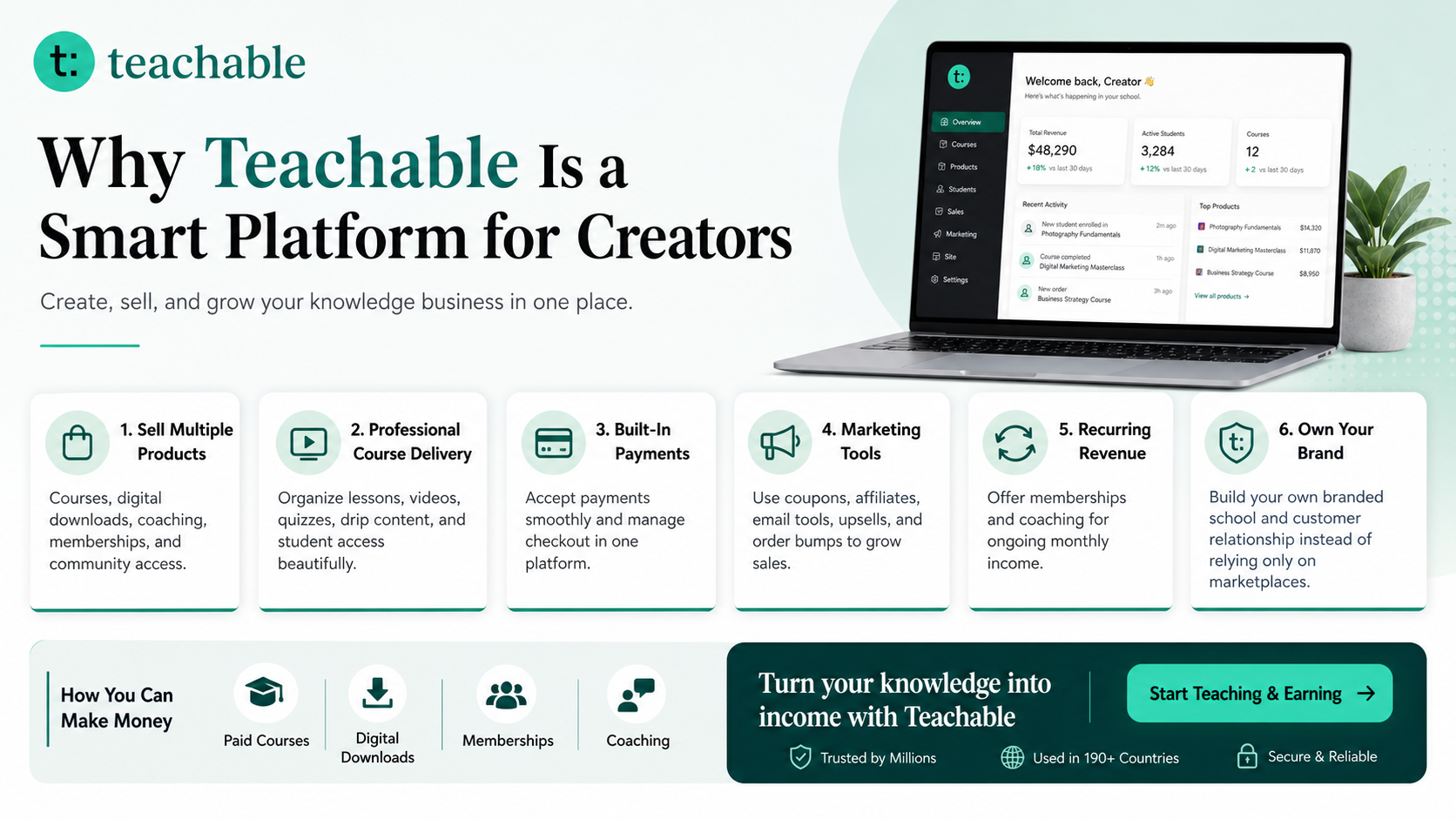
Video: How to Create a Course with Teachable
FAQs
Why should beginners learn how to create an etf watchlist?
Because ETFs are transparent, but the investor still has to read the important data. Costs, liquidity, tracking, holdings, and index changes can all affect real returns.
What is the most important ETF document?
The monthly factsheet is often the easiest regular document for beginners. The scheme document and key information document give deeper details about strategy, risks, and expenses.
How often should I check ETF facts?
Monthly tracking is not required for every investor, but quarterly and yearly reviews are sensible. Check more often only when making a fresh investment.
What is tracking error?
Tracking error measures how closely a fund follows its target index. Lower tracking error generally means the ETF is doing a better job of replicating the index.
Why does liquidity matter?
Liquidity and bid-ask spread affect the hidden cost of buying and selling. A thinly traded ETF may be harder to exit at a fair price during stress.
Should I avoid an ETF if the expense ratio rises?
Not automatically. Compare the new cost with alternatives, tracking quality, liquidity, and tax impact before switching.
Can ETF holdings change?
Yes. Holdings change when the underlying index changes or when the fund rebalances. Investors should check whether the exposure still matches their goal.
Is a checklist enough to select an ETF?
A checklist helps, but it is not a guarantee. You still need to understand the index, risk, costs, and how the ETF fits into the full portfolio.