Affiliate disclosure: This article may include referral links and useful resource links. If you click and buy through certain links, Sensecentral may earn a commission at no extra cost to you. Recommendations are included to help you compare options and build smarter.
How to Make an Extra $100 a Week

If you are searching for How to Make an Extra $100 a Week, the best starting point is not a giant business plan. It is a small, repeatable money system that fits your current time, tools, confidence level, and responsibilities. Many people fail with side hustles because they copy ideas that look exciting online but do not match their skills, location, schedule, or cash flow needs.
This guide is written for Sensecentral readers who want practical, low-risk income ideas. The goal is to help you choose an offer, test it quickly, avoid unnecessary spending, and track whether the effort is actually moving you closer to your target. You do not need to be an expert on day one. You need a clear problem to solve, a simple delivery process, and enough consistency to learn from real feedback.
The approach below focuses on earn an extra $100 per week with small repeatable tasks. You will see examples, comparison tables, daily action steps, free tools, useful resources, and realistic warnings. Treat the numbers as planning targets, not promises. Actual earnings depend on your skills, market demand, pricing, speed, and follow-up.
Table of Contents
Quick Answer
The fastest realistic path is to choose one small offer, sell it to a narrow audience, deliver it manually, and improve it after every response. For this topic, the core goal is to earn an extra $100 per week with small repeatable tasks. That means you should avoid complicated businesses at the beginning. Start with something you can explain in one sentence and deliver in one to three days.
That target equals about $14 per day, or two to four small paid tasks depending on your offer. For example, instead of saying, “I need more money,” say, “I need two $25 tasks each week,” or “I need five $100 client projects this month.” Clear math makes your actions obvious. You can then decide how many messages to send, how many listings to create, how many samples to publish, or how many local people to contact.
A good beginner side hustle has four qualities: it solves a real problem, it is easy to start, it does not require big upfront spending, and it can be repeated. The best first target is not perfection. The best first target is proof that someone is willing to pay for the result.
Income Math and Reality Check
Side hustle income becomes less confusing when you separate revenue, profit, and available money. Revenue is the total money received. Profit is what remains after platform fees, tools, travel, supplies, payment charges, and refunds. Available money is what remains after you set aside money for taxes, reinvestment, savings, or debt payments. This distinction matters because many beginners celebrate sales but later realize the real profit was much smaller.
Use a simple formula: Target income ÷ average order value = number of sales needed. If your offer is $25, a $100 target needs four sales. If your offer is $100, a $500 target needs five sales. If your offer is $250, a $1,000 target needs four clients. This is why pricing matters. A low price may feel easier to sell, but it can force you to complete too many tasks.
Also consider your time. If a $20 job takes five hours, you are earning only $4 per hour before expenses. If a $75 job takes two hours, the same effort can become meaningful income. The goal is not to charge high prices immediately. The goal is to understand the relationship between price, effort, quality, and demand.
Sensecentral tip: Track your hourly reality from the beginning. A side hustle that looks profitable on social media may feel very different after counting messages, revisions, delivery time, and waiting for payment.
Best Side Hustle Ideas for This Goal
The best ideas for this post are not necessarily the trendiest ideas. They are the ideas that match your available tools and can produce feedback quickly. For How to Make an Extra $100 a Week, consider starting with a simple service, a small digital product, or a repeatable local task. This lets you test demand before creating a complex website, buying software, or building a large audience.
1. Productized freelance service
A productized service is a service with a fixed outcome, fixed price, and fixed delivery window. Examples include “I will create five Instagram carousel templates,” “I will clean one spreadsheet,” “I will write ten product descriptions,” or “I will audit one landing page.” This works well because buyers understand what they will receive, and you do not have to negotiate every detail from zero.
2. Digital templates and downloadable assets
Digital products can be useful when you know how to package a repeated solution. Templates, checklists, planners, spreadsheets, Notion dashboards, design packs, and mini-guides can help people save time. They take effort to create once, but they can be sold repeatedly if the product solves a real problem. Start simple: one useful template is better than a huge bundle nobody understands.
3. Local or remote help services
Many people overlook simple help services because they do not sound exciting. But small businesses, busy families, freelancers, and creators often need practical help: organizing files, updating listings, creating simple graphics, researching options, formatting documents, or setting up basic tools. These services can be started with little or no money because your first asset is your time.
4. Knowledge-based offers
If you know how to do something useful, you can sell the knowledge before building a full course. Offer a short consultation, checklist, workshop, audit, or personalized action plan. Later, if people keep asking the same questions, you can turn the repeated advice into a digital product or a Teachable course.
Comparison Table: Which Option Fits Best?
| Side Hustle Option | Best For | Setup Cost | Time to First Result | Why It Fits |
|---|---|---|---|---|
| Freelance Micro-Services | Beginners with one useful skill | $0 to $20 | 3 to 14 days | Sell a small result such as a page edit, graphic, spreadsheet, or research summary. |
| Digital Templates | Creators and organized thinkers | $0 to $30 | 1 to 4 weeks | Sell checklists, planners, dashboards, scripts, or business templates. |
| Local Help Services | People who prefer nearby customers | $0 to $25 | 1 to 7 days | Offer errands, setup help, organizing, simple tech help, or weekend tasks. |
| Research Assistance | Detail-oriented beginners | $0 | 3 to 10 days | Help creators, businesses, students, or founders collect useful information. |
| Simple Content Repurposing | Fast learners and creators | $0 to $15 | 1 to 3 weeks | Turn long content into captions, summaries, carousels, or short-form outlines. |
This table is not a rulebook. It is a decision tool. Choose the option that you can start this week with your current skills. A lower-income idea that you can actually execute is better than a high-income idea that stays in your notebook for six months.
Step-by-Step Action Plan
Step 1: Pick one audience
Do not try to sell to everyone. Choose one clear group: local business owners, students, bloggers, coaches, busy parents, Etsy sellers, YouTubers, freelancers, job seekers, or small shops. A narrow audience makes your offer easier to write and your examples more relevant.
Step 2: Define one painful problem
People pay faster when the problem is clear. “I design graphics” is vague. “I create five promotional graphics for your weekend sale” is easier to understand. “I do research” is vague. “I create a competitor comparison spreadsheet for your new product idea” is specific. The more concrete the problem, the easier the sale.
Step 3: Create a simple offer
Your first offer should include the result, price, delivery time, and what the customer must provide. Example: “For $49, I will create a one-page content idea sheet with 30 post ideas for your niche. Delivery in 48 hours. You only need to send your topic and target audience.” A clear offer reduces back-and-forth and helps you look professional even as a beginner.
Step 4: Build proof quickly
Proof does not always mean paid testimonials. It can be a sample, a before-and-after redesign, a screenshot of a spreadsheet, a mock content calendar, a short case study, or a small free audit. The goal is to show the buyer what “done” looks like. If you cannot show proof yet, create three sample projects for imaginary but realistic customers.
Step 5: Contact people consistently
Income comes from conversations. Send helpful messages, reply to local posts, join relevant communities, ask existing contacts for referrals, and publish useful examples. Avoid spam. A good message is short, specific, and focused on the buyer’s problem. Mention one helpful observation and offer a simple next step.
Step 6: Deliver, collect feedback, and improve
The first few projects are not only for income. They are market research. Notice what buyers ask, what they ignore, what confuses them, and what they praise. Improve your offer after each project. Raise prices slowly when delivery becomes smoother and demand improves.
Free Tools and Useful Resources
You can start with a lean tool stack: a notes app for ideas, a spreadsheet for tracking income, a free design tool for simple visuals, a file-sharing tool for delivery, and a calendar reminder for follow-ups. Expensive software can be useful later, but it should not be your first move. Your first move is to validate demand.
For side hustlers, the most useful tools are often boring: invoice templates, calculators, checklists, content planners, proposal templates, and simple dashboards. These tools help you work faster and look more organized. Use free tools first, then upgrade only when a paid tool clearly saves time or helps you earn more.
Useful resource from Sensecentral: This post contains affiliate-style resource recommendations. Some links may earn a commission at no extra cost to you. Always compare tools and choose only what fits your plan.
Explore Our Powerful Digital Products
Browse these high-value bundles for website creators, developers, designers, startups, content creators, and digital product sellers. These resources can help you save time when building websites, selling templates, creating content, or packaging your own offers.
Zee Sharp: Free Productivity Tools Hub
Zee Sharp is a growing suite of free online tools for productivity, development, and creativity. No sign-up. No watermarks. Just tools. Use it when you need quick utilities while planning, writing, calculating, formatting, or building your side hustle workflow.
Creator Platform Resource: Teachable
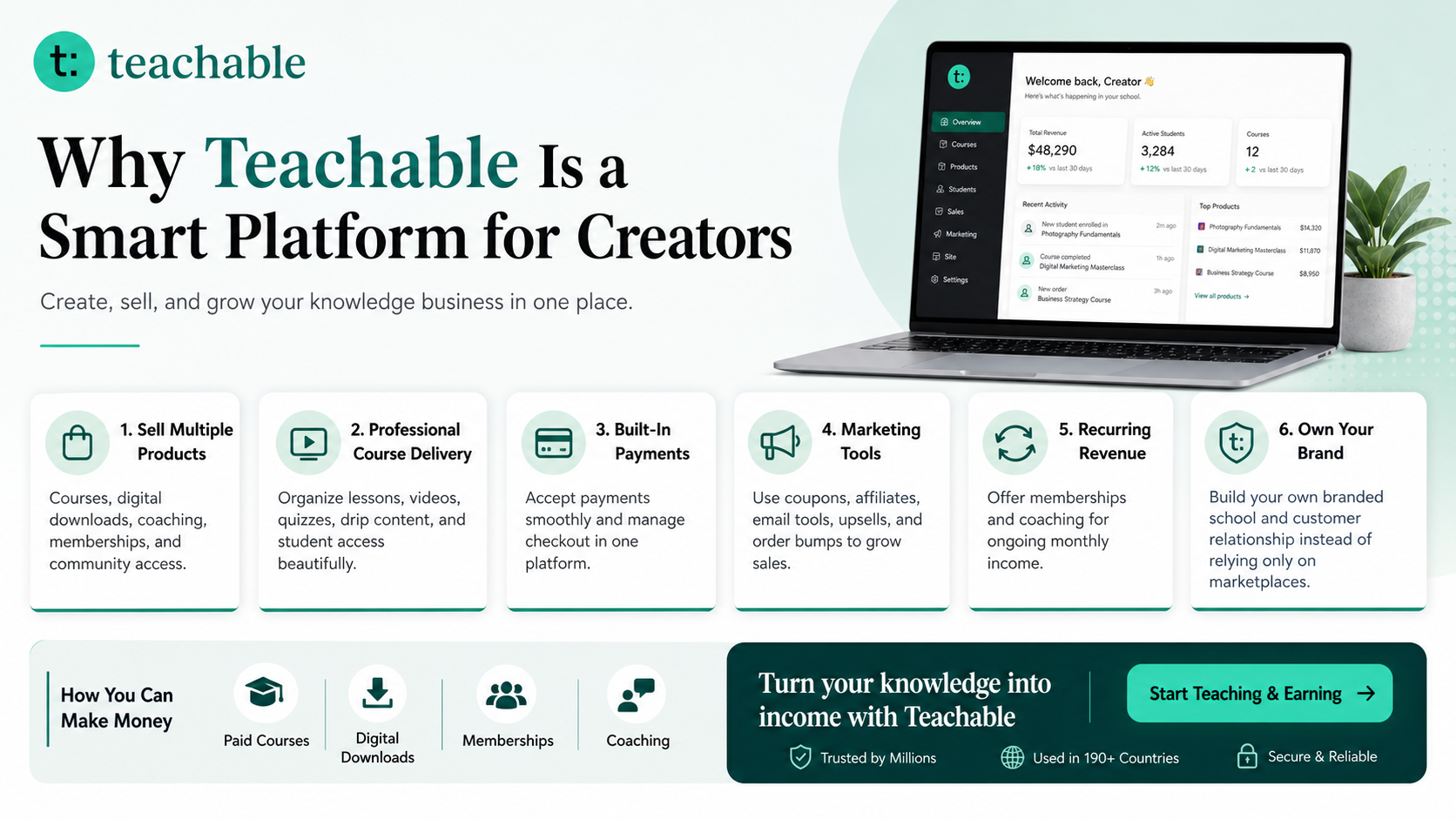
Teachable is an online platform that lets creators build, market, and sell courses, digital downloads, coaching, and memberships. It helps educators and entrepreneurs turn their knowledge into a branded digital business without needing complex coding.
How to Make Money with Teachable: A Complete Creator’s Guide
Progress Tracker: What to Measure
Tracking helps you avoid emotional decision-making. A side hustle may feel like it is failing when you are actually building early momentum. It may also feel busy when it is not profitable. Use the table below to measure real progress.
| Metric | Why It Matters | Weekly Target |
|---|---|---|
| Offers sent | Shows whether you are creating enough opportunities. | 10 to 30 focused messages |
| Replies received | Measures whether your message and audience are aligned. | 2 to 8 replies |
| Paid orders | Confirms demand and cash flow. | 1 to 5 depending on price |
| Delivery time | Protects your hourly profit. | Reduce by 10% with templates |
| Repeat buyers | Turns random income into reliable income. | Ask every happy buyer for a next step |
For this post, your most important tracking areas are qualified conversations, offers sent, paid tasks completed, and repeat buyers. Review them every Sunday. If the numbers are low, do not panic. Adjust one variable at a time: audience, offer, price, proof, or follow-up.
Common Mistakes to Avoid
Mistake 1: Buying before validating
Do not spend on tools, courses, inventory, or ads until you have proof that someone wants the offer. Many beginners spend money because spending feels like progress. But tools do not create demand. Customers create demand. Validate first, upgrade later.
Mistake 2: Choosing an idea only because it is trending
Trends can create opportunities, but they also create crowded markets. A simple service with steady demand can beat a viral idea that disappears in three months. Ask whether people already pay for the result, whether you can reach them, and whether you can deliver consistently.
Mistake 3: Underpricing forever
Starting low can help you learn, but staying too low creates burnout. Raise prices when you have proof, better delivery, or repeat demand. You can also create packages: basic, standard, and premium. Packages help buyers choose based on need instead of asking for random discounts.
Mistake 4: Not following up
Many sales happen after a polite follow-up. People are busy. They forget. They need time. A simple follow-up after two or three days can recover opportunities without being pushy. Keep it helpful: “Just checking if you still need help with this. I can send a quick example if useful.”
Mistake 5: Confusing activity with progress
Watching tutorials, changing logos, browsing tools, and rewriting bios can feel productive. But income usually comes from creating offers, contacting buyers, delivering work, and improving based on feedback. Put most of your energy there.
How to Grow the Income
Once you have a few paid results, growth becomes more practical. Start by improving the same offer instead of adding five new offers. Create templates, checklists, scripts, and delivery systems. These reduce your time per project and improve quality. When delivery becomes predictable, you can raise prices or offer monthly support.
Next, look for repeat buyers. A one-time design project can become a monthly content pack. A spreadsheet cleanup can become a monthly reporting service. A resume review can become a job application package. A website edit can become a monthly website care plan. Repeat work is the bridge between random earnings and reliable income.
Finally, consider turning your knowledge into assets. If you answer the same questions repeatedly, create a guide, template, mini-course, or workshop. This is where platforms like Teachable can be helpful for creators who want to sell structured knowledge, coaching, memberships, or digital downloads. Keep the first version simple and improve it with buyer questions.
Key Takeaways
- Start small: Choose one offer and one audience before building a complex brand.
- Use simple income math: Divide your target by your average order value to know how many sales you need.
- Validate before spending: Do not buy tools, ads, or inventory before proving demand.
- Track weekly: Measure offers sent, replies, sales, delivery time, profit, and repeat buyers.
- Improve step by step: Better proof, clearer offers, stronger follow-up, and higher-value packages create growth.
FAQs
How quickly can I earn from this side hustle approach?
Some people earn within a few days if they already have a useful skill, a clear offer, and access to potential buyers. For most beginners, a realistic first target is to get conversations and feedback within the first week, then aim for the first small sale within 2 to 4 weeks. The timeline depends on your offer, pricing, outreach, and consistency.
Do I need a website to start?
No. A website can help later, but it is not required for your first test. You can start with a simple portfolio page, a Google Doc, a marketplace profile, a social media profile, or direct outreach. Build a website when you know what offer and audience deserve a permanent home.
What if I have no technical skills?
Choose service ideas that rely on communication, organization, research, writing, local help, or simple free tools. Many paid tasks do not require coding or advanced software. They require reliability, clarity, and the ability to complete a useful result.
Should I use paid ads?
Paid ads are not the best first step for most beginners. Start with free validation through outreach, communities, referrals, content, and marketplaces. Ads can scale a proven offer, but they can also waste money if your offer, pricing, and conversion process are not ready.
How do I know when to quit or change the idea?
Do not quit after a few quiet days. First check whether you contacted enough people, whether your audience is specific, whether your offer is clear, and whether your proof is convincing. If you have sent focused outreach for several weeks with no replies, test a different audience or offer before abandoning the entire side hustle.
Internal Links and Further Reading from Sensecentral
Continue learning with these related Sensecentral resources:
References
Use these sources to understand disclosures, taxes, market validation, and creator platforms before making financial or business decisions: