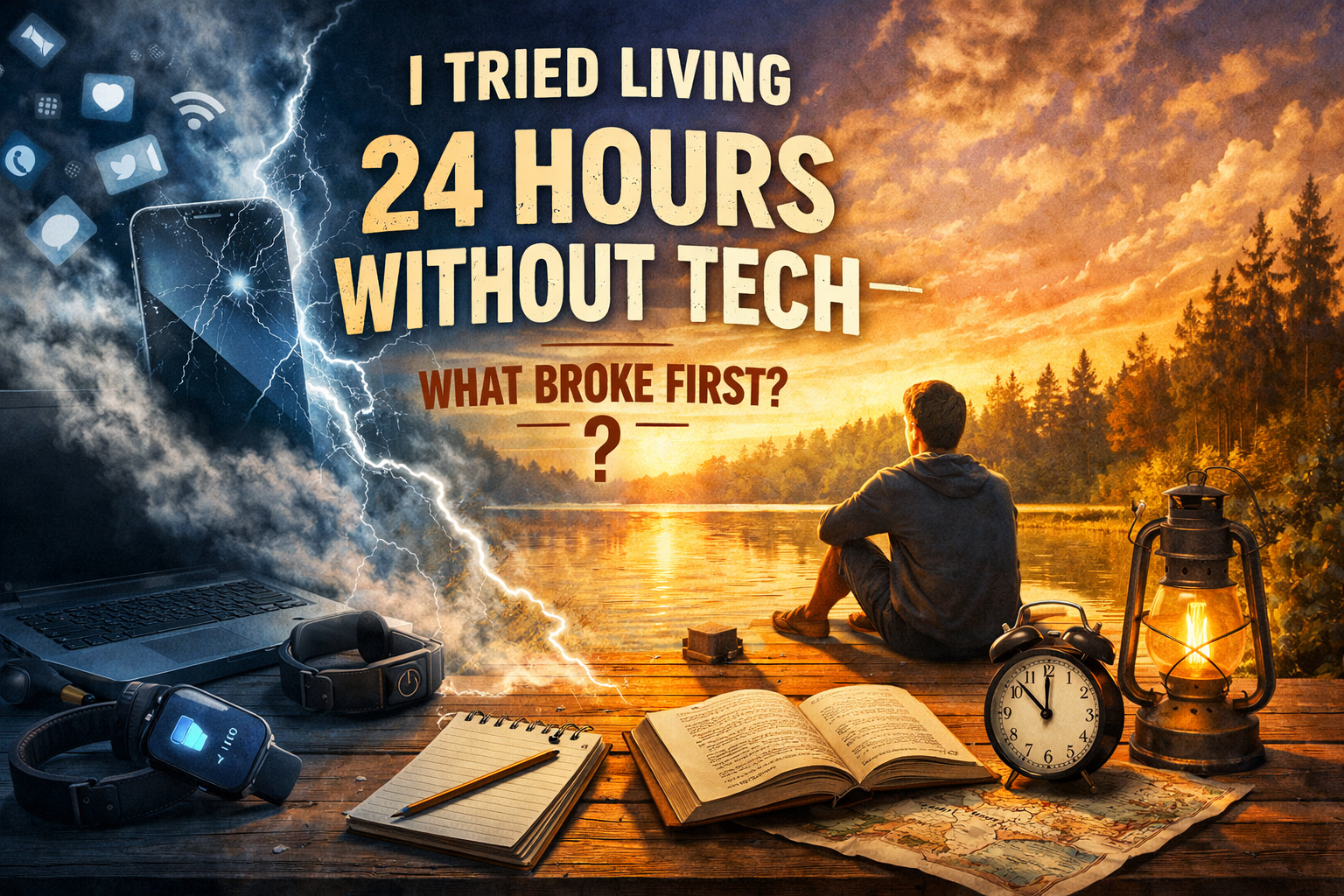
For one day, I unplugged. No smartphone. No laptop. No smartwatch. No TV. No “just quickly checking” anything. I thought the hardest part would be boredom. I was wrong. The hardest part was how much of my daily life is quietly propped up by tech—even the parts I swear are “simple.”
- The Rules of My 24-Hour No-Tech Experiment
- What I Thought Would Break First
- Hour-by-Hour: What Actually Happened
- Hour 1: The Alarm Problem
- Hour 2–3: The Phantom Reach
- Hour 4–5: Planning Turned Into Guesswork
- Hour 6–8: The Navigation Collapse
- Hour 9–11: The Social Silence
- Hour 12–14: Time Started Acting Differently
- Hour 15–17: Entertainment Withdrawal (But Not How I Expected)
- Hour 18–20: I Started Noticing Everything
- Hour 21–24: The Final Test—The “Just This Once” Moment
- So… What Broke First?
- What I Learned (And What You Can Copy)
- A Practical “No-Tech Day” You Can Actually Do
- FAQ: Living Without Tech for 24 Hours
- 1) Is it safe to go 24 hours without a phone?
- 2) What if my work needs tech?
- 3) Can I use a basic phone instead of a smartphone?
- 4) What’s the hardest part for most people?
- 5) Does a digital detox actually improve mental health?
- 6) What should I do when I feel the urge to check my phone?
- 7) Will I become more productive?
- 8) How do I prevent “rebound scrolling” afterward?
- Final Takeaway
This is a full breakdown of what happened when I tried living 24 hours without technology, what failed first, what surprised me, what I learned about attention (and anxiety), and a practical way you can try it too—without turning it into a miserable survival challenge.
The Rules of My 24-Hour No-Tech Experiment
Before starting, I had to define “tech,” because modern life is basically built on invisible electronics. I decided the goal wasn’t to live like it’s 1800—it was to see what breaks when my digital tools disappear.
Here were my rules:
✅ What I avoided
Smartphone (calls, texting, camera, notes, alarms, apps—everything)
Laptop/desktop/tablet
Social media and messaging apps
Streaming, TV, YouTube
Smartwatch/fitness trackers
GPS and maps
Digital payments (UPI, card tap, online banking)
News apps, podcasts, music streaming
✅ What I allowed (so the day remained realistic)
Basic household electricity: lights, fan, fridge
Stove for cooking
Emergency phone access only if someone’s safety required it (never used)
Offline printed materials: books, newspapers, notes
Pen, paper, analog clock if available
In short: no digital convenience, but normal living.
What I Thought Would Break First
I expected:
boredom
missing entertainment
“nothing to do” anxiety
What actually broke first:
my ability to move through the day smoothly
my sense of orientation
my automatic habit loops (reach phone → scroll → dopamine → repeat)
It wasn’t “I have nothing to do.”
It was “I don’t know how I usually do anything.”
Hour-by-Hour: What Actually Happened
Hour 1: The Alarm Problem
The first failure was embarrassingly basic: waking up.
Most of us don’t just use our phones to wake up. We use them to:
set multiple alarms
check the time without getting up
instantly assess the day (messages, calendar, weather)
Without an alarm, I had to rely on an analog clock and internal timing. The result? I woke up uncertain—not late, not early, just… unsure. That uncertainty was the first crack.
What broke first: my confidence that the day is “under control.”
Hour 2–3: The Phantom Reach
Within minutes, I noticed the weirdest thing:
my hand kept moving toward where my phone usually sits.
Not because I needed anything.
Because my brain wanted the tiny reward of checking.
This is the part nobody talks about: tech isn’t only a tool; it becomes a pacifier for micro-emotions:
awkwardness
waiting
slight stress
mild boredom
uncertainty
Without that quick digital soothing, those feelings didn’t disappear. They simply showed up, unfiltered.
What broke: my automatic emotional numbing system.
Hour 4–5: Planning Turned Into Guesswork
When I needed to do something simple—like handle errands or plan tasks—the absence of a phone was louder than expected.
Normally, my phone quietly manages:
reminders
lists
location/time estimates
quick research (“What time does it open?”)
quick decisions (“Which route is faster?”)
Without it, I had two choices:
do fewer things, more slowly
plan like a human being again—on paper, with uncertainty
I chose paper.
It worked… but it felt like stepping into fog. My brain was used to instant clarity.
What broke: my expectation of immediate answers.
Hour 6–8: The Navigation Collapse
This was the biggest practical problem: navigation.
Even if you know your city well, tech has trained us to outsource:
directions
traffic patterns
landmarks
“where exactly is the entrance?”
Without maps, I had to:
ask people
look for signs
memorize turns
accept minor mistakes
And that was the moment I understood something important:
GPS didn’t just make travel easier. It made being wrong feel unacceptable.
When you always have perfect navigation, wrong turns become a personal failure instead of a normal part of being alive.
What broke: my tolerance for small uncertainty.
Hour 9–11: The Social Silence
No messages. No calls. No pings.
At first, it was peaceful. Then it became strange.
Not because I needed to talk to anyone—because I realized how much of my social life is built on light-touch presence:
quick replies
reactions
“seen”
background connection
Without tech, connection became binary: either you’re with someone, or you’re not.
This exposed another truth:
digital communication doesn’t just connect us—it also reduces loneliness by simulating closeness.
What broke: my assumption that I’m “socially connected” all day.
Hour 12–14: Time Started Acting Differently
At the halfway point, I noticed something shocking:
The day felt longer.
Not in a painful way. In a “wow, time is actually time” way.
Tech compresses time because it fills every gap:
waiting → scrolling
silence → audio
boredom → feeds
Without tech, gaps returned. And in those gaps, my mind did what it used to do naturally:
reflect
replay conversations
generate ideas
daydream
feel emotions fully
It wasn’t always comfortable.
But it was incredibly… real.
What changed: time stopped being something to “kill.”
Hour 15–17: Entertainment Withdrawal (But Not How I Expected)
I assumed I’d miss movies or social media the most. I didn’t.
What I missed was the ability to “switch off” instantly.
Without tech, rest required intention:
sit quietly
walk
stretch
read
do nothing without stimulation
That’s harder than it sounds when your nervous system is used to constant input.
I learned that tech often functions like a remote control for my brain:
press play → feel better
open app → feel less restless
Without it, I had to build calm the slow way.
What broke: my instant-relief button.
Hour 18–20: I Started Noticing Everything
This part felt almost poetic:
I noticed how loud normal streets are.
I noticed how often I interrupt myself.
I noticed how many decisions I make per hour.
I noticed how often I reach for stimulation, not because I need it—but because I’m trained to.
It wasn’t a magical enlightenment. It was just awareness returning.
And awareness is powerful… because it shows you your defaults.
What returned: attention.
Hour 21–24: The Final Test—The “Just This Once” Moment
The hardest part came near the end, when I felt I’d “earned” a small exception.
That’s the real trap:
“I’ll just check one thing.”
“Just reply quickly.”
“Just see the news.”
“Just 2 minutes.”
Because tech doesn’t re-enter your life gently.
It re-enters like a flood.
So I didn’t break the rule.
But I did write down what I wanted to check—and it was eye-opening:
messages (validation)
news (control)
analytics (reward)
notifications (meaning)
weather (certainty)
The phone is not one thing.
It’s a bundle of emotional needs packaged as a rectangle.
What almost broke: my discipline—powered by rationalization.
So… What Broke First?
If I had to answer honestly:
1) My habit loops
My hand moved before my brain decided.
2) My sense of certainty
Without maps, reminders, weather, quick answers, I felt “unprepared.”
3) My instant soothing mechanism
Without scrolling, I had to feel what I was avoiding.
And then came the bigger realization:
Tech didn’t just entertain me. It held up my routines, decisions, and emotional regulation.
What I Learned (And What You Can Copy)
The real benefits weren’t “more productivity”
They were:
calmer attention
better awareness of impulses
more meaningful rest
reduced mental clutter
time felt richer
The real challenge wasn’t boredom
It was:
discomfort
uncertainty
waiting without stimulation
handling small anxiety without a digital escape
A Practical “No-Tech Day” You Can Actually Do
If 24 hours feels intense, try this instead:
Option A: 4-hour mini detox
Put phone in another room
Use paper for notes
Take a walk without audio
Do one analog activity (cook, clean, read)
Option B: “No-Tech Mornings”
No phone for the first 60 minutes
No notifications until breakfast
Journal or stretch first
Option C: “Tech Windows”
Use tech only in scheduled blocks (e.g., 11–12 and 6–7)
Everything else remains offline
Even one small change exposes how your brain negotiates.
Key Takeaways
The first thing that “breaks” isn’t entertainment—it’s your automatic habit loops (the reflex to check your phone).
Modern life runs on hidden tech support: alarms, reminders, navigation, payments, and quick answers.
Without constant stimulation, time feels slower—but richer, and your mind starts finishing thoughts again.
The hardest moments are uncertainty and discomfort, not boredom—because tech often works as instant emotional relief.
A realistic detox doesn’t need to be extreme: start with 4 hours, no-tech mornings, or scheduled tech windows.
Prevent rebound scrolling by reintroducing tech with intention (messages first, feeds later—or not at all).
FAQ: Living Without Tech for 24 Hours
1) Is it safe to go 24 hours without a phone?
It can be, if you plan for emergencies. Let someone close know what you’re doing, and keep emergency access available if needed. Safety comes first.
2) What if my work needs tech?
Choose a weekend or holiday, or do a partial detox (like evenings only). The experiment still works if you reduce tech significantly.
3) Can I use a basic phone instead of a smartphone?
Yes. A basic phone for calls only keeps you reachable while still removing the biggest distractions.
4) What’s the hardest part for most people?
Not entertainment—habit withdrawal and the discomfort of silence, waiting, and uncertainty.
5) Does a digital detox actually improve mental health?
For many people it helps reduce overstimulation and improve attention. But results vary. If tech is deeply tied to your job or support system, a partial detox may be healthier than an extreme one.
6) What should I do when I feel the urge to check my phone?
Name the urge (“I’m seeking stimulation”), pause for 10 seconds, and replace it with a simple action: drink water, breathe, write one sentence, or walk for 2 minutes.
7) Will I become more productive?
Maybe, but the bigger win is usually clarity—you stop scattering attention and start finishing thoughts.
8) How do I prevent “rebound scrolling” afterward?
Reintroduce tech with a plan: check messages once, then stop. Don’t open social apps immediately. Start with essentials first.
Final Takeaway
Going 24 hours without tech didn’t prove that technology is evil.
It proved something more useful:
I didn’t realize how much of my life was running on autopilot—until the autopilot disappeared.
What broke first wasn’t my phone.
It was my default way of coping with modern life.
And once you see that, you can decide—on purpose—what role tech should play in your day.