- Table of Contents
- A Black Hole in One Sentence
- Black Hole Anatomy (The Parts That Matter)
- 1) Event Horizon (The “Waterfall Edge”)
- 2) Accretion Disk (The Bright Stuff)
- 3) The “Shadow” (The Silhouette)
- 4) Singularity (The Unknown Core)
- How Do Black Holes Form?
- Stellar Collapse (Star-Size Black Holes)
- Mergers (Black Holes Combining)
- Supermassive Growth (Galaxy-Center Giants)
- What Does “Inside a Black Hole” Even Mean?
- What Happens as You Get Close?
- 1) Gravity Gets Extreme
- 2) Spaghettification (Stretching and Squeezing)
- 3) Time Dilation (The Weird Clock Effect)
- 4) Radiation and Heat (The Real Danger Near Active Black Holes)
- Crossing the Event Horizon: The Point of No Return
- What Happens After You Cross?
- Types of Black Holes (Quick Guide)
- How Do We Know Black Holes Exist?
- What the Famous Black Hole Images Really Show
- M87* (First-Ever Black Hole Image, Released in 2019)
- Sagittarius A* (Our Milky Way’s Central Black Hole, Released in 2022)
- Do Black Holes Last Forever? (Hawking Radiation)
- Common Myths (And the Simple Truth)
- Myth 1: Black holes suck everything like a vacuum cleaner.
- Myth 2: The event horizon is a physical “wall.”
- Myth 3: We can easily use black holes as wormholes.
- Myth 4: The black hole image shows the hole itself.
- Key Takeaways
- FAQ
- Can anything escape a black hole?
- Would you see darkness if you fell into one?
- Do black holes destroy everything nearby?
- Is the singularity real?
- Are black holes proven?
- What’s the difference between the “shadow” and the event horizon?
- References & Further Reading (External Links)
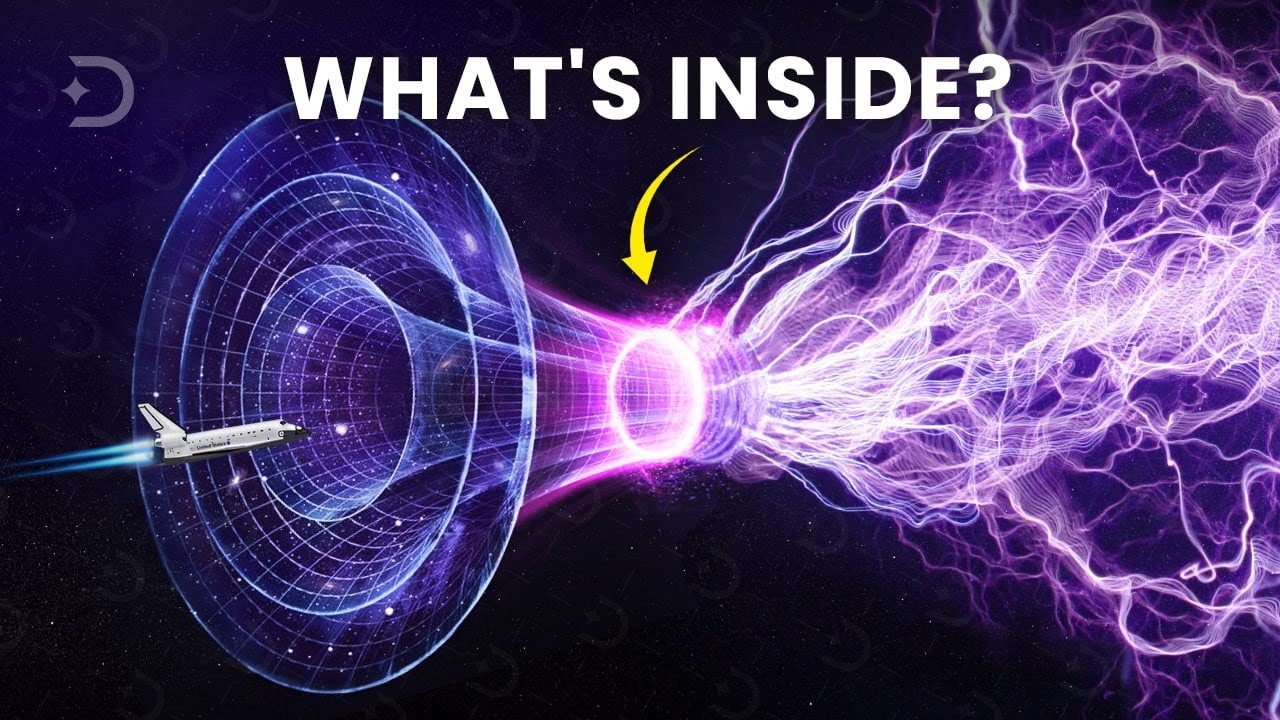
If black holes sound like “space monsters,” you’re not alone. They’re often described as cosmic vacuum cleaners that swallow everything. But the truth is both simpler and more mind-bending:
- A black hole is not a “hole.” It’s a region of space where gravity is so strong that escape becomes impossible past a boundary.
- “Inside” a black hole means “beyond a point of no return,” where every possible path forward leads deeper in.
- We can’t look inside directly—but we can understand what physics predicts and what observations confirm.
Let’s take the mystery apart in plain language—no complicated equations, no PhD required.
Table of Contents
A Black Hole in One Sentence
A black hole is a region of space where gravity is so intense that beyond a boundary called the event horizon, nothing—not even light—can escape.
That’s it. That’s the core idea. Everything else is details and consequences.
Black Hole Anatomy (The Parts That Matter)
1) Event Horizon (The “Waterfall Edge”)
Imagine a river flowing toward a huge waterfall. Far upstream, you can paddle back. Closer to the edge, the current gets stronger. At one exact boundary, the water becomes so fast that no boat can paddle back.
That boundary is the event horizon. Once you cross it, “escape” isn’t about speed or engines anymore—space itself is shaped so that all possible futures go inward.
2) Accretion Disk (The Bright Stuff)
Black holes are “black,” but the area around them often isn’t. Gas and dust can spiral in like water down a drain, heating up from friction and becoming extremely bright. That swirling, glowing structure is called an accretion disk.
This is why many “black hole pictures” look like bright rings: we’re seeing hot material around the black hole, not the black hole itself.
3) The “Shadow” (The Silhouette)
The black hole doesn’t emit light, but its gravity bends light around it. The result can be a dark central region in images—often called the black hole’s shadow. It’s more like a silhouette created by light-bending and captured photons.
4) Singularity (The Unknown Core)
In Einstein’s general relativity, the center becomes a place where density and curvature blow up to infinity—a singularity. But here’s the honest truth:
- We do not have a complete theory that combines gravity and quantum physics.
- So the “singularity” may signal that our current math breaks down, not necessarily that nature creates an actual “infinite point.”
How Do Black Holes Form?
Stellar Collapse (Star-Size Black Holes)
When a very massive star runs out of fuel, it can no longer support itself against gravity. The core collapses. If the remaining core is massive enough, it collapses past the point where an event horizon forms.
Mergers (Black Holes Combining)
Black holes can orbit each other, spiral inward, and merge into a larger one. These mergers create ripples in spacetime called gravitational waves.
Supermassive Growth (Galaxy-Center Giants)
At the centers of many galaxies (including our own Milky Way), there are supermassive black holes. They likely grew through a mix of:
- eating gas and stars over long periods,
- merging with other black holes,
- and possibly forming early in the universe through rapid growth pathways.
What Does “Inside a Black Hole” Even Mean?
In everyday life, “inside” means you can look around and map the walls. With black holes, the key is causality—what can influence what.
Outside the event horizon: you can still send signals outward (light, radio, anything) and escape is possible in principle.
Inside the event horizon: every possible path you can take leads deeper inward. It’s not just “hard to escape.” It’s “escape is not part of the geometry anymore.”
So “inside a black hole” is less like being trapped in a room, and more like being past the last exit on a one-way highway—except the “highway” is spacetime itself.
What Happens as You Get Close?
1) Gravity Gets Extreme
Gravity increases as you approach. But it’s not just stronger gravity—it’s the difference in gravity across your body that matters. That difference is called a tidal force.
2) Spaghettification (Stretching and Squeezing)
If you fall feet-first toward a small black hole, your feet feel stronger gravity than your head. That means you get stretched—like spaghetti.
For supermassive black holes, the tidal forces near the horizon can be smaller, so you might not get torn apart until much later.
3) Time Dilation (The Weird Clock Effect)
From far away, an outside observer would see your clocks slow down as you get close. Your light becomes redder and dimmer. You appear to “freeze” near the horizon (this is a simplified description, but it’s a useful mental image).
From your own perspective, your clock feels normal. You don’t feel time “slowing down” on your wristwatch.
4) Radiation and Heat (The Real Danger Near Active Black Holes)
Popular stories focus on the horizon, but many real black holes are surrounded by intense, hot, high-radiation environments. An active accretion disk can be deadly long before the horizon matters.
Crossing the Event Horizon: The Point of No Return
Here’s the strangest part for beginners:
You may not feel anything special at the exact moment you cross the event horizon—especially for a large black hole. There is no solid “surface.” It’s a boundary defined by how paths in spacetime behave.
But once you cross it, the future direction of “out” stops being available. It becomes as impossible as going to “yesterday.”
What Happens After You Cross?
In General Relativity: All Roads Lead to the Center
Inside, the equations of general relativity say you can’t avoid moving toward the center—just like you can’t avoid moving toward tomorrow. The “center” becomes part of your unavoidable future.
What’s Actually at the Center?
This is where science gets beautifully honest. We have strong evidence that event horizons exist and that black holes behave as predicted in many ways. But the very center is beyond direct observation, and our physics is incomplete there.
So the simple truth is:
- We can describe the boundary and surroundings very well.
- We can predict what should happen up to a point.
- But “the final answer” about the singularity likely requires quantum gravity—a theory we don’t fully have yet.
Types of Black Holes (Quick Guide)
- Stellar-mass black holes: formed from collapsing massive stars.
- Intermediate-mass black holes: “middleweight” candidates; still actively researched.
- Supermassive black holes: millions to billions of times the Sun’s mass, often in galaxy centers.
How Do We Know Black Holes Exist?
1) We See Their Gravity
We watch stars orbit something invisible, extremely massive, and extremely compact. If it were a normal cluster of stars, it would glow or behave differently.
2) We See Bright Disks and Jets
When black holes feed, their surroundings can shine across the electromagnetic spectrum—radio, X-ray, and more. Some systems launch jets that extend thousands of light-years.
3) We “Hear” Mergers via Gravitational Waves
LIGO’s first direct detection of gravitational waves in 2015 came from a black hole merger signal. That’s a different kind of evidence: not light, but spacetime ripples.
What the Famous Black Hole Images Really Show
M87* (First-Ever Black Hole Image, Released in 2019)
The famous orange ring isn’t a photograph of the black hole’s “body.” It’s glowing gas around it. The dark center is the shadow: a region where light is captured or strongly bent.
Sagittarius A* (Our Milky Way’s Central Black Hole, Released in 2022)
The image looks similar, but it was harder to capture because Sagittarius A* changes quickly. Still, the result is consistent with the same basic physics: a bright ring around a dark center.
Do Black Holes Last Forever? (Hawking Radiation)
Classically, black holes only grow. But quantum physics suggests something shocking: black holes can slowly lose mass through Hawking radiation.
The simple version:
- Quantum effects near the event horizon can produce a tiny trickle of radiation.
- If a black hole isn’t gaining mass from its surroundings, it can slowly shrink.
- For black holes made from stars, this process is unbelievably slow—far longer than the current age of the universe.
So yes, in theory black holes can evaporate—but not in any way that affects your daily life.
Common Myths (And the Simple Truth)
Myth 1: Black holes suck everything like a vacuum cleaner.
Truth: If the Sun were replaced by a black hole of the same mass, Earth would orbit almost the same way. Black holes are dangerous mainly if you get close.
Myth 2: The event horizon is a physical “wall.”
Truth: It’s a boundary in spacetime, not a solid surface.
Myth 3: We can easily use black holes as wormholes.
Truth: Wormholes are speculative. Real black holes are not known to be safe portals.
Myth 4: The black hole image shows the hole itself.
Truth: It shows light from hot gas around it and the shadow created by light-bending/capture.
Key Takeaways
- A black hole is defined by the event horizon: the boundary beyond which escape is impossible.
- “Inside” means you’re past a causal point of no return, not inside a hollow tunnel.
- Many black holes are “seen” by their accretion disks, jets, and gravitational effects—not by direct light from the hole.
- Falling in involves extreme tidal forces, time effects, and (often) lethal radiation from surrounding matter.
- The exact nature of the center (“singularity”) is still an open frontier because quantum gravity isn’t complete.
FAQ
Can anything escape a black hole?
From inside the event horizon, no signal can escape outward. Outside the horizon, matter and light can still escape if they’re not trapped.
Would you see darkness if you fell into one?
You could still see light from the outside universe for a while, but it would look distorted and shifted in color due to extreme gravity and motion. The environment near an active black hole could also be blindingly bright.
Do black holes destroy everything nearby?
No. Like any object, their gravity depends on mass and distance. You only get shredded if you get very close.
Is the singularity real?
General relativity predicts it, but many physicists suspect it signals the limits of the theory. We need quantum gravity to know what truly happens at the core.
Are black holes proven?
We have multiple strong lines of evidence: stellar orbits around invisible compact masses, emissions from accretion disks and jets, gravitational-wave detections of mergers, and horizon-scale imaging consistent with predictions.
What’s the difference between the “shadow” and the event horizon?
The event horizon is the true point of no return. The “shadow” is the dark region in images created by light-bending and photon capture—bigger than the horizon and influenced by how light travels near it.
References & Further Reading (External Links)
- NASA: Black Hole Basics
- NASA: Black Hole Anatomy
- NASA GSFC: Imagine the Universe — Black Holes
- NASA Space Place: What Is a Black Hole?
- NASA: What happens when something gets too close?
- EHT: First Image of M87* (2019 press release)
- EHT Collaboration Paper (arXiv): The Shadow of the Supermassive Black Hole
- EHT: First Image of Sagittarius A* (2022)
- Chandra: Sagittarius A* Image Page
- NASA JPL: How the first black hole image was captured
- LIGO Caltech: GW150914 press release
- Physical Review Letters: Observation of GW150914
- Encyclopaedia Britannica: Event Horizon
- Encyclopaedia Britannica: Hawking Radiation
- NASA Glossary: Hawking Radiation (H–M)
- ESA: Black holes
- Stanford Encyclopedia of Philosophy: Spacetime Singularities