It is a surveying method used to determine the level of points/objects with reference to the selected datum.
· It is also used to set out engineering works.
Uses of Levelling:
· To determine the difference in levels of points/Objects
· To obtain contour map of an area
· To obtain cross section of roads, canals etc.,
· To determine the depth cutting and filling in engineering works.
· To establish points or erect machinery or construct a building component at a predetermined level.
Important Terms:
Bench Mark:
It is surveyor’s mark cut on a stone/ rock or any reference point used to indicate a level in a levelling survey.
Reduced Level:
· Reduced level of a point is the level of the point with respect to the level of permanent feature or bench mark.
· It indicates whether the point is above or below the reference point (datum).
Instruments used in levelling:
Instruments used in levelling are,
(i) Levelling instrument
(ii) Levelling staff
Levelling Instrument :
· Simplest form of levelling instrument is dumpy level.
· The different parts of levelling instrument are,
(a) Telescope (b) Eye-piece (c) focussing knob (d) level tube (e) cross bubble (f) foot screws (g) levelling head (h) diaphragm (i) ray shade
Dumpy Level:
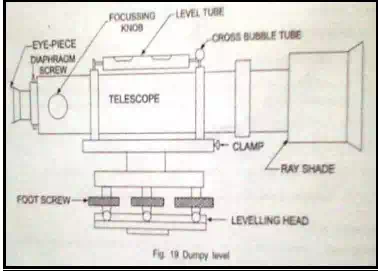
Levelling Staff:
· It is an important accessory used with levelling instrument at the time of conducting levelling survey.
· Reading is taken on the levelling staff held properly at the point concerned by viewing through the telescope of the levelling instrument.
· Usually 4 m levelling staff may be used of folding type or telescopic type
· Aluminium levelling staff foldable at every metre length has also came to the market
· The levelling staff consists of three pieces.
· The topmost one slides into the middle one and the middle portion slides into the bottom one.
· When the staff is fully pulled, it will read exactly 40 decimeters (4m) from the bottom shoe.
Graduation in levelling staff:
· Every metre length is divided into 200 divisions.
· The divisions are painted in black and white alternately of thickness 5 mm each.
· The graduation figures are marked at every decimeter length.
· The number indicating metre is in red and the decimeter number is in black
· Thus, a graduation figure of 24 indicates 2 metres and 4 decimeters.
· The graduation are made continuously one above the other in the same line.
· The division lines should be parallel to the base of the bottom shoe and perpendicular to the length of the staff.
· The edges of the division lines should be straight sharply defined.
· They should be clear and made distinctly visible by properly contrasting.
· The graduation colour paints used should not crack or blister when exposed to adverse or atmospheric conditions.