
Liquid crude or product pipelines are handled much the same way, with pump stations and block valve stations along the pipeline. However, when the pipeline goes up or down over hills and mountains, they behave differently. Liquid, due to the much higher specific gravity, will experience much higher pressure drops uphill, and increases downhill, than gas. This often requires additional pumping capacity uphill and corresponding pressure-reducing turbines (or braking stations) downhill. In case electrical power is used, the braking power from the turbine can be fed back into the grid.
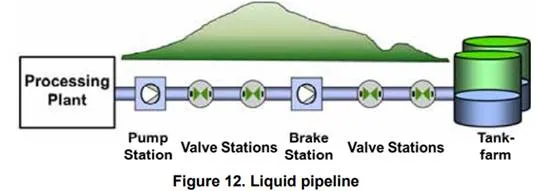
Block valve stations (or line valve stations) are used with many of the same functions as gas pipelines. It is important to limit accidental spills in case of rupture of the pipeline, and placement will be determined both by maximum leak volume as well as city, river or valley crossings and wherever it is particularly important to prevent spills.