
The present serviceability index (PSI) is based on the original AASHO Road Test PSR. Basically, the PSR was a ride quality rating that required a panel of observers to actually ride in an automobile over the pavement in question. Since this type of rating is not practical for large-scale pavement networks, a transition to a non-panel based system was needed.
To transition from a PSR serviceability measure (panel developed) to a PSI serviceability measure (no panel required), a panel of raters during 1958 to 1960 rated various roads in the states of Illinois, Minnesota, and Indiana for PSR. This information was then correlated to various pavement measurements (such as slope variance (profile), cracking, etc.) to develop PSI equations. Further, the raters were asked to provide an opinion as to whether a specific pavement assessed for PSR was “acceptable” or “unacceptable” as a primary highway (see PSR). Thus, although PSI is based on the same 5-point rating system as PSR it goes beyond a simple assessment of ride quality. About one-half of the panel of raters found a PSR of 3.0 acceptable and a PSR of 2.5 unacceptable. Such information was useful in selecting a “terminal” (or failure) serviceability (PSI) design input for empirical structural design equations. It is interesting to note that the original AASHO Road Test rater opinions are based on car ride dynamics; it is unclear whether such levels are acceptable for trucks.
Pavement performance can then be defined as “The serviceability trend of a … (pavement segment) with increasing number of axle applications” (Highway Research Board, 1972[1]). Figure 1 further demonstrates this concept.
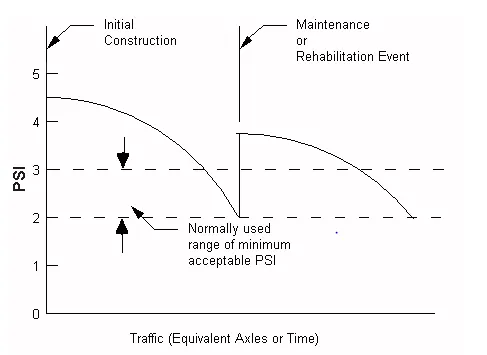
Figure 1. Concept of pavement performance using Present Serviceability Index (PSI) (Hveem and Carmany, 1948).