- What happened (and what’s still unconfirmed)
- Rare earths 101: what they are and why magnets matter most
- Why Japan is exposed: where rare earths sit in Japan’s tech stack
- Where rare earth magnets show up in Japan’s tech supply chain
- Japan remembers 2010—and built defenses
- What could break first: likely pressure points in Japan’s supply chain
- 1) Tier-2 and Tier-3 suppliers (the invisible bottleneck)
- 2) High-temperature and high-performance magnet grades
- 3) Products that require stable quality and certification
- 4) Price pressure and margin compression
- Scenario map: from “paperwork delays” to “real shortages”
- Scenario A: “Friction, not a ban” (most common early-stage outcome)
- Scenario B: “Targeted slowdowns” (pressure applied strategically)
- Scenario C: “Sustained curbs” (months-long constraint)
- Scenario D: “Shock event” (sudden escalation)
- Japan’s options: stockpiles, diversification, recycling, redesign
- 1) Strategic stockpiles (buy time, not independence)
- 2) Diversifying suppliers (the hardest but most decisive lever)
- 3) Recycling and “urban mining” (faster than new mines, but still limited)
- 4) Redesign and substitution (strategic, but not instant)
- 5) Allied coordination (critical minerals become “club goods”)
- Global knock-ons: prices, allies, and the new “magnet race”
- 1) Price volatility and regional premiums
- 2) Faster industrial policy (subsidies, permitting, strategic reserves)
- 3) Trade law and retaliation risk
- What to watch next (signals that matter)
- Key Takeaways
- FAQs
- 1) Are rare earths actually rare?
- 2) Why are “heavy” rare earths so important for Japan?
- 3) Could Japan replace China quickly?
- 4) Will consumers in Japan notice this?
- 5) Is this similar to 2010?
- 6) What’s the single most important indicator that this is escalating?
- References & further reading

Last updated: January 10, 2026
Rare earths rarely make headlines until they suddenly do—because modern technology quietly depends on them.
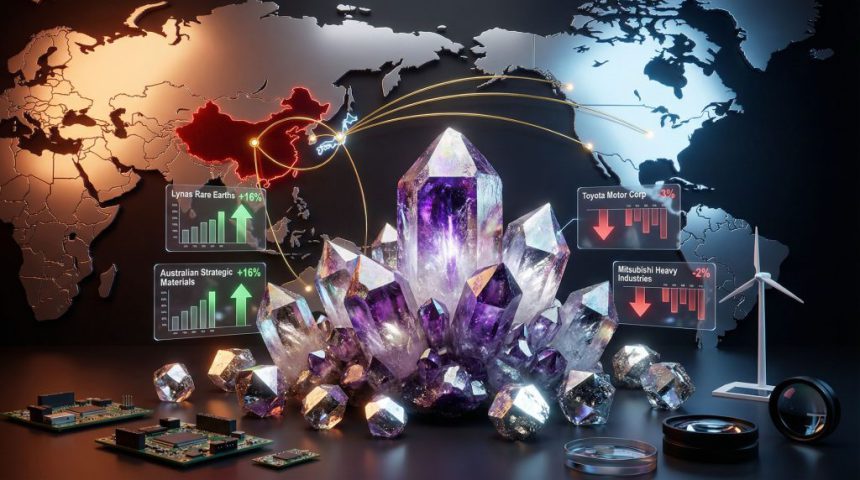
This week, they are back at the center of geopolitics after reports that China has begun restricting exports of certain rare earths and rare-earth magnets to Japanese companies, following a separate Chinese announcement limiting exports of “dual-use” goods to Japan’s military.
If you’re wondering why this matters beyond diplomacy, here’s the short answer:
rare earth magnets are a hidden “must-have” component inside motors, sensors, speakers, pumps, robotics, and advanced electronics—the exact building blocks of Japan’s automotive, electronics, and precision manufacturing strengths.
Even small disruptions can ripple across production lines, inventories, pricing, and product launches.
This post breaks down what’s happening, what could be affected, and how Japan’s tech supply chain may respond—based on what’s known so far and the lessons of past rare-earth shocks.
What happened (and what’s still unconfirmed)
According to reporting summarized by Reuters, the situation has two layers:
- Layer 1 (official): China announced restrictions on exports of certain dual-use items to Japan’s military—goods and technologies that can be used for civilian and military purposes.
- Layer 2 (reported impact): The Wall Street Journal reported that, since the announcement, Chinese exporters have experienced a freeze or slowdown in license reviews that appears to affect Japanese companies across industries—potentially including “heavy” rare earths and the magnets that contain them.
This distinction matters because policy announcements and real-world enforcement can diverge. Officials may say “civilian users won’t be affected,” while exporters and importers experience slower approvals, additional end-user checks, or informal “soft curbs.”
In supply chains, those frictions can feel like a ban even when no formal ban exists.
If you want to read the reporting directly, start here:
- Reuters (Jan 9, 2026): China curbs rare earth exports to Japanese companies after dual-use ban (WSJ report)
- Reuters (Jan 6, 2026): China bans exports of dual-use items for military purposes to Japan
- Reuters (Jan 7, 2026): Japan condemns China’s dual-use export ban as rare earth curbs loom
What’s clear is that rare earths are being treated as strategic leverage again.
What’s still unclear is the exact scope: which materials, what quantities, how strict the licensing becomes, and whether disruptions are temporary “signal moves” or the start of a sustained campaign.
Why this is happening now
Rare earths sit at the intersection of economic security, defense supply chains, and clean-tech manufacturing.
When political tension rises, governments look for pressure points that are high-impact, hard to replace quickly, and politically controllable—rare earth processing and magnet exports fit that profile.
Rare earths 101: what they are and why magnets matter most
Rare earth elements (REEs) are a group of 17 elements used in everything from polishing powders and catalysts to lasers, sensors, and high-performance magnets.
Despite the name, many aren’t “rare” in the Earth’s crust—what’s rare is economical, environmentally manageable processing and the industrial know-how to turn ore into high-purity materials.
For Japan’s tech supply chain, the biggest story isn’t “rare earths” in the abstract—it’s permanent magnets, especially neodymium-iron-boron (NdFeB) magnets.
These magnets are compact, powerful, and efficient, making them ideal for:
- EV and hybrid motors
- Robotics and factory automation
- Hard drives, speakers, microphones, vibration motors
- Pumps, sensors, actuators, precision tools
- Wind turbine components and industrial motors
Why “heavy” rare earths are the real choke point
Some of the most geopolitically sensitive REEs are so-called heavy rare earths like dysprosium and terbium.
A small addition of these materials can dramatically improve a magnet’s ability to maintain performance at high temperatures—critical for automotive and industrial environments.
That is why controls focused on heavy rare earths and magnet exports can be disproportionately disruptive:
you can’t easily “swap them out” without redesigning motors, changing suppliers, or accepting performance losses.
For a deeper, data-driven overview of how export controls can cascade through magnet-dependent industries, see:
- IEA analysis: export controls and supply concentration risks
- CSIS: consequences of China’s rare earth export restrictions
Why Japan is exposed: where rare earths sit in Japan’s tech stack
Japan is a manufacturing powerhouse—but it is also a resource importer. That combination creates a specific vulnerability:
Japan’s value-add is in precision production, but many critical inputs are sourced externally.
In Reuters reporting, analysts estimate China supplies roughly around 60% of Japan’s rare earth imports.
Even if Japan has diversified compared to 2010, that’s still a dominant share—especially if the risk is concentrated in heavy rare earths and magnets.
Where rare earth magnets show up in Japan’s tech supply chain
Think of rare earth magnets like the “muscle fiber” of modern devices: tiny parts that deliver motion, torque, vibration, and energy efficiency.
In Japanese industry, they map onto four major pillars:
- Automotive: EV/hybrid traction motors, power steering, pumps, sensors, and dozens of small motorized subsystems.
- Consumer electronics: audio components, camera systems, haptics, cooling fans, and compact motors.
- Industrial automation: factory robots, CNC tooling, precision actuators, and high-efficiency motors.
- Semiconductors & equipment: the chip itself may not “contain rare earths,” but the tools, robotics, and motion systems that build chips often do.
This is why the “Japan tech supply chain” angle matters: the impact is not limited to one sector.
A magnet constraint can hit cars + electronics + robotics at the same time—which is precisely how systemic supply shocks form.
Japan remembers 2010—and built defenses
Japan has lived through rare-earth anxiety before, most notably around the 2010 Senkaku/Diaoyu tension period when rare earth shipments to Japan were widely reported to face informal restrictions.
Whether every detail of that episode was formal policy or informal friction, the lesson stuck: dependence can be weaponized.
Since then, Japan has pursued multiple buffers, including overseas supply partnerships and stockpiling frameworks.
A well-known example is cooperation involving Japan’s metals and energy security agency (JOGMEC) and private partners to secure supply from non-Chinese producers:
- JOGMEC release (Mar 30, 2011): agreements supporting rare earth supply to Japan
- Lynas/Sojitz strategic alliance PDF (Nov 2010)
Japan also formalized a strategic approach to “rare metals” and resource security:
- METI (Japan) overview: international resource strategy for rare metals
- IEA policy database: Japan’s national stockpiling system (60 days; higher for high-risk minerals)
What could break first: likely pressure points in Japan’s supply chain
In real supply chains, disruption usually starts quietly. The first signs are rarely “we ran out.”
They look more like:
- license review times doubling or tripling
- new end-user documentation requirements
- smaller approved quantities per shipment
- suppliers asking customers to accept substitutions or new specs
- spot-price spikes for specific oxides/metals (especially heavy REEs)
So where would pressure appear first in Japan?
1) Tier-2 and Tier-3 suppliers (the invisible bottleneck)
Large Japanese manufacturers often have buffers and alternative sourcing teams. Smaller suppliers—making motors, sensors,
audio components, or industrial subassemblies—often have less negotiating power and thinner inventories.
If approvals slow, smaller firms feel it first, and the disruption then climbs up the chain.
2) High-temperature and high-performance magnet grades
Not all magnets are equal. High-coercivity magnets designed for heat and durability rely more on heavy rare earth additives.
Those are harder to substitute quickly, so constraints tend to show up there first.
3) Products that require stable quality and certification
Even if alternative suppliers exist, switching is not instant.
Industrial and automotive components often require validation, reliability testing, and supplier qualification.
That turns a “materials problem” into a “time problem.”
4) Price pressure and margin compression
Even before physical shortages appear, uncertainty itself increases costs:
companies hedge, stockpile, or rush-buy; suppliers raise prices to manage risk; and buyers compete for limited non-Chinese output.
For broader background on rare earth market structure and supply concentration, a highly credible baseline source is:
- USGS Mineral Commodity Summaries (Rare Earths, 2025) — PDF
- IEA: Global Critical Minerals Outlook 2025 (executive summary)
Scenario map: from “paperwork delays” to “real shortages”
Because the current situation blends official policy + reported enforcement behavior, the smartest way to understand risk is scenario planning.
Here are four realistic scenarios for Japan’s tech supply chain:
Scenario A: “Friction, not a ban” (most common early-stage outcome)
- What it looks like: licensing takes longer; documentation expands; approvals become inconsistent.
- Supply chain effect: manageable but costly; more inventory held; more working capital tied up.
- Japan’s response: draw on buffers, accelerate diversification, prioritize key product lines.
Scenario B: “Targeted slowdowns” (pressure applied strategically)
- What it looks like: certain magnet grades or heavy REEs see repeated delays; some firms get approvals while others stall.
- Supply chain effect: production scheduling headaches; premium pricing; supplier switching begins.
- Japan’s response: government-industry coordination; emergency procurement; faster qualification pathways.
Scenario C: “Sustained curbs” (months-long constraint)
- What it looks like: approvals tighten, volumes shrink, and restrictions become a durable feature of the relationship.
- Supply chain effect: real shortages in niche components; delayed product output; export competitiveness pressure.
- Japan’s response: deeper non-China supply investment; recycling mandates; substitution R&D; allied coordination.
Scenario D: “Shock event” (sudden escalation)
- What it looks like: new lists, explicit bans, or broader “dual-use” interpretation.
- Supply chain effect: immediate price spikes; production stoppages in exposed segments; urgent political response.
- Japan’s response: emergency stockpile release; trade action; accelerated industrial policy.
In practice, Scenario A often arrives first—and if diplomacy cools, it may end there. But if tensions rise, A becomes B, and B becomes C.
Japan’s options: stockpiles, diversification, recycling, redesign
Japan is not starting from zero. It has spent more than a decade building a playbook. But the effectiveness depends on scale and speed.
Here are the main levers—and what they can realistically do.
1) Strategic stockpiles (buy time, not independence)
Stockpiles can soften the first wave of disruption, especially for high-risk minerals.
Japan has frameworks where typical targets are measured in “days of supply” (often around 60 days, potentially higher for higher-risk categories).
Useful background:
- IEA policy: Japan’s stockpiling targets and structure
- International Energy Forum (Dec 2025) — critical minerals and stockpiling context
Key limitation: stockpiles are a bridge. They buy months—not years—unless replenished by diversified supply.
2) Diversifying suppliers (the hardest but most decisive lever)
Japan’s most durable defense is to reduce single-country dependence, especially in heavy rare earths and magnet materials.
That means:
- investing in non-China mining and separation capacity
- building midstream processing partnerships
- supporting magnet manufacturing outside China
- securing long-term offtake agreements
Relevant reads:
- CSIS (2025): developing rare earth processing hubs
- CSIS (2025): rare earth & magnet controls and defense supply chains
Reality check: diversification is slow because processing is capital intensive, regulated, and environmentally complex.
But once built, it reduces vulnerability in a way stockpiles cannot.
3) Recycling and “urban mining” (faster than new mines, but still limited)
Japan is strong in materials science and could expand recovery of rare earths from end-of-life motors, electronics, and industrial waste.
Recycling is appealing because it:
- reduces import dependence
- creates domestic supply loops
- can scale faster than greenfield mining
However, rare earth recycling is technically challenging, collection-dependent, and often constrained by economics unless supported by policy.
4) Redesign and substitution (strategic, but not instant)
Over time, manufacturers can reduce reliance on specific elements through:
- magnet designs using lower dysprosium/terbium content
- motor designs that reduce permanent magnet dependence
- alternative chemistries and materials where feasible
But redesign cycles can take years—especially in automotive and industrial systems where safety and reliability are non-negotiable.
5) Allied coordination (critical minerals become “club goods”)
When supply chains are strategic, alliances matter.
Recent reporting suggests G7 economies are actively discussing critical minerals cooperation with partners like Australia and India—an indicator that mineral security is moving up the global agenda.
- Reuters (Jan 10, 2026): critical minerals discussion involving G7 and partners
- JETRO PDF: Japan–India economic security cooperation (Aug 2025)
Global knock-ons: prices, allies, and the new “magnet race”
Even though this story is framed around Japan, the underlying issue is global:
rare earth processing and magnets are a strategic manufacturing “center of gravity.”
Three global dynamics tend to follow when export controls tighten:
1) Price volatility and regional premiums
When approvals slow, buyers move from contracts to spot markets; spot markets move fast; and prices can detach from fundamentals.
Regional premiums can appear—meaning Japanese or European buyers may pay more than others if supply becomes politically constrained.
2) Faster industrial policy (subsidies, permitting, strategic reserves)
Governments respond by funding processing plants, magnet factories, and stockpiles.
Europe, for instance, has been discussing rare earth resilience under its critical raw materials agenda.
- European Parliament think tank: China’s rare-earth export restrictions (Nov 2025)
- European Raw Materials Alliance (ERMA)
3) Trade law and retaliation risk
Rare earths have been at the WTO before. A prominent dispute involved Chinese export restrictions on rare earths and other raw materials.
That history doesn’t guarantee similar outcomes today—but it shows trade rules are part of the chessboard.
- WTO dispute page: DS431 (rare earths, tungsten, molybdenum)
- EU Commission memo (2014): WTO Appellate Body confirms China’s export restrictions illegal
What to watch next (signals that matter)
If you want to track whether this becomes a short-term tremor or a long-term shock, watch these signals:
- License timelines: are approvals taking days, weeks, or months?
- Scope clarity: does China publish clearer lists or keep enforcement ambiguous?
- Customs data: do shipments to Japan fall sharply over the next 1–3 monthly releases?
- Price behavior: do dysprosium/terbium-related inputs spike relative to broader rare earth indices?
- Company behavior: are Japanese firms warning about procurement risk, switching designs, or raising guidance uncertainty?
- Diplomatic temperature: are both sides escalating or creating off-ramps?
The biggest mistake in rare-earth stories is assuming disruption must be dramatic to be meaningful.
Often, the most effective leverage is quiet uncertainty—because manufacturers hate unpredictable inputs more than high-cost predictable ones.
Key Takeaways
- Rare earths are geopolitical again because they sit inside the motors and components that power Japan’s industrial strengths.
- Magnets matter more than ore: restricting magnet exports or heavy rare earth inputs can hit multiple industries at once.
- Early disruption looks like “paperwork”: licensing delays and end-user checks can function like curbs without a formal ban.
- Japan has defenses (stockpiles, overseas partnerships), but sustained curbs would still raise costs and force redesigns.
- Allied coordination is accelerating: critical minerals are becoming a central theme in economic security partnerships.
FAQs
1) Are rare earths actually rare?
Many are not rare in abundance; what’s rare is the ability to process them cleanly and economically at scale.
Processing and magnet manufacturing capacity is where the real concentration risk lives.
2) Why are “heavy” rare earths so important for Japan?
Heavy REEs like dysprosium and terbium can improve magnet performance at high temperatures.
That’s crucial for automotive, industrial motors, and any application where heat and reliability matter.
3) Could Japan replace China quickly?
Not quickly across the board. Japan can mitigate risk through stockpiles, diversified imports, and recycling,
but scaling new processing and magnet supply chains typically takes years, not months.
4) Will consumers in Japan notice this?
If disruptions remain small, consumers may not notice.
If curbs become sustained, the effects are more likely to show up as higher costs, delayed product cycles,
and tighter availability in specific tech segments rather than immediate shortages of everyday electronics.
5) Is this similar to 2010?
The political context differs, but the strategic logic rhymes:
rare earths are a powerful lever because they’re hard to replace quickly and embedded across many high-value products.
6) What’s the single most important indicator that this is escalating?
A sustained, measurable drop in export volumes (paired with rising prices for heavy REEs and magnet grades),
plus consistent reports of license denials or prolonged review freezes, would be strong evidence of escalation.
References & further reading
- Reuters (Jan 9, 2026): China curbs rare earth exports to Japanese companies after dual-use ban
- Reuters (Jan 6, 2026): China bans exports of dual-use items for military purposes to Japan
- Reuters (Jan 7, 2026): Japan condemns China’s dual-use export ban as rare earth curbs loom
- IEA: Supply concentration risks and export controls
- IEA: Global Critical Minerals Outlook 2025 (executive summary)
- IEA policy database: Japan’s national stockpiling system
- USGS: Mineral Commodity Summaries 2025 — Rare Earths (PDF)
- METI (Japan): International resource strategy (rare metals)
- JOGMEC: Rare earth supply-related agreements (2011)
- Lynas/Sojitz strategic alliance announcement (PDF)
- CSIS: Consequences of China’s rare earth export restrictions
- CSIS: Developing rare earth processing hubs
- WTO: DS431 dispute page (rare earths)
- EU Commission (2014): WTO Appellate Body confirms China restrictions illegal
- European Parliament think tank: China’s rare-earth export restrictions
- Reuters (Jan 10, 2026): G7 critical minerals meeting (Australia/India invited)
- JETRO PDF: Japan–India economic security cooperation
- European Raw Materials Alliance (ERMA)
- International Energy Forum (Dec 2025): Critical minerals market context (PDF)
Disclosure: This article discusses evolving reporting. Some details may change as governments publish more specifics or as trade data updates.