The great variety of weaves found in the textiles of to-day are modifications of a few fundamental weaves invented in the earliest times.
The chief fundamental weaves are:
(1) Plain weave.
(2) Twills.
(3) Sateen.
To which may be added the derivatives—
(4) Rib weave.
(5) Basket weave.
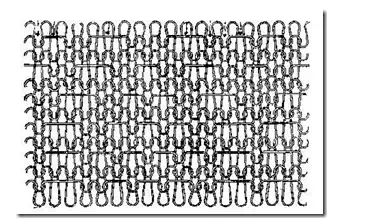
DIAGRAM OF FANCY KNIT GOODS
These do not include the many fancy weaves, too numerous to classify, and the open work weaves, made in the Leno loom, in which some of the threads are crossed. Knit goods are made by the interloping of a single thread, by hand or on circular knitting machines and lace by an analogous process, using several systems of threads. Felt is made up of matted fibers of fur and wool and has no thread structure.
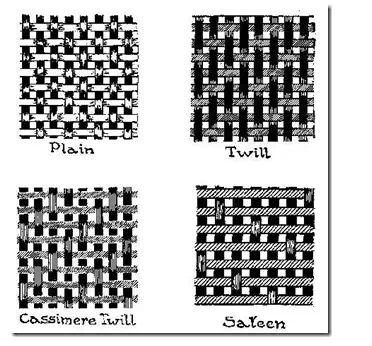
WEAVE DIAGRAMS
Plain Weave
The plain weave is the most common, nearly all light weight goods being thus woven. In plain weaving, each thread of both warp and filling passes alternately over and under the threads at right angles. This makes a comparatively open cloth, requiring the smallest amount of yarn for the surface covered. This weave is used in nearly all cotton goods, as in muslins, sheetings, calicoes, ginghams, and thin woolen goods. Even in the plain weave variety is obtained by having some of the threads larger than others, either in warp or filling or both, thus producing stripes and checked effects