The line manager is best placed to analyse, keep track of, anticipate and act on the team’s own development needs. And as a manager he or she is an actor in that team – so it is important to present activity as development for ‘us’, to have an impact on ‘our’ performance’, not just for ‘you, the team’. The next section of five questions and tools are designed to provide some language to help you address team development.
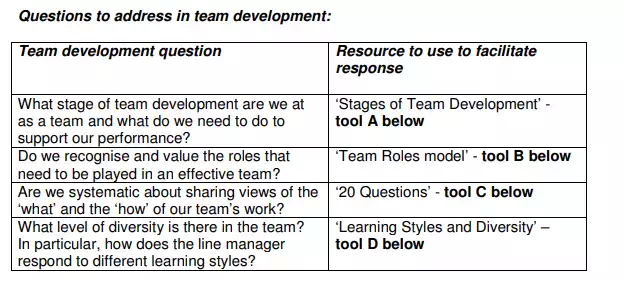
Team Development Tool A
How to identify your team’s stage of team development
‘Team building’ is a commonly-used term used to cover a range of development activities to reach a range of potential goals. It is worth being explicit about what is meant by the term.
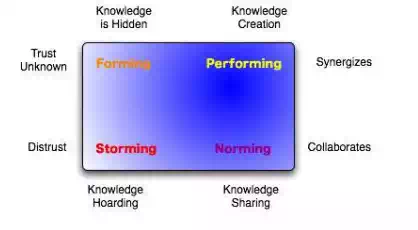
Tuckman described the steps that a team goes through in its development – the classic ‘Forming-Storming-Norming-Performing’ stages – and described the behaviours that the team and line managers will demonstrate and observe at these stages.
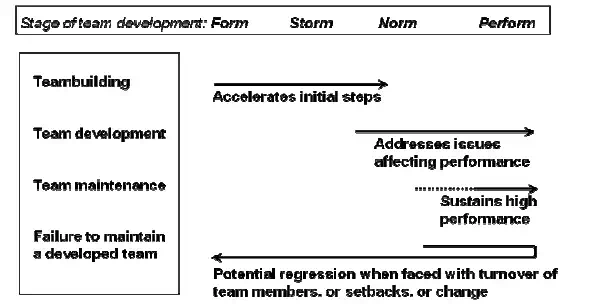
Depending on the team’s ‘stage of development’, there are different team building, development and maintenance activities that can be taken to support the team’s performance.
While the process may appear simple and linear, of course the wider working environment can provide shocks to the team’s development – such as a change of personnel, or location, or objectives.
The line manager should identify at what stage of development the team is operating, and then identify what is the appropriate action to take with the team to support performance.
Developing team performance
It is the line manager’s responsibility to take action to develop team performance, linked to the team’s ‘stage of team development’:
The team’s stages of development
Tuckman (1965) described the stages of growth that teams normally go through: This text describes project teams, but the model applies equally to all teams who experience change in terms of purpose, roles, membership (both the loss and gain of team members) and location.
This graphic illustrates the outline behaviours with relation to collaboration and to knowledge management.